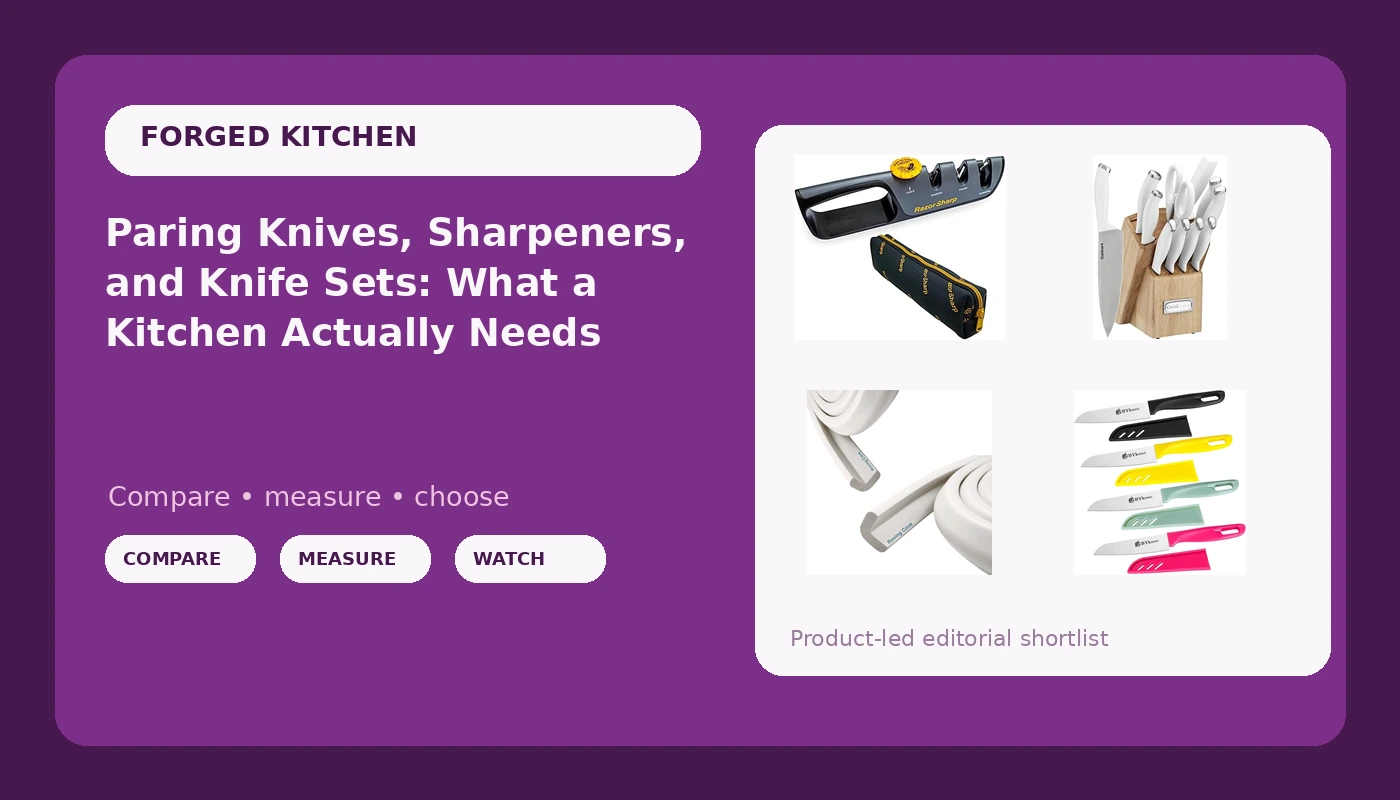
Walk into most home kitchens and you will find the same scene: a block of knives that were sharp once, a paring knife living in the dishwasher, and no real plan for what happens when an edge finally goes. Paring knives and knife sharpeners are the two most overlooked purchases in that picture, mostly because they are cheap, unglamorous, and easy to treat as an afterthought. The rest of the equation is a set that covers the core shapes so you are not improvising with the wrong blade, plus a little attention to the hard edges around a counter or desk where people work fast and lean hard. This is a plain breakdown of four very different tools that end up in the same shopping cart, what each one is genuinely for, and where each one stops being useful.
Related: How to Hone and Sharpen a Knife Without Ruining the Edge →
Quick answer
There is no single best pick here, because these four products do not do the same job. If you need to cover the basic shapes in one purchase, the Cuisinart Block Knife Set is the practical starting point. If you already own knives and the problem is dullness rather than selection, the RazorSharp Knife & Scissor Sharpener adds an adjustable angle guide so you are not guessing at the bevel. If you want small knives you can abuse, hand to a helper, and replace without wincing, the BYkooc paring knives arrive as four knives with four sheaths. And if the sharp corners of a counter, island, or desk are the hazard in your house, the Roving Cove edge protector is a 12 foot strip of cushioning. The trade-offs are explained below.
Four useful options
| Model | Best fit | What stands out |
|---|---|---|
| Cuisinart Block Knife Set, 12pc Cutlery Knife Set | Covering the core knife shapes in one purchase | 12 pieces with a block, stainless steel blades, and a manufacturer dishwasher safe rating |
| RazorSharp™ Knife & Scissor Sharpener | Keeping edges in shape between proper sharpenings | Adjustable 14 to 24 degree angle guide, and it handles scissors as well as knives |
| BYkooc 8 pieces Paring Knives | Small prep, peeling, and shared kitchen tasks | Four peeling knives plus four sheaths, German steel, PP plastic ergonomic handle |
| Roving Cove Furniture Edge Protector | Sharp furniture and counter edges in a busy kitchen | Large 12 foot edge-only strip of cushioning |
The core set: Cuisinart Block Knife Set, 12pc Cutlery Knife Set
A set like this lives or dies on one thing, and it is not the piece count. In a working kitchen, roughly 80 percent of the cutting is done by a single knife, usually the chef's knife, with a paring knife and a serrated bread knife covering most of the rest. The steak knives in a 12 piece set are table tools, not prep tools, and they should not be the reason you buy it. What matters is whether the chef's knife has a comfortable handle and a blade that can be brought back to a usable edge. The manufacturer rates these blades dishwasher safe, which is a statement about the steel and finish surviving the cycle. It is not a promise that the edge stays crisp, because heat, detergent, and knocking around a rack are hard on any cutting edge. Hand wash and dry if you want the edge to last, and treat the block as storage, not as a sharpening system.
The maintenance tool: RazorSharp™ Knife & Scissor Sharpener
The adjustable angle is the interesting part, because angle is where most home sharpening goes wrong. A typical Western or German style kitchen knife is ground somewhere around 20 degrees per side, while a thinner Japanese style blade often sits closer to 15. A guide that spans 14 to 24 degrees lets you roughly match the knife in your hand instead of forcing one bevel onto everything. The honest trade-off with any guided pull-through sharpener is that it removes steel in a fixed pattern, so it is a maintenance tool rather than a restoration tool. Use it when an edge has gone from tired to genuinely dull, and use a honing steel or ceramic rod in between to realign the edge rather than grind it away. A honing steel is not a sharpener, and a sharpener is not a honing steel. You want both, and you want to reach for the right one.
The small knives: BYkooc 8 pieces Paring Knives
A paring knife is the most used and most abused blade in a home kitchen. It gets used to open packaging, cut fruit for a kid at the counter, trim chicken, and pry at things it should never touch. That is exactly why a four pack with sheaths makes sense: you are buying the job, not the heirloom. German steel is a descriptor of the steel specification, not a claim about where the knife was made, so read it as a general family of stainless steel rather than a country of origin. The sheaths matter more than they look. Small knives stored loose in a drawer knock against each other, and the edges chip and roll. A sheath turns a drawer into safe storage. The trade-off is straightforward: these are light, inexpensive knives that will take a usable edge and will not hold it through a long session the way a heavier forged blade will. Buy them to absorb the abuse, keep your good chef's knife out of it, and sharpen them when they slow down.
The hard edges: Roving Cove Furniture Edge Protector
This is not a knife product, and it should not be sold to you as one. It is a strip of edge cushioning, and it belongs in this conversation for one reason: a kitchen has more sharp, hard edges at hip and head height than any other room in the house. A counter overhang, an island, a desk where homework happens. If there are small children, or anyone unsteady on their feet, cushioning those edges is a reasonable safety purchase. The important detail in the name is the phrase edge only. You get 12 feet of edge material and no corner pieces, so plan your layout before you order. If your hazard is a sharp corner rather than a long straight run, measure it and decide whether you need a separate corner product, because this one will not cover it. And it does nothing for blade safety. Knives belong on a magnetic strip, in a sheath, or in a block, never loose on a counter.
Prices and availability may change. Product images, names, and retailer links must be matched by verified ASIN. Do not state a current price, rating, stock status, or measured result without current evidence.
Why one knife in a set does most of the work
The single most useful thing to understand before buying any set is that piece count is a marketing number, not a measure of usefulness. A 12 piece set can look generous while the only two knives you touch are the chef's knife and the paring knife. The bread knife earns its place if it can actually cut bread, which means a long serrated edge and enough stiffness to get through a crust without wandering. Steak knives are for the table. A utility knife sits awkwardly between the chef's knife and the paring knife and often goes unused. When you evaluate a set, ask what the chef's knife feels like in your hand, whether the handle is comfortable for the way you grip, and whether the blade geometry lets you sharpen it without fighting a thick bolster. If the answer to those is yes, the rest of the block is garnish.
Honing, sharpening, and what an angle guide changes
Honing and sharpening are different operations and the confusion between them ruins a lot of good knives. Honing realigns a folded edge back to straight, which is why a few passes on a steel can bring a tired knife back for a session. It removes almost no metal. Sharpening grinds away steel to create a fresh edge, and it is the only thing that fixes an edge that has genuinely dulled. Angle matters because it defines the edge geometry: a wider angle such as 20 degrees per side is more durable and better suited to a Western stainless blade, while a narrower angle around 15 degrees cuts more freely but is more fragile. An adjustable guide in the 14 to 24 degree range lets you pick the closest match for the knife in front of you. What a guide cannot do is make a decision for you, so learn roughly what your knives are ground at.
A simple edge routine for a home kitchen:
- Hone before a long prep session with a steel or ceramic rod, a few light passes per side.
- Sharpen only when honing stops bringing the edge back, not on a fixed calendar.
- Match the angle to the knife, around 20 degrees for Western stainless and around 15 for thinner Japanese style blades.
- Work in light, even passes and check progress with a sheet of paper or a ripe tomato rather than pressing harder.
- Wash and dry by hand, then store on a strip, in a block, or in a sheath, never loose in a drawer.
Practical guidance for a working kitchen
- Buy the shapes you actually use, not the highest piece count on the shelf.
- Keep a cheap paring knife for the jobs you would never hand to a good blade.
- Keep the sheaths, because loose storage in a drawer is what chips small edges.
- Read dishwasher safe as a claim about surviving the cycle, not about holding an edge.
- Cushion the hard counter and desk edges where people actually stand and work.
Which option should you choose?
Choose the Cuisinart Block Knife Set, 12pc Cutlery Knife Set when you are starting from nothing and want the basic shapes plus storage in one order. Choose the RazorSharp™ Knife & Scissor Sharpener when you already own knives and the real problem is that they are dull and you want a guide so you are not guessing at the bevel. Choose the BYkooc 8 pieces Paring Knives when you want small knives with sheaths that can take abuse and be replaced without regret. Choose the Roving Cove Furniture Edge Protector when the sharp thing in your kitchen is a counter or desk edge at hip height, and only if a straight run of edge material covers what you need.
Two caveats worth stating plainly. First, no sharpener makes a knife stay sharp forever, and a pull-through guide is a maintenance tool rather than a repair for a chipped or badly damaged edge. Second, this article reports what the manufacturer lists for each product, not measured performance, so check the current listing for what is included before you order.
The bottom line
A functional kitchen does not require a big set or an expensive one. It requires a chef's knife you can keep sharp, a paring knife you are willing to abuse, a way to bring edges back when honing stops working, and a bit of sense about where the sharp and hard surfaces are. The Cuisinart set handles selection, the RazorSharp sharpener handles maintenance, the BYkooc knives absorb the small jobs, and the Roving Cove strip handles the furniture edges that have nothing to do with cooking but everything to do with a kitchen people move through quickly. Buy the pieces that match the problem you actually have, and build the sharpening habit around them.