Related: Best Chef's Knife for Real Prep Work: What to Look For
Most people buy a kitchen knife set the way they buy a toaster: one transaction, one box, done. I spent sixteen years on the line and four more running a butcher shop, and I've sharpened enough blades to know the box is rarely the problem. The problem is that nobody tells you which piece in that box you will actually use. You will use the chef's knife. You will use a paring knife far more than you expect. Everything else is garnish.
So this is not a list of the ten best knives on the internet. It is four pieces I would put in a working kitchen, in the order I would buy them, plus the sharpener that keeps all of them honest. A full block set, a hand forged set with a bag, one small paring knife, and a three-stage sharpener. If you are starting from zero, read top to bottom. If you already own a chef's knife you love, skip straight to the sharpener.
Best for a Full Drawer Reset: MARTHA STEWART Eastwalk 14 Piece Knife Block Set
The Eastwalk set is the one I would hand to someone who wants a single purchase and a clean counter. High carbon stainless steel, triple riveted forged handles, an acacia wood block in linen white. The spec sheet reads like a set designed to sit out on the counter rather than hide in a drawer, and that matters more than people admit. Knives you can see are knives you use.
The phrase that earns my attention is triple riveted forged handle. That combination is the difference between a knife that survives a decade of home cooking and one that wobbles by month eight. A riveted handle transfers the force from your palm straight into the blade. A molded handle absorbs that force and eventually separates from the tang. When you get this set in your hands, grab the chef's knife and squeeze hard. If you feel any movement between the handle scales and the steel, walk away.
The 14 piece count is built the way every 14 piece count gets built, which means steak knives and a bread knife are carrying a lot of the number. I have opinions about that. A bread knife that can't get through a crust without sawing is dead weight in a block slot. Six steak knives you use twice a year are six knives competing with the tools you reach for daily. That is not a reason to skip the set. It is a reason to know what you are buying.
Who it is for: a household that cooks dinner most nights, wants matching tools, and has no interest in assembling a collection one knife at a time. Who it is not for: anyone who already owns a chef's knife they love. That person should keep the knife and skip the block.
Best for a Heavy Blade and a Knife Bag: DRGSKL Serbian Chef Knife Set
The Serbian chef knife is a shape, not a brand, and it is the shape I get asked about most. Tall blade, curved belly, a spine high enough to give you knuckle clearance and a place to rest your off hand. It is a hybrid between a chef's knife and a cleaver, and for someone who cooks a lot of vegetables and likes to scoop with the blade, it is a genuinely useful profile.
DRGSKL's version is ten pieces with a bag. The bag is the tell. This is a set built for someone who moves their knives, whether that is a camp kitchen, a small apartment with no counter, or a knife roll that lives in a trunk. Hand forged construction means the blade was shaped under heat instead of stamped from a sheet, and that usually means a thicker spine and more weight out front, which is exactly what this pattern wants.
Two things I would check before committing. First, the handle. Hand forged sets in this range sometimes ship with handles rounder than they should be, and a round handle rotates in your grip during a long prep. You want a shape that tells your hand where the edge is. Second, the edge geometry out of the box. A hand forged blade often arrives with a thick edge that needs a session on a stone before it cuts the way it should. Budget for that and you will be happy.
Who it is for: the cook who wants one heavy, tall blade and a way to carry it. Who it is not for: anyone who wants a matching block on the counter.
Best Small Knife: Cuisinart C77TR-3PR Triple Rivet Paring Knife
The paring knife is the piece nobody plans for and everybody reaches for. Hulling strawberries, trimming chicken, breaking down a shallot, peeling an apple in your hand. A chef's knife is the wrong tool for all of it. A 3.5 inch blade is the right one.
Cuisinart's Triple Rivet paring knife is the version I would buy for a kitchen that needs one more knife and no more decisions. Part of the Triple Rivet collection, triple rivet handle construction, black handle, 3.5 inch blade. If you already own anything else from that line, this is a match rather than a stray.
The honest caveat: a paring knife at this level is not a hand finished blade, and the steel is not going to win a sharpening contest against a $200 gyuto. What it will do is take a decent edge off a 1,000 grit stone, hold it long enough to do the small work, and then get replaced without a second thought when the handle finally gives out. That is the deal with paring knives. Buy the inexpensive one, keep it sharp, replace it. Save your money for the knife you use for everything else.
The Piece That Decides Everything: 5 Precision Adjust 3-Stage Sharpener
Sharpness is a maintenance habit, not a purchase. You can spend a fortune on a Japanese gyuto and destroy it in three months if you never touch a stone. You can also buy an inexpensive stamped knife, learn to maintain it, and out-cut everyone on your block.
A three-stage sharpener is the compromise most home cooks should actually make. The first stage sets a fresh edge on a dull blade. The second refines it. The third is usually a ceramic or diamond stage for hone and polish. That progression does on a bench what I do by hand with two stones, in a fraction of the time and with far less risk of ruining an edge angle.
What to know before you buy one. Three-stage pull-through sharpeners remove more steel than a stone does, because the guides are fixed and you grind the whole edge every pass. On a cheap knife that is fine. On a good knife, lean on the fine stage and use the coarse stage sparingly. Also understand that a sharpener is not a replacement for a honing steel. The steel realigns an edge that has rolled over. The sharpener cuts a new one. You need both, and if you only buy one, buy the sharpener and use whatever rod you already have.
Check for replaceable abrasives when you shop. A sharpener whose stages can be swapped lasts years. One with a sealed housing is disposable.
The knife shortlist at a glance
This is the table I would tape inside a cabinet door. One row per item, what it actually is, and who it suits. Prices change constantly, so check the listing rather than trusting a number in a chart.
| Item | What it is | Best for | What to check | Price |
|---|---|---|---|---|
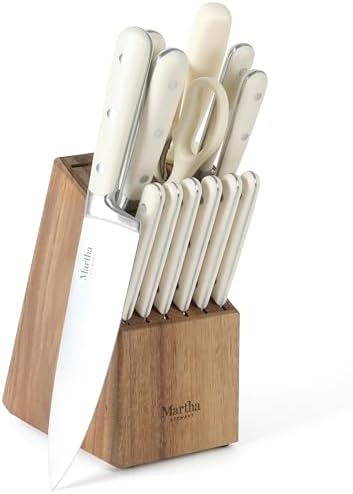 Visit on Amazon → Visit on Amazon →MARTHA STEWART Eastwalk 14 Piece Knife Block Set |
Block set, high carbon stainless, triple riveted forged handles, acacia block | A whole kitchen in one purchase | Handle fit on the chef's knife, and how the block holds the blades | $59.99 |
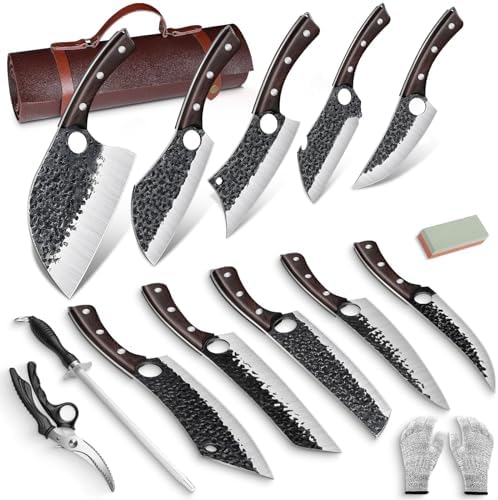 Visit on Amazon → Visit on Amazon →DRGSKL Serbian Chef Knife Set |
10 piece hand forged set with a carry bag | A tall, heavy blade you can travel with | Handle shape, and the edge angle out of the box | $139.99 |
 Visit on Amazon → Visit on Amazon →Cuisinart C77TR-3PR Paring Knife |
3.5 inch triple rivet paring knife | The small work nobody plans for | Whether the handle matches your existing knives | $8.95 |
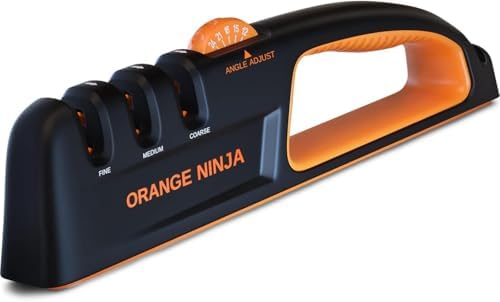 Visit on Amazon → Visit on Amazon →5 Precision Adjust 3-Stage Sharpener |
Three-stage pull-through sharpener | Keeping any of the above cutting | Replaceable abrasives, and which stage you use most | $31.99 |
The row that matters most is the last one. A sharp knife set that nobody maintains is a dull knife set within two months, and no block, bag, or handle material changes that.
How I test a knife
Every blade I pick up gets the same four questions, and they have not changed in sixteen years.
Does it hold an edge through a full prep shift? Not a test cut on a tomato. Fifty pounds of onions, carrots, and potatoes, and then check the edge against a thumbnail. A knife that needs a steel three times in one shift is a knife that will annoy you forever.
Is the handle comfortable after 200 cuts? A knife can be razor sharp and still lose, because fatigue shows up in your grip before it shows up in the blade. Riveted handles, full tangs, and shaped scales all exist to answer this question.
Can I sharpen it without fighting the tool? A thick bolster that runs all the way to the heel makes it nearly impossible to grind the full edge on a stone. If I cannot maintain it, I will not keep it.
Would I reach for it on a busy Saturday service? That is the whole test compressed into one question. The knives that survive a rush are the ones that come home with me. Everything else goes in the drawer for guests.
What the specs actually tell you
Forged versus stamped is the first divide. Stamped steel is not bad. It is thin, light, and takes an edge quickly, and it is how a knife gets made for a low price. Forged steel is denser and heavier, and a forged knife with a riveted handle is a knife you hand down. The Martha Stewart set and the DRGSKL set both lead with forged construction, which is the right place to spend money.
Full tang is non-negotiable in my kitchen. The steel should run the full length of the handle. A bolted or partial tang is a knife waiting to fail you mid-service, usually on the day you need it most.
Hardness is a tradeoff, not a score. Harder steel holds an edge longer and chips more easily under a bone or a frozen item. Softer steel rolls instead of chipping, which means a honing steel brings it back in seconds. For a home kitchen, slightly softer and easier to maintain beats maximum hardness almost every time.
Then there is the block itself. Some blocks hold blades by pinching the edge in a slot, which dulls knives every time you put them away. Rotate a knife in and out of a tight slot for a year and you have effectively been sharpening it in reverse. Check how the block grips before you commit counter space to it.
Should you buy the Martha Stewart Eastwalk set?
Yes, for the right buyer. If you want one purchase, matching handles, and a block that looks intentional on the counter, this delivers it, and the forged triple riveted construction is the part that matters. Check the chef's knife in your hand before you commit, and understand that the steak knives are filler. If you already own a chef's knife you trust, skip this and buy the sharpener instead.
Should you buy the DRGSKL Serbian set?
Yes, if the Serbian profile appeals to you and you want ten pieces with a bag to move them in. Hand forged construction usually means weight and spine thickness, and the bag makes this the set for a camp kitchen, a small apartment, or anyone who does not want a block at all. Budget a stone session to thin the edge and check the handle shape in your grip first.
Should you buy the Cuisinart paring knife?
Yes. It costs about as much as lunch and it does a job your chef's knife cannot do well. Triple rivet handle, 3.5 inch blade, and it will take a working edge off a stone. This is a tool you buy, use hard, and replace, and there is no shame in that. Every working kitchen needs one.
Should you buy the 3-stage sharpener?
Yes, unless you already own stones and use them. A three-stage sharpener is the difference between a set of knives that improves every month and a set that quietly dies in a block. Favor the fine stage on good knives, keep a honing steel for realignment, and check that the abrasives can be replaced. Buy it before you buy another knife.