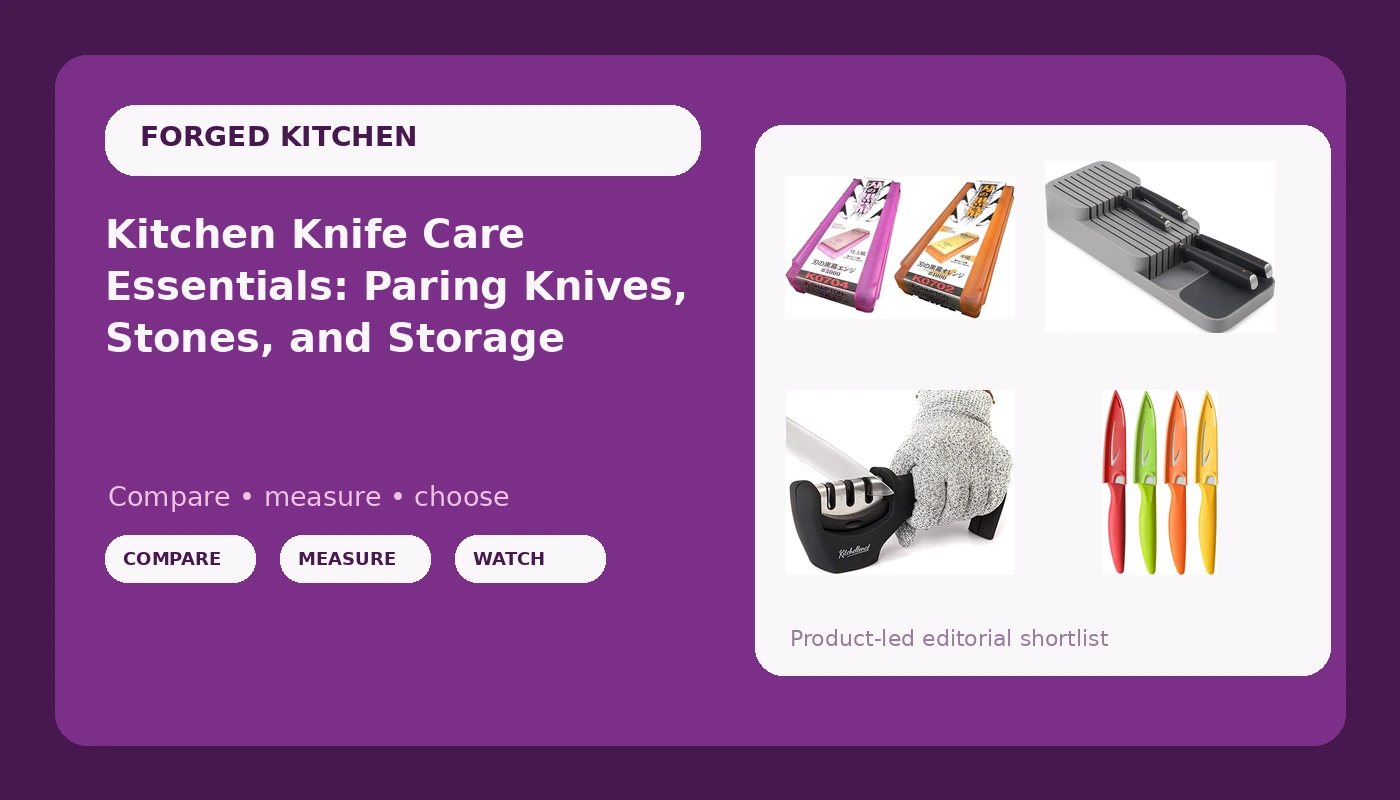
Most dull-knife complaints are not really knife complaints. They are maintenance complaints. A blade that slices paper on day one and smears a tomato by month three did not get worse steel. It lost its edge, and nobody put one back on it. That is why a kitchen knife care essentials setup matters more than the logo stamped on the blade. The four items below cover the parts of that setup a home kitchen actually uses: a small paring knife for the work a chef's knife is too big for, a two-grit whetstone set for restoring an edge, a 3-stage pull-through sharpener for fast touch-ups, and a drawer organizer so the knives you just sharpened stop knocking into each other.
Related: Knife Sharpening Basics: Angles, Grits, and Burr Removal →
Quick answer
No single purchase fixes a knife drawer. The order that works is sharpen first, store second, then add the small knife you keep reaching for. A two-grit whetstone set is what restores an edge. A 3-stage pull-through sharpener is what buys time between stone sessions. A set of 4-inch paring knives covers peeling and small prep. A drawer organizer keeps finished edges from meeting each other in the dark. Starting from nothing, the sharpener is the fastest improvement and the stone is the one that lasts.
Four useful options
| Model | Best fit | What stands out |
|---|---|---|
| VITUER Paring knife, 4PCS Paring knives (4 Knives and 4 Knife cover), 4 Inch Peeling Fruit and Vegetable Knife, Ultra Sharp Kitchen Knives, German Steel, PP Plastic Handle | Peeling, trimming, and small prep | Four 4-inch paring knives, each with a cover |
| SHAPTON Ha No Kuromaku Ceramic Whetstone (A-set) Medium Grit (#1000) + Fine Grit (#5000) | Rebuilding and refining an edge | Two grits in one set, #1000 for the work and #5000 for the finish |
| 4-in-1 Kitchen Knife Accessories: 3-Stage Knife Sharpener Helps Repair, Restore, Polish Blades and Cut-Resistant Glove (Black) | Fast touch-ups between stone sessions | Three sharpening stages plus a cut-resistant glove |
| Joseph Joseph DrawerStore Knife Organizer, holds up to 9 knives, Kitchen Organization & Drawer Storage, Compact, Gray | Drawer-based storage | Holds up to 9 knives in a compact, tiered layout |
The everyday peeler: VITUER Paring knife, 4PCS Paring knives (4 Knives and 4 Knife cover), 4 Inch Peeling Fruit and Vegetable Knife, Ultra Sharp Kitchen Knives, German Steel, PP Plastic Handle
The case for four paring knives instead of one is unglamorous and practical: one is always clean, one is always dry, and none of them are in the sink when you need to hull a quart of strawberries. A 4-inch blade is the right length for shallots, garlic, mushroom stems, and trimming silverskin off a tenderloin. It is the wrong tool for breaking down a squash, and no amount of technique changes that. The trade-off here is the handle. A molded plastic handle on a light stamped blade is not a knife you hand down, and it is not meant to be. It is meant to be sharp, cheap to replace, and available when your chef's knife is busy being a chef's knife.
The sharpening foundation: SHAPTON Ha No Kuromaku Ceramic Whetstone (A-set) Medium Grit (#1000) + Fine Grit (#5000)
This is the item that turns a drawer of knives into a working kit. A pull-through sharpener can get a blade back to usable, but a stone is what lets you control the angle and the finish. The trade-off is time and patience. Stones need water, a stable surface, and a consistent angle, and the first few sessions on any knife will look worse before they look better. A #1000 stone is the workhorse grit: it removes enough steel to rebuild an apex without gouging the blade. A #5000 stone does not sharpen so much as polish, knocking down the scratch pattern left by the coarser grit. Skipping the fine stone leaves a toothy edge that bites into tomatoes but struggles with clean slices. Skipping the medium stone and going straight to fine is a common mistake that produces a shiny, still-dull blade.
The quick fix: 4-in-1 Kitchen Knife Accessories: 3-Stage Knife Sharpener Helps Repair, Restore, Polish Blades and Cut-Resistant Glove (Black)
Pull-through sharpeners get dismissed by people who own stones, and that dismissal is mostly about snobbery rather than function. They work. The honest trade-off is that a fixed-angle pull-through removes more steel per use than a controlled pass on a stone, and it cannot match the finish a #5000 stone produces. Used weekly, it will eat a knife. Used occasionally, on a house knife, a bread knife, or a friend's neglected blade, it is a reasonable tool that takes thirty seconds instead of thirty minutes. The included glove is a small thing that matters more than it sounds: the most common knife injury in a home kitchen happens during sharpening or washing, not during service.
The storage layer: Joseph Joseph DrawerStore Knife Organizer, holds up to 9 knives, Kitchen Organization & Drawer Storage, Compact, Gray
Storage is the step everyone skips and the step that undoes the other three. Knives thrown loose into a drawer chip each other, and a chipped edge needs stone work to fix, which means the sharpening you just did is partly wasted. A tiered insert keeps edges separated and lets you see what you own, which is its own benefit when you are trying to stop buying duplicates. The trade-off is fit: this is a drawer insert, so it only works if your drawer is deep and wide enough for the layout. Measure before you buy, and accept that a magnetic strip on the wall does the same job in less space if you have the wall.
Prices and availability may change. Product images, names, and retailer links must be matched by verified ASIN. Do not state a current price, rating, stock status, or measured result without current evidence.
Why a paring knife earns a permanent spot on the board
The standard advice is that a knife set is 80 percent chef's knife and 20 percent everything else, and that is true. It is also incomplete, because the 20 percent is where a lot of the actual cooking happens. A paring knife is what you reach for to peel a pear, core a tomato, trim green beans, devein shrimp, score a loaf, or cut the stem end off an onion without dragging out a 10-inch blade.
A 4-inch blade is short enough to control and long enough to be useful. That length matters more than steel type at this size, because the failure mode for small knives is not dullness, it is awkwardness. The other argument for a multi-piece paring set is hygiene and workflow: a set lets you peel citrus, then trim meat, then cut fruit without stopping to wash a single blade in between. That is a small thing that adds up over a prep session.
What grit numbers mean on a whetstone
Grit is a measure of abrasive particle size, and the number runs opposite to the size. Lower numbers cut faster and coarser. Higher numbers cut slower and finer. A #1000 stone is a medium grit and the standard starting point for maintaining a kitchen knife: coarse enough to raise a burr in a reasonable number of passes, fine enough that the resulting edge is not ragged. A #5000 stone is a fine grit used after the medium stone to reduce the scratch pattern and refine the apex.
The practical sequence for a knife that has gone properly dull is: establish the bevel and raise a burr on the #1000, then remove that burr and polish on the #5000. A knife that only needs a refresh often needs nothing more than the #1000 followed by a light pass on the fine stone. Skipping straight to the fine stone on a dull knife is the single most common home sharpening error, because a polished dull edge is still a dull edge.
Two more things worth knowing. Ceramic stones in this family are generally used with a splash of water rather than a long soak, though you should follow the maker's instructions for the specific stone. And a stone that has dished in the middle will not give you a consistent angle, so flattening it periodically is part of ownership, not an optional upgrade.
- Start from a knife that already has a decent bevel, or accept that the first session is repair work.
- Hone on a steel or rod regularly. Honing realigns an edge, it does not remove enough steel to sharpen.
- When honing stops working, move to the #1000 stone and sharpen until you feel a burr along the full length of the edge.
- Refine on the #5000 stone with light pressure, then remove the burr with a few edge-trailing passes.
- Store the knife so the edge touches nothing, and repeat the cycle when slicing starts to drag.
Practical guidance for a home kitchen
- Keep the pull-through sharpener for other people's knives, house knives, and days when you need an edge in under a minute. Do not make it your only sharpening tool.
- Dry blades completely before they go into storage. Moisture in a closed drawer is how you get spots and pits.
- Keep the covers on the paring knives. A covered 4-inch blade in a crowded drawer is a solved problem; an uncovered one is a cut waiting to happen.
- Use the cut-resistant glove while you are learning to sharpen. The riskiest moment with any knife is the one where your hand is wet and your attention is on the angle.
- Store knives apart, whether that means a drawer insert, a magnetic strip, or a blade guard. Edges that touch edges chip.
- Sharpen on a schedule, not on a feeling. A monthly check beats waiting until dinner is already going badly.
Which option should you choose?
Choose the VITUER Paring knife, 4PCS Paring knives (4 Knives and 4 Knife cover), 4 Inch Peeling Fruit and Vegetable Knife, Ultra Sharp Kitchen Knives, German Steel, PP Plastic Handle when you want small-blade coverage for peeling, trimming, and shared kitchen duty, and you are not looking for an heirloom. Choose the SHAPTON Ha No Kuromaku Ceramic Whetstone (A-set) Medium Grit (#1000) + Fine Grit (#5000) when you are ready to learn actual sharpening and want both the working grit and the finishing grit in one purchase. Choose the 4-in-1 Kitchen Knife Accessories: 3-Stage Knife Sharpener Helps Repair, Restore, Polish Blades and Cut-Resistant Glove (Black) when you want a faster path to a usable edge and a glove to go with it. Choose the Joseph Joseph DrawerStore Knife Organizer, holds up to 9 knives, Kitchen Organization & Drawer Storage, Compact, Gray when your knives currently live loose in a drawer and you want that to stop.
One caveat worth stating plainly: nothing here guarantees how long an edge will last. Edge retention depends on the steel, the cutting surface, what you cut, and how often you maintain it. Treat any claim about a knife staying sharp as a maintenance question, not a product feature.
The bottom line
Knife care is a habit assembled from inexpensive parts, not a single upgrade. A stone set gives you the ability to put an edge back on a blade, a pull-through sharpener covers the weeks you do not get to the stone, a paring knife handles the small work that a chef's knife is too big for, and storage keeps all of it from undoing itself. Buy the pieces that match the work you actually do, learn the #1000 then #5000 progression, and check your drawer measurements before you commit to an insert.