Related: How to Keep a Chef's Knife Sharp Between Sharpening
I have spent sixteen years around other people's knives, six of them on a fine dining line and four running a butcher shop, and the fastest way to spot a home kitchen that fights its food is to open the drawer. Dull steel. A bread knife doing the work of a chef's knife. A honing steel that has never once touched a blade. That is why I treat knife sets and sharpeners as one purchase instead of two. The set decides what you can cook. The sharpening plan decides for how long.
A knife set is 80 percent chef's knife. The rest is garnish. So I do not rank sets by piece count, and I do not care how many steak knives come in the box. I care whether the big knife can take an edge, whether the handle is still comfortable after 200 cuts, and whether the blade can be brought back without fighting a bolster.
The four products below cover the whole conversation: a small set that does the actual work, an in-drawer organizer that keeps edges from banging into each other, a big block set for a house full of guests, and the electric sharpener I hand to people who are never going to learn a stone. None of the sets is worth buying without the fourth item, or some other sharpening plan.
The Working Set: COKUMA 3-Piece Knife Set With Sheath
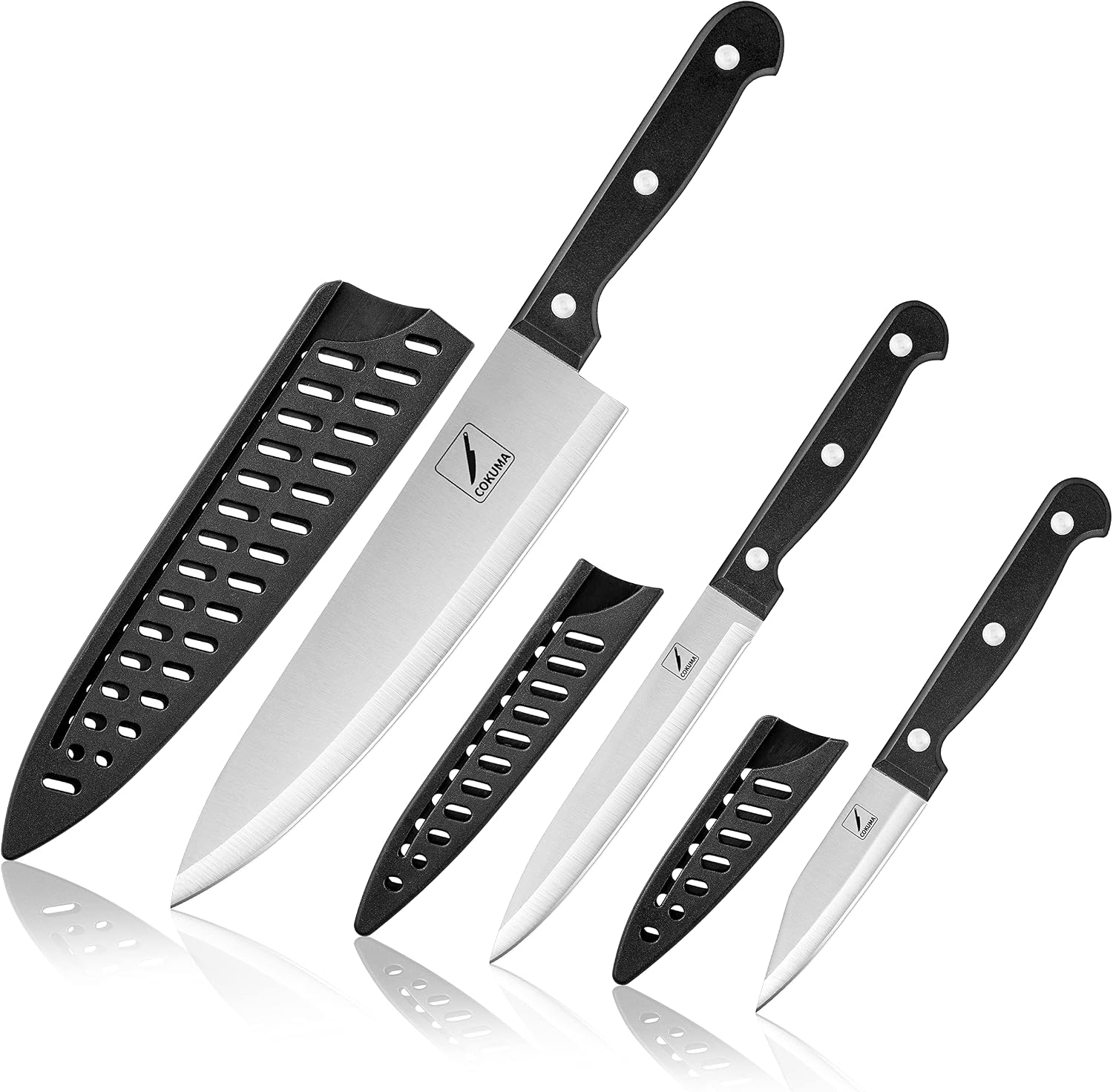
Three knives, three sheaths: an 8 inch chef's knife, a 4.5 inch utility knife, and a 4 inch paring knife. Stainless steel, black handles.
That is the shape of a functional kitchen. The chef's knife takes the bulk of the work, onions, peppers, breaking down a chicken, the whole pile of aromatics at the start of a braise. The utility knife covers the awkward middle ground, tomatoes, sandwiches, trimming a tenderloin. The paring knife is for shallots, strawberries, and anything that happens in your hand instead of on the board. There is nothing in that list you will never use, which is more than I can say for most boxes.
The sheaths matter more than people expect. Knives that rattle loose in a drawer chip each other, and a chipped edge is the beginning of a dull knife. Sheathed blades can live in a drawer or a knife bag without damage.
Here is the honest part: a set at this level is stamped stainless, not forged German steel. It will not hold an edge through a long session the way a harder blade does, and you will touch it up more often. That is acceptable if you accept the maintenance. Stamped steel is not bad. It is just not a knife you hand to your grandkids. For a first apartment, a rental kitchen, or a cook who is still deciding whether they like cooking, three good shapes beat fifteen mediocre ones every time.
The Drawer Fix: Utoplike In-Drawer Bamboo Knife Block
I make fun of knife blocks, and I mean it. The classic countertop block holds blades edge-down or edge-up against a slot, and every insertion is a chance to knock the edge around. It also eats counter space you could be using for a board. My daily knives live on a magnetic strip, and the block stays on the shelf for guests.
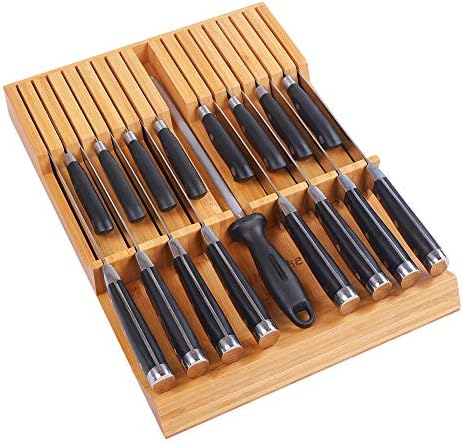
An in-drawer organizer is the version I can actually defend. Blades rest flat and separated, they do not drop edge-first into a slot, and the whole thing disappears when you close the drawer. This one is bamboo, sized large, and it wipes clean, which matters because a drawer organizer that traps crumbs and moisture is worse than no organizer at all.
If your knives are currently rolling around with a can opener and a vegetable peeler, this is the cheap fix. If your kitchen has no spare drawer, skip it and put a magnetic strip on the wall instead. Either one beats a loose pile, and both beat a block that dulls your blades on the way in.
The Guest-House Set: Astercook 15-Piece Knife Set With Block and Sharpener
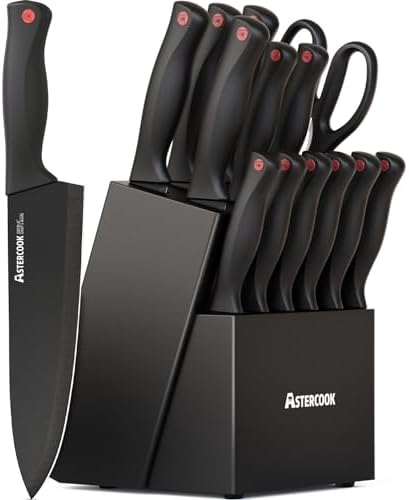
Fifteen pieces, a block, and a sharpener included. German steel as labeled. On paper it is the set most people put in a cart, and I want to be fair about it and clear about it at the same time.
Fair: if you are furnishing a rental, a vacation house, or a kitchen where four people cook and nobody wants to share, this solves the problem in one box. Guests get a block that looks like a kitchen, there is a knife for every task, and nothing in it costs enough to make you nervous when someone leaves it in the sink. Bread knife, slicer, utility, paring, steak knives, the works.
Clear: a set with this many pieces is a set built around the block and the extras, not around one great blade. My rule has not changed. Skip the big-piece-count sets unless you specifically need pieces for other people. If you want one knife that holds an edge through a Saturday service, this is not that set, and the included pull-through sharpener is a maintenance tool rather than a sharpening plan. It will keep a soft blade usable. It is not what I would run a hard Japanese knife through.
The Sharpening Plan: Chef'sChoice Professional Electric Knife Sharpener
This is the fourth item, and in most homes it is the one that decides whether the other three keep working.
Two stages, 100 percent diamond abrasives, a FlexHone and strop stage, and precision angle guides set for 20 degree straight-edge and serrated knives. That angle guide is the whole point. Most people ruin a blade because they cannot hold a consistent angle by hand, so they wobble, round off the edge, and conclude the knife is junk. Here the slot holds the angle for you. The first stage does the shaping, the second stage hones and strops, and you finish with a knife that cuts paper again.
It handles serrated knives too, which is rare and worth saying out loud. A bread knife with flattened serrations is useless, and dragging one across a stone is how you kill it.
The tradeoff is honesty about what it is. Electric sharpeners remove more steel than a stone does. That is fine if you use it when the knife is genuinely dull, every few months in a home kitchen. It is not a weekly habit. Weekly maintenance is a honing steel, and a honing steel is not a sharpener. It realigns. That distinction is the one thing I want every home cook to take away from this page.
How I test a knife
Every blade that comes through my kitchen gets the same morning test, and the standard is not negotiable. Paper first, then a ripe tomato. If the knife cannot shave through a tomato skin without crushing it, it is dull and it gets sharpened before it touches a board.
Then the prep shift. Fifty pounds of vegetables, onions, carrots, potatoes, peppers, all of it, because that is the volume that exposes a bad handle and a blade that rolls. I notice two things during that shift. Does the edge survive the whole pile, or does it start skating on onion skins after twenty minutes. And is my hand still comfortable after 200 cuts, because a handle that feels fine in a store feels like a punishment at cut 150.
Last, the sharpening test. I take the knife to the stone and see whether the geometry fights me. A thick bolster that runs all the way to the edge makes it nearly impossible to sharpen the first inch of blade, and that first inch is the one you use the most. If a knife cannot be brought back, it does not matter how it felt on day one.
Analysis and test results
Steel is a tradeoff, and every claim you read about "stays sharp forever" is marketing. Harder steel holds an edge longer and cuts longer between sharpenings, but it is more brittle and it fights you on the stone. Softer steel rolls and dulls faster, but it comes back with a few passes and it does not chip when you hit a chicken bone. German knives sit on the softer side. Japanese knives sit on the hard side. Neither is wrong. Pick the one that matches how you cook and how much maintenance you will actually do.
Full tang is non-negotiable in my kitchen. Steel that runs the full length of the handle is the difference between a knife and a toy, and a bolted handle is a knife that fails mid-service. When you handle a set, look at the handle construction before you look at the blade shape.
Storage dulls more knives than cutting does. Countertop blocks that hold blades against a slot edge, loose drawers where knives bang into each other, a sink full of dishes with a chef's knife at the bottom of it. A magnetic strip for daily knives, an in-drawer organizer for the rest, and sheaths for anything that travels.
And the maintenance habit beats the purchase every time. The best knife in the world goes dull. You need a honing steel for weekly realignment, a sharpener or a stone for actual sharpening, and a 20 degree angle you can trust. If you only do one thing after reading this, do that one.
The knife and sharpener reference table
This is how I sort these four, by role instead of by piece count. Every product name links to its listing.
| Product | Role in the kitchen | Edge and steel | Sharpening | My call |
|---|---|---|---|---|
 Visit on Amazon → Visit on Amazon →COKUMA 3-piece set with sheaths |
The three shapes that do real work | Stamped stainless, straight edge | Stone or a guided sharpener, touch up often | Best first set for a small kitchen |
 Visit on Amazon → Visit on Amazon →Utoplike in-drawer bamboo organizer |
Storage that protects edges | Blades rest flat, no slot damage | None needed, wipe clean | Best fix for a loose knife drawer |
 Visit on Amazon → Visit on Amazon →Astercook 15-piece set with block |
Coverage for guests and rentals | German steel as labeled, many pieces | Included pull-through is maintenance only | Buy for a house full of other cooks |
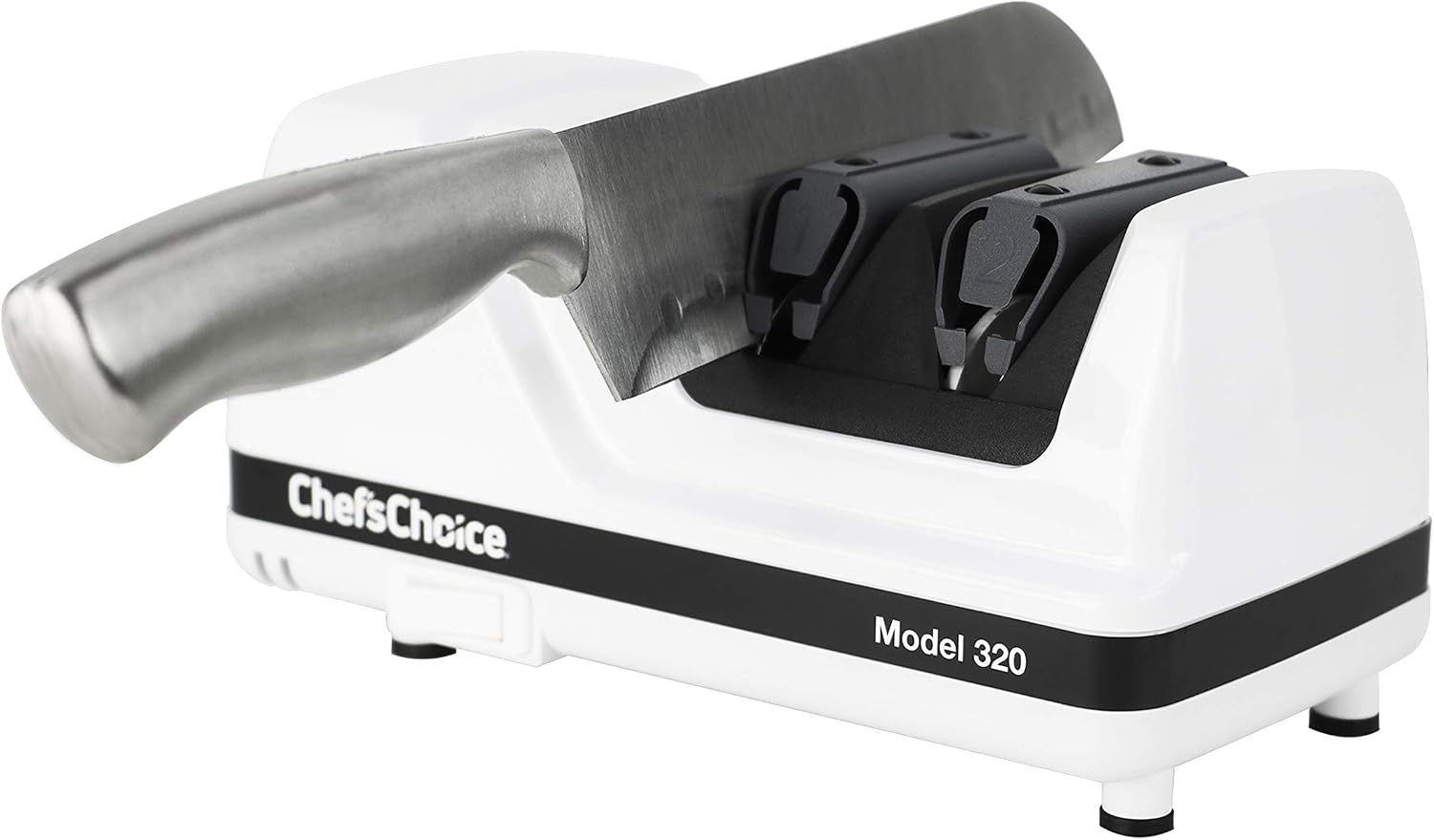 Visit on Amazon → Visit on Amazon →Chef'sChoice 2-stage sharpener |
The reason the other three keep cutting | Diamond abrasives, 20 degree guides | This is the sharpening plan | Best pick for anyone who will not learn a stone |
The order of operations is what matters here. Set first, storage second, sharpening always. A cheap knife that gets sharpened beats an expensive knife that never does, and I have watched that play out in professional kitchens for sixteen years.
Should you buy the COKUMA 3-piece set?
Yes, if you want three shapes and nothing to throw away. Chef's knife, utility, paring, sheaths included, and every one of them gets used. It is stamped stainless, so it will not hold an edge like a forged German blade, and you will touch it up more often. Buy it as a first set or a travel set. If you want one knife to hand down, save your money and buy a forged chef's knife instead.
Should you buy the Utoplike in-drawer block?
Yes, if your knives are currently loose in a drawer. Blades resting flat beat blades dropping edge-first into a slot, bamboo wipes clean, and the organizer disappears when the drawer closes. If you have no spare drawer, use a magnetic strip instead. Either beats a pile of knives knocking against a can opener.
Should you buy the Astercook 15-piece set?
Buy it for a rental, a vacation house, or a kitchen with a lot of guests. Do not buy it as your one knife. A set with this many pieces is built around the block and the extras, the included pull-through sharpener is a maintenance tool rather than a sharpening plan, and the chef's knife will not hold an edge through a long session the way harder steel does. Great coverage, average blade.
Should you buy the Chef'sChoice sharpener?
Yes, if you are never going to learn a stone. The angle guides hold the blade at 20 degrees so you cannot ruin the edge by wobbling, the two stages shape and then strop, and it handles serrated knives without flattening them. Use it when the knife is actually dull, not weekly. Weekly is a honing steel, and you still need one.
The whole kit lives or dies on the last item. Pick your set, fix your storage, then decide how you are going to keep an edge on it. That is the entire buying decision. Everything else is piece count.