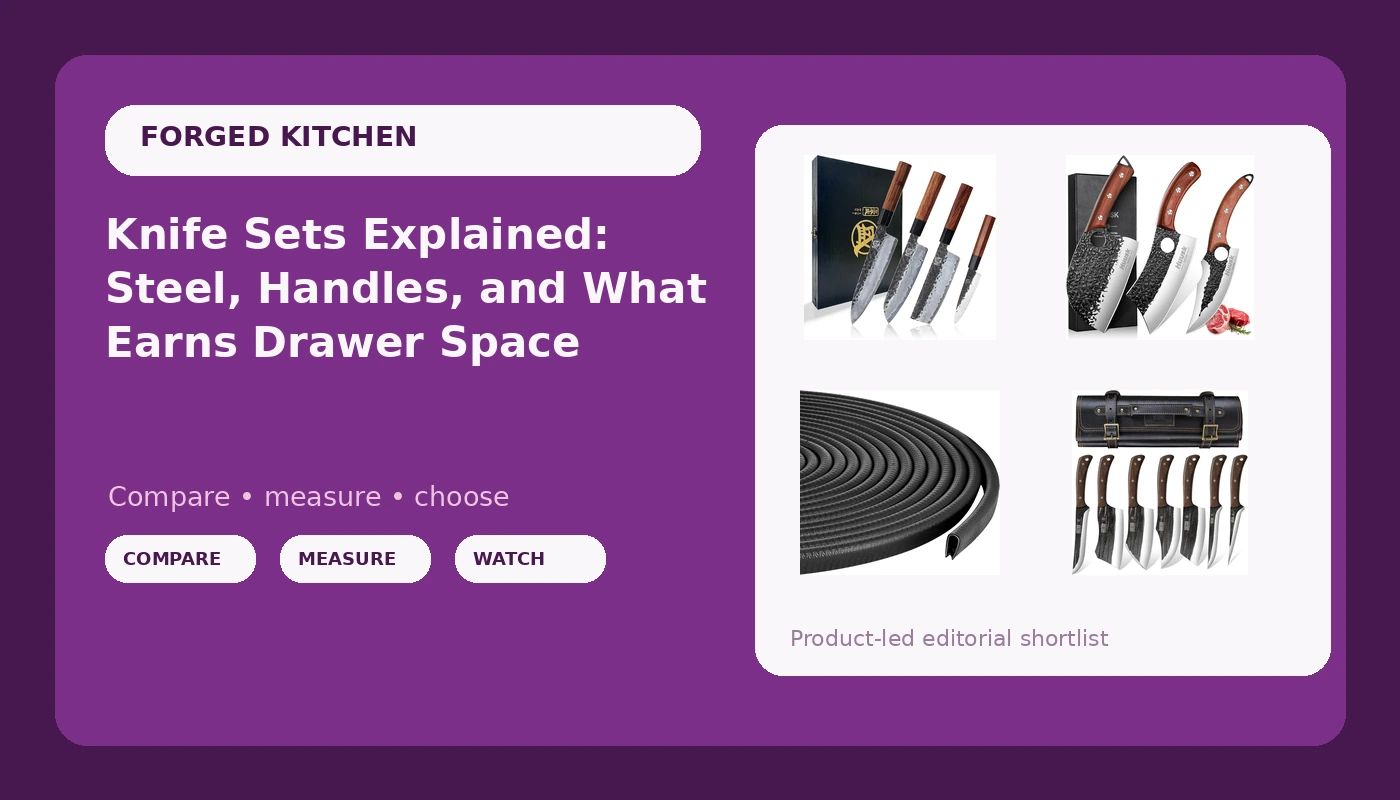
A kitchen knife set is really one knife plus a supporting cast, and most shoppers learn that after the purchase instead of before it. The block looks generous in the photo, the piece count looks impressive on the box, and six months later two of those blades have never touched an onion. This explainer covers what actually matters in kitchen knife sets: how the steel is built, what a full tang does for you at the board, why butcher-style blades behave differently from a thin Japanese-style profile, and where an inexpensive edge guard fits into the picture. No price claims, no lab numbers, just the distinctions that decide whether a set earns counter space or drawer space.
Related: How to Hone and Sharpen a Chef's Knife Without Ruining the Edge →
Quick answer
For most home kitchens, four pieces is the sweet spot: one chef's knife you use constantly, one smaller blade for detail work, and two support pieces you reach for weekly. Among the options here, the MITSUMOTO SAKARI 4-Piece Japanese Chef Knife Set is the layered-steel choice, the HOSHANHO Butcher Knife Set is the heavy-blade choice that ships with a roll bag, and the Huusk Kitchen Knife Set is the hand-forged, gift-oriented pick. The Rubber Edge Trim Guard is not a knife at all. It is edge protection for drawers, cabinets, and the openings where blades live, and it belongs in this conversation because storage is where most edges quietly get damaged.
Four useful options
| Model | Best fit | What stands out |
|---|---|---|
| MITSUMOTO SAKARI 4-Piece Japanese Chef Knife Set, San-Mai 9Cr18MoV | Cooks who want a small, focused set with Japanese-style profiles | San-mai layered construction with a 9Cr18MoV core, four pieces instead of fifteen |
| HOSHANHO Butcher Knife Set, Sharp Kitchen Knife Set & Roll Bag Gift for Men | Cooks who break down proteins and larger cuts | Butcher-style blade shapes with a roll bag included for storage and transport |
| Huusk Kitchen Knife Set - Hand Forged Viking Chef Knives for Meat, Men Gift | Gift buyers who want character over convention | Hand-forged styling, set format, presented as a gift for meat cooks |
| Rubber Edge Trim Guard 32.8ft/10m, Adhesive Free Door Edge Protector, U Shape Edge Seal Strip with Embedded Metal Clips Fits 3/64" to 1/4" Thick Edges (Black) | Anyone storing knives in drawers or against cabinet lips | 32.8 ft of U-shape rubber trim, embedded metal clips, no adhesive required |
The layered-steel set: MITSUMOTO SAKARI 4-Piece Japanese Chef Knife Set, San-Mai 9Cr18MoV
San-mai means three layers: a hard core steel sandwiched between softer cladding. The core does the cutting; the cladding adds toughness and, in many Japanese-style blades, a visible lamination line along the face. A 9Cr18MoV core is a chromium-heavy stainless, which is the practical reason this kind of set tolerates a home kitchen without the constant wiping that a carbon steel blade demands. The trade-off is the same one that follows every thin, hard Japanese-style edge: it rewards a light hand and punishes shortcuts. Bones, frozen product, and the side of a sheet pan are not what this geometry is for. If you want a four-piece set that stays honest about its purpose, this is the one here that does.
The butcher's set: HOSHANHO Butcher Knife Set, Sharp Kitchen Knife Set & Roll Bag Gift for Men
Butcher knives are shaped for a different job than a chef's knife. More belly, more weight forward, and a profile that lets you push through sinew and connective tissue instead of trying to slice cleanly around it. If you break down whole chickens, trim pork shoulders, or portion larger roasts, that weight is an asset. If your cooking is mostly vegetables and quick weeknight sautés, it is a set of blades you will find yourself working around. The roll bag is the detail worth noticing. Slotted blocks and magnetic strips both hold a knife, but a block slot that grips the blade on the way in and out is a slow dulling machine, and a roll bag sidesteps that entirely. Keep the blades dry before they go in, and the bag will outlast the knives.
The hand-forged gift set: Huusk Kitchen Knife Set - Hand Forged Viking Chef Knives for Meat, Men Gift
"Hand forged" describes how the blade was shaped, not how hard the steel is, and those two things get conflated constantly in knife marketing. Forging a blade gives it a forged look and, done well, a refined grain structure. It does not automatically give you a harder edge or a longer-lasting one, because hardness comes from the steel alloy and the heat treatment that follows. That distinction matters here because this set sells on character, and character is a legitimate reason to buy a knife. A knife you enjoy picking up gets used, and a knife that gets used gets maintained. Just run the same checks you would on any set: comfortable handle, a blade that takes an edge without fighting you, and a shape that suits what you actually cook.
The edge guard: Rubber Edge Trim Guard 32.8ft/10m, Adhesive Free Door Edge Protector, U Shape Edge Seal Strip with Embedded Metal Clips Fits 3/64" to 1/4" Thick Edges (Black)
This is the odd item in a knife article, and it earns its place for one reason: drawers damage edges. A knife stored loose in a drawer slides, hits the drawer lip, and rolls against whatever else is in there. Lining the exposed edge of a knife drawer, or the lip of a cabinet where blades get stacked, takes five minutes with a roll of U-channel trim and removes a whole category of small chips and rolled edges. The adhesive-free design is the useful part, since adhesive trim tends to fail in a kitchen that swings between humid and dry. Measure your edge thickness before ordering, since this trim is specified for edges between 3/64 inch and 1/4 inch thick.
Prices and availability may change. Product images, names, and retailer links are matched to verified listings. No current price, rating, stock status, or measured result is stated here without current evidence.
What full tang and san-mai actually mean
A full tang means the steel runs the entire length of the handle, so the blade and handle are one continuous piece of metal with scales pinned or riveted on either side. A partial tang, or a blade joined to a hollow handle, is a mechanical connection, and mechanical connections are what fail first in a kitchen. You do not need to see the tang to judge it, but you can usually feel the difference: a full tang knife has weight through the handle and no flex when you press the spine against the board.
San-mai is a construction method rather than a tang style, and the two get confused because both describe how metal is put together. In a san-mai blade, a hard core is clad in softer stainless on both faces. The core holds the edge; the cladding protects it. Mono-steel blades skip the cladding and are simpler to thin and sharpen over time. Neither approach is automatically better. Layered blades tend to look more interesting and resist staining well; single-steel blades are more forgiving of an aggressive sharpening session.
Steel hardness and why "stays sharp" is a maintenance claim
Hardness on the Rockwell scale tells you how long an edge resists rolling, and it comes with a cost. Push hardness up and the blade holds an edge longer but chips more readily and takes longer on a stone. Push it down and the blade is easy to bring back but needs it more often. That is the whole trade, and no marketing copy changes it.
This is why "stays sharp" is the wrong promise to shop on. An edge does not stay sharp because of a purchase. It stays sharp because someone hones it before use, sharpens it on a schedule, and does not cut on glass or ceramic. Any set, at any construction, will dull. The question is how pleasant it is to bring back.
Here is the order of decisions that keeps a set purchase from going wrong:
- Pick the one knife you will use for most of your cooking, then let that knife define the set rather than the other way around.
- Check the construction: layered san-mai or mono-steel, and whether the handle is full tang.
- Match blade weight to your actual menu, with thinner Japanese-style profiles for vegetables and heavier butcher shapes for proteins.
- Confirm the storage. A roll bag or a magnetic strip beats a slotted block that drags the edge.
- Budget for maintenance from day one: a honing steel, a sharpening method, and the habit of drying blades by hand.
How to keep a new set working
- Skip any set where half the pieces are steak knives. You are paying for a block and a bread knife.
- Hand wash and dry every blade. Dishwasher heat and detergent attack handles and edge geometry.
- Hone before each session to realign the edge, and sharpen on a schedule rather than when the knife is already dull.
- Store on a magnetic strip, in blade guards, or in a roll bag, not loose in a drawer against other tools.
- If your knives do live in a drawer, protect the drawer lip with edge trim and keep the blades in guards.
Which option should you choose?
Choose the MITSUMOTO SAKARI 4-Piece Japanese Chef Knife Set, San-Mai 9Cr18MoV when you want a small, focused set with layered steel and thin, slice-friendly profiles. Choose the HOSHANHO Butcher Knife Set, Sharp Kitchen Knife Set & Roll Bag Gift for Men when your cooking centers on proteins and larger cuts and you want storage that does not work against the edge. Choose the Huusk Kitchen Knife Set - Hand Forged Viking Chef Knives for Meat, Men Gift when you are buying for a cook who values a hand-forged look and would rather have personality than a plain stainless handle. Choose the Rubber Edge Trim Guard 32.8ft/10m, Adhesive Free Door Edge Protector, U Shape Edge Seal Strip with Embedded Metal Clips Fits 3/64" to 1/4" Thick Edges (Black) when your knives are stored in drawers or against cabinet lips and you want to stop the small damage before it starts.
One caveat on evidence: the descriptions above stick to what the listings state about construction, materials, and included items. Anything about how a specific blade performs over months depends on your board, your technique, and how often you maintain it. Check current price and availability on each listing, and treat the specifications there as the source of record.
The bottom line
Kitchen knife sets are decided by construction and by one knife, not by piece count. A four-piece set with layered steel and a full tang will outwork a fifteen-piece block every time, and a butcher-style set with a roll bag solves storage while it solves protein work. Whatever you buy, add the two things no set includes: a honing steel and a sharpening habit. Then protect the edges when the knives are not in your hand, because a drawer lip is where good geometry goes to die.