A kitchen knife set is one of those purchases that looks simple until you are standing in front of the shelf. A 20 piece block set sits next to a three knife starter pack, and two feet away there is a magnetic strip that holds no knives at all. Every one of them is marketed as essential. None of them is essential for every kitchen.
The problem is that most buyers shop by piece count, because piece count is the number printed largest on the box. It is also the least useful number. What matters is whether the blades hold up to daily prep, whether the storage keeps edges away from anything that will chip or roll them, and whether you have a routine for keeping them sharp. Get those three things right and a modest kitchen knife set will outperform an expensive one that lives loose in a drawer.
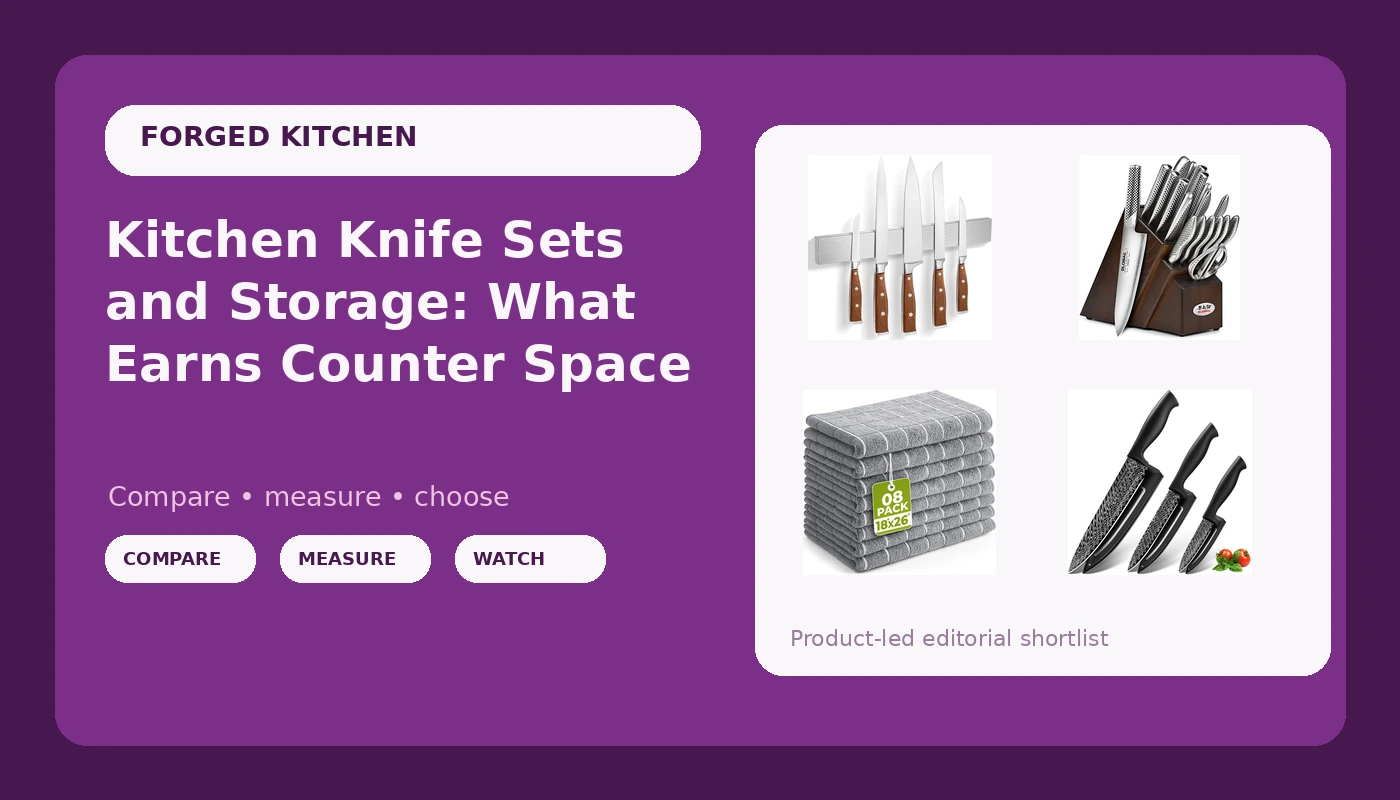
This is not a ranking. It is a look at four products that solve four different parts of the same problem: the blades themselves, where they live when they are not in your hand, and how you keep them clean and dry between uses.
Related: How to Hone a Knife Without Rounding the Edge →
Quick answer
There is no single kitchen knife set that fits every kitchen. A full block set covers the widest range of cutting tasks in one purchase. A compact three piece set with covers is the simplest way to start or to equip a small kitchen. A magnetic strip solves storage when counter space is tight, and a stack of microfiber towels supports the drying and wiping routine that keeps blades in working order. Choose by the space you have and the habits you already keep, then plan for sharpening before you plan for anything else.
Four useful options
| Model | Best fit | What stands out |
|---|---|---|
| Global 20 Piece Knife Block Set | A kitchen that wants one purchase to cover most cutting tasks | Twenty pieces plus a block, so the whole setup arrives at once and every blade has a home |
| Gourmetop 3PCS Kitchen Knife Set with Cover | Small kitchens, first apartments, and anyone replacing a single worn out knife | Three pieces that ship with covers, so storage is part of the package |
| Magnetic Knife Holder for Wall, 9.7 Inch | Counters with no free space and walls or refrigerator sides that are empty | A magnetic strip that mounts to a wall or a refrigerator and can also hold utensils and small metal tools |
| Utopia Towels Microfiber Kitchen Towels 8 Pack 18x26 Inch Grey | Anyone who wants a dedicated drying towel for blades and boards | Eight towels at 18 by 26 inches, so a clean one is always within reach |
The full set: Global 20 Piece Knife Block Set
A set this size is really two purchases bundled together: the blades and the furniture that holds them. That is convenient, and it is also where the trade-offs live. A block occupies permanent counter space, and twenty pieces means several of them will see occasional use at best. The honest way to think about a large set is that you are buying a chef's knife, a couple of supporting blades, and a storage system, with the rest as filler that costs you nothing extra as long as you did not pay a premium for it.
The block itself deserves scrutiny. Slots that grip a blade too tightly or sit at an angle that drags the edge against hard material will dull a knife every time you put it away. If the slots feel snug and the blade slides in without scraping, the block is doing its job. If it fights you, store the daily knives elsewhere and treat the block as overflow.
The compact starter: Gourmetop 3PCS Kitchen Knife Set with Cover
This is the shape of set I would hand to someone moving into a first apartment or restocking a kitchen after a move, and not because it is a compromise. Three knives with covers solve the two problems that actually break a starter setup: not enough blades to cook a real meal, and nowhere safe to put them. Covers mean the drawer stays a drawer instead of becoming a sharp-edged jumble.
What a compact set will not do is replace a dedicated chef's knife you already love, and it will not cover heavy butchery or long slicing sessions the way a larger blade will. Treat it as a working baseline. Learn to keep it sharp, learn what each of the three shapes is actually for, and upgrade the one knife you reach for most once you know which one that is.
The wall storage: Magnetic Knife Holder for Wall, 9.7 Inch
Magnetic storage gets the geometry right. A block holds a knife by the blade inside a slot; a strip holds it by the flat of the blade in open air. Nothing contacts the edge, nothing traps moisture against the steel, and you can see at a glance what is clean and what is not. For a small kitchen, a strip is often the difference between knives that get used and knives that stay buried.
The trade-offs are real. A strip needs a wall or an appliance side that you are willing to mount hardware to, and it puts blades at eye level where children and sleeves can reach them. Nine and a half inches of strip holds a working rotation, not a collection, which is a feature if you are trying to keep the collection honest. Keep the strip away from the stove, where grease and steam will settle on the blades, and wipe the strip itself when you wipe the knives.
The wipe down: Utopia Towels Microfiber Kitchen Towels 8 Pack 18x26 Inch Grey
This is the least glamorous item in the group and the one that most directly protects the other three. Water is the quiet enemy of a working knife. A blade left wet on a board or dropped damp into a block will spot, and over time it will pit. A dry towel within arm's reach turns drying into a one second habit instead of a decision.
The practical move is to dedicate one towel to knives and boards and keep it separate from the towel you use on greasy pans and hands. Eight towels in a pack makes that separation easy to maintain, and it means you are never drying a blade with something that just wiped up raw chicken. Wash them apart from anything abrasive and they will keep doing the job.
Prices and availability may change. Product images, names, and retailer links must be matched by verified ASIN. Do not state a current price, rating, stock status, or measured result without current evidence.
Why piece count is the wrong number to shop by
A knife set is roughly 80 percent chef's knife. The rest of the pieces are supporting cast. That single idea explains most of the confusion in the knife aisle, because a 20 piece set and a 3 piece set may contain equally good chef's knives, and the extra seventeen pieces are what you are actually paying for.
Two construction details matter more than the count. The first is whether the steel runs the full length of the handle, which is what people mean by full tang. A blade that stops short of the handle and is held on by rivets or a bolted joint is a knife with a failure point built into it. It may last years in a home kitchen, but it is not a tool you hand down, and it is not a tool I would want in my hand during a rush.
The second is the shape of the blade and the hardness of the steel. German style blades tend to be thicker and softer, which means they take an edge easily and tolerate being honed back into shape. Japanese style blades are thinner and harder, which means they cut with less effort and hold that edge longer, but they chip if you twist them through a chicken joint or hack at a frozen block. Hardness is measured on the Rockwell scale, and higher is not automatically better. It is a trade: longer edge retention in exchange for brittleness and a harder time on the sharpening stone.
What you should ignore is the marketing around piece count and the word professional. A bolsterless knife marketed as a professional tool is still a bolsterless knife. A set with four steak knives and a bread knife that cannot slice bread is a set designed to fill a box, not to cook dinner.
What actually keeps a knife sharp
Sharpness is a maintenance habit, not a purchase. The best blade in the world goes dull, and the difference between a knife that works for a decade and one that works for a year is what you do on a Tuesday night, not what you spent.
Start by separating the two tools people constantly confuse. A honing steel does not sharpen. It realigns a folded edge back to center, which restores the feeling of sharpness on a blade that is still structurally sound. A sharpening stone or a proper sharpener removes steel and creates a new edge. You need both, and you need them at different intervals. Hone often, sharpen rarely, and sharpen deliberately.
Then look at what the knife touches. Glass and ceramic cutting boards are edge killers. So is a drawer full of loose cutlery, and so is a block whose slots drag the blade on the way in. So is a damp blade left to air dry. None of those are dramatic failures. They are small ones repeated a few hundred times.
If you want a simple test of whether your routine is working, pick a morning, take your most used knife, and try to slice a ripe tomato without pressing. Do that once a month. When the tomato squashes instead of slicing, you have your answer, and you will know whether the problem is alignment or a genuinely dull edge.
If you are deciding today, work through it in this order:
- Count the knives you actually used in the last week. That number, not the number in the listing, is your target.
- Decide where the knives will live before you buy them. Block, strip, drawer with covers, or a mix.
- Check the handle construction on any set you are considering, and rule out anything without a full tang.
- Set a sharpening plan before the first blade goes dull, whether that is a stone, a guided sharpener, or a service.
- Buy the drying towel at the same time as the knives, because the habit is easier to start than to add later.
Practical guidance for a setup that lasts
- Keep the chef's knife as the priority. If you are splitting a budget, spend it there and let the other pieces be ordinary.
- Store daily knives where air reaches them. A strip or a drawer with covers beats a block for anything you use every day.
- Hone before you cook, not after. A few passes on a steel takes seconds and buys you weeks between sharpenings.
- Never leave a blade wet. Dry it the moment it comes out of the sink or off the board.
- Keep one towel for blades and boards and one for everything else, and wash them separately from anything gritty.
- Cut on wood or soft plastic. The board is part of the knife's lifespan, not a separate purchase.
- Do not put good knives in the dishwasher. Heat, moisture, and rattling against other items undo everything above.
Which option should you choose?
Choose the Global 20 Piece Knife Block Set when you want a single purchase to cover most cutting tasks and you have permanent counter space for a block. Choose the Gourmetop 3PCS Kitchen Knife Set with Cover when you are starting out, outfitting a small kitchen, or replacing a worn out knife and you would rather not give up counter space to storage. Choose the Magnetic Knife Holder for Wall, 9.7 Inch when storage is the bottleneck and you have a wall or an appliance side to mount it to. Choose the Utopia Towels Microfiber Kitchen Towels 8 Pack 18x26 Inch Grey when you want a dedicated drying and wiping setup so the rest of the routine is easy to keep.
The caveat is that none of these decisions fixes a dull knife. Storage and drying protect an edge; they do not create one. Whatever you buy, the sharpening plan is the part that determines how the setup feels in a year.
The bottom line
A kitchen knife set is a system of three parts: the blades, the storage, and the upkeep. A 20 piece block set covers the most ground in one order. A compact three piece set with covers gets you cooking with almost no footprint. A magnetic strip puts the daily knives where air and eyes can reach them, and a pack of microfiber towels keeps the blades dry enough to hold up. Buy for the space you have, check the handle construction before you commit, and set up a sharpening habit on day one. The knives are the easy part. The habit is what lasts.