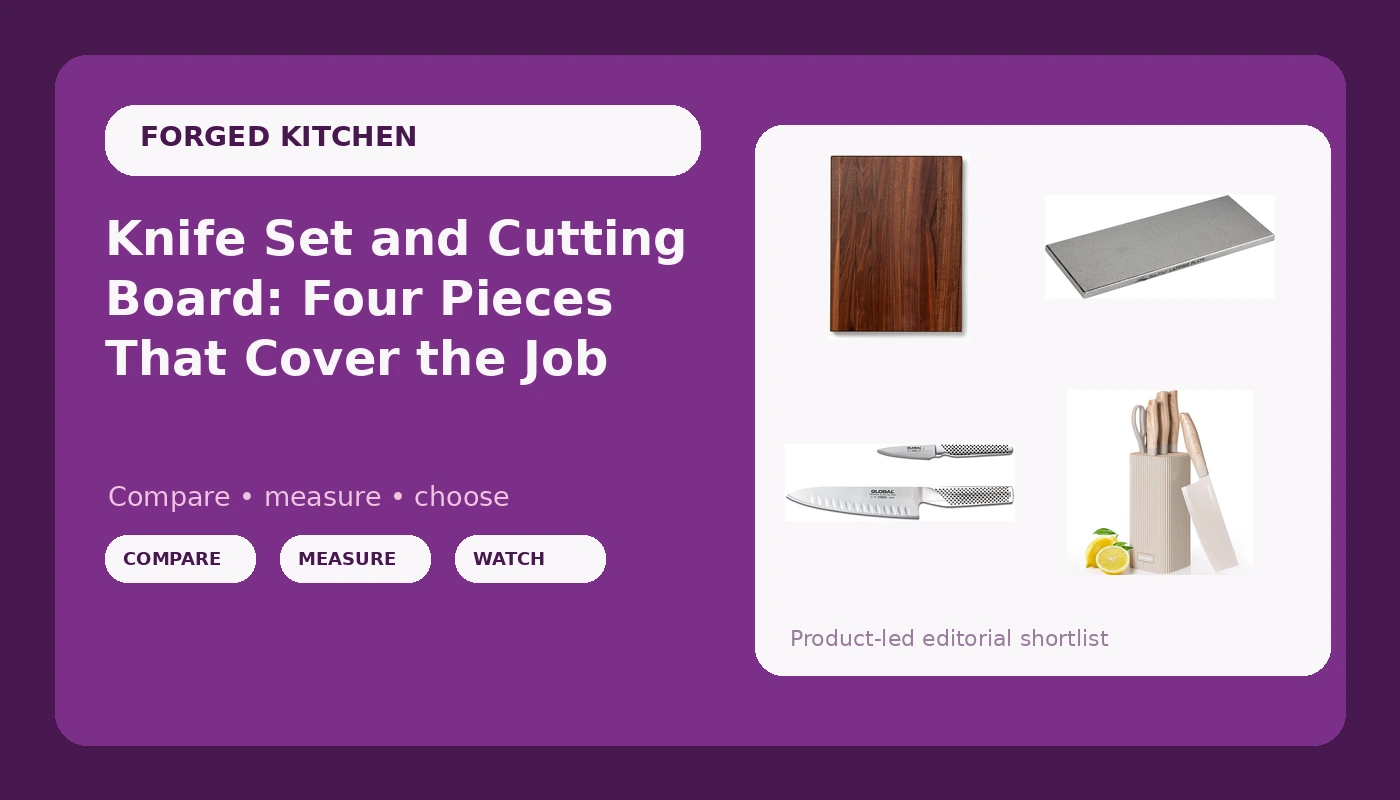
Most people buy a knife set and cutting board as two unrelated purchases: a block that looks good on the counter, and a board that fits in the cabinet. Then the knives go dull within a month, the board warps, and the whole thing feels like a mistake. The problem is not the shopping. It is that the knives, the surface you cut on, and the stones you sharpen on are one system, and each part decides how well the others work. A thin, hard edge dies fast on a glass or bamboo board. A thick, stable board on a wobbling counter is a cut waiting to happen. A sharpening stone that has dished in the middle grinds a curve into your blade no matter how clean your technique is. Four pieces cover the whole system: a two-knife core, a budget block set for anyone who wants everything at once, a thick walnut board, and the flattening plate that keeps a stone honest.
Related: How to Hone a Knife Without Rolling the Edge →
Quick answer
The shortest path to a setup that works is two good knives, one thick board you are willing to oil, and a way to keep your sharpening stones flat. A two-piece cook's set covers the primary cutting jobs with no filler. A six-piece block set gives you more pieces and a storage block at the entry level, and the trade is steel and handle construction. A 1.5-inch walnut board gives you a stable, reversible surface that is easier on an edge than glass, bamboo, or composite. And if you sharpen on waterstones, a diamond lapping plate keeps them flat so the bevel you set is the bevel you get. None of these pieces is glamorous. All four of them decide whether the others work.
4 useful options
| Model | Best fit | What stands out |
|---|---|---|
| Global 2 Piece Cook's Set G-78 & GSF-46 | Cooks who want two working knives and no filler | Two-piece set with no block and no steak knives; the model numbers identify exactly what ships |
| Astercook Knife Set, 6-Piece Kitchen Knife Set with Block | First kitchens and guest kitchens that want everything at once | Six pieces with a matching block; high carbon stainless blades with wood-grain handles |
| John Boos R-Board Series Rectangular Wooden Walnut Cutting Board 20”x15”, 1.5” Thick, 12-lb Reversible Butcher Block with Edge-Grain & Finger Grips, Made in the USA | Anyone cutting daily who wants one board to keep | 20 by 15 inches, 1.5 inches thick, reversible, edge-grain walnut, finger grips, made in the USA |
| DMT Dia-Flat Diamond Lapping Plate for Flattening Conventional and Waterstone, 4 by 10 Inch | Anyone who sharpens on stones | 4 by 10 inch diamond plate built for flattening conventional stones and waterstones |
The two-knife core: Global 2 Piece Cook's Set G-78 & GSF-46
Here is the arithmetic that matters. In a typical fifteen-piece block, you get one chef's knife, one or two smaller blades, and then a pile of pieces that exist to fill slots: four to six steak knives, a slicer, shears, and a serrated bread knife that many owners never sharpen because serrations are a hassle on a stone. The knife you reach for does most of the work, which means most of what you paid for is decoration. A two-piece set skips that entirely. It also means you have to buy the rest on purpose, which is the point: when you need a paring knife or a slicer later, you choose it deliberately instead of inheriting it. The trade is that nothing here hones or sharpens the blade for you, so budget for a honing steel and a stone as part of the same purchase. Look at how the heel of the blade sits relative to the handle, too. A thick full bolster that runs all the way down to the edge makes it hard to get the last inch of blade flat on a stone, and that last inch is the part you use most.
The budget block set: Astercook Knife Set, 6-Piece Kitchen Knife Set with Block
This is the set you buy when the alternative is cooking with whatever is in the drawer. It solves the problem of not having a knife, a block, or a place to put either. Two things are worth knowing before you commit. First, nothing in the product name describes a forging process or full-tang construction, so if those details matter to you, read the listing rather than assuming. Second, dishwasher-safe is a claim about cleaning convenience, not about edge life. Heat, detergent, and the banging around inside a dishwasher are hard on any blade, and hand washing and drying takes about thirty seconds. The block deserves a thought as well. Slots that grip the edge can dull a knife over months of insertion, so set blades down gently, and if you notice the edges going shiny and blunt, consider a magnetic strip or a drawer insert instead. For a first apartment, a rental kitchen, or a guest house, none of that changes the value of having six pieces in one box.
The cutting surface: John Boos R-Board Series Rectangular Wooden Walnut Cutting Board 20”x15”, 1.5” Thick, 12-lb Reversible Butcher Block with Edge-Grain & Finger Grips, Made in the USA
Thickness is not a style choice. A 1.5-inch board has enough mass that it stays put while you work, and it does not flex or rock under the blade, which is where most cutting accidents actually start. The reversible design gives you two faces, so you can dedicate one to onions and garlic and keep the other clean for bread and fruit. Walnut is a softer hardwood than hard maple, and a softer surface lets an edge bite and release instead of skating, which is why wood boards in general treat knives better than glass, ceramic, or composite. Bamboo is the one that surprises people: it is a grass, dense and often high in silica, and it is noticeably harder on an edge than a walnut or maple block. The upkeep is real but small. Oil it when the surface looks dry, never soak it, never put it in a dishwasher, and store it flat or on edge rather than leaning, because a warped board is an unstable board.
The maintenance tool: DMT Dia-Flat Diamond Lapping Plate for Flattening Conventional and Waterstone, 4 by 10 Inch
This is the piece nobody wants to buy and the one that decides whether the other three perform. Every sharpening session removes material from the middle of a stone, and over months the middle dishes out. A dished stone cannot grind a flat bevel, no matter how steady your hands are, because the stone itself is curved. You get an edge that looks sharp and behaves inconsistently. Flattening is a maintenance habit, the same way honing is. Check the stone with a straightedge, lap it flat when it needs it, and your knives get the geometry you intended. If you have not started sharpening yet, this is not the first purchase. Buy a stone first, learn to use it, and add the lapping plate when the stone starts to dish.
Prices and availability may change. Product images, names, and retailer links must be matched by verified ASIN. Do not state a current price, rating, stock status, or measured result without current evidence.
Why a two-knife set beats a fifteen-piece block
Count the pieces you actually touch in a week. For most home cooks it is one large knife for onions, proteins, and squash, and one small knife for shallots, herbs, and trimming. Everything else in a big block is occasional. That does not make the extra pieces useless, but it does mean the money spent on them is not buying cutting performance. Steel quality, heat treatment, and grind decide how a knife feels on the board, and those things cost money per blade. Spread across fifteen pieces at a low total, each knife gets very little of it. This is why the set shape matters more than the piece count. Two knives from a maker that grinds its own blades will outperform a fifteen-piece block in daily use, and the block will still be sitting there taking up counter space.
Two construction details are worth checking on any knife you plan to keep. Full tang means the steel runs the length of the handle, which is the difference between a knife and a handle glued to a blade. And a bolster, the collar between blade and handle, protects your fingers but complicates sharpening if it runs all the way to the edge. Neither detail is about brand prestige. They are about whether the knife is still in service in five years.
What the board does to your edge
A cutting board is the other half of every cut you make, and its hardness sets how fast your edge wears. Edge grain is a board cut so the long fibers run parallel to the surface; it is stable, easy to maintain, and gentle enough for daily work. End grain stands the fibers up like a brush, so the edge slips between them, which is why butcher blocks are built that way. Both are wood and both are kinder than glass, ceramic, stone, or composite. A soft board also grips better, so food stays where you put it.
Stability is the safety feature people skip. A board that rocks, slides, or flexes turns a routine chop into a hazard. That is what thickness and mass buy you, and it is why a 12-pound board stays where you set it while a thin flexible mat does not. Set a damp towel under any board that still moves.
- Count the jobs you actually do in a week, not the ones you imagine doing.
- Decide between a two-knife core and a full block based on that count, not on piece count.
- Match the board to your counter and storage: measure before you buy, and check that it fits where it will live.
- Budget for maintenance in the same purchase: a honing steel, a stone, and eventually a way to flatten that stone.
- Read the listing for construction details the name does not state, and confirm the return window before you commit.
Keeping the system working
- Hone before or after most sessions, but treat honing as realignment, not sharpening. It does not remove metal and it does not restore a dull edge.
- Sharpen on a stone when honing stops bringing the edge back, and keep the stone flat with a lapping plate.
- Hand wash and dry knives rather than leaving them in a sink or a dishwasher, even when a listing says dishwasher safe.
- Oil a wood board when it looks dry, never soak it, and store it flat or on edge so it cannot warp.
- Replace or resurface a board once it develops deep grooves, because those grooves hold bacteria and no amount of scrubbing gets them clean.
Which option should you choose?
Choose the Global 2 Piece Cook's Set G-78 & GSF-46 when you already know which two knives you reach for and you would rather spend on those than on a block full of filler. Choose the Astercook Knife Set, 6-Piece Kitchen Knife Set with Block when you are equipping a first kitchen, a rental, or a guest space and need a complete, tidy set in one purchase. Choose the John Boos R-Board Series Rectangular Wooden Walnut Cutting Board 20”x15”, 1.5” Thick, 12-lb Reversible Butcher Block with Edge-Grain & Finger Grips, Made in the USA when your daily cutting happens on one surface and you want that surface thick, stable, and reversible. Choose the DMT Dia-Flat Diamond Lapping Plate for Flattening Conventional and Waterstone, 4 by 10 Inch when you already sharpen on stones and want them to stay flat.
One caveat on all four: these recommendations rest on the manufacturer descriptions supplied here, not on measured testing. Blade steel, handle construction, and board hardness vary in ways that a product listing does not always capture, so verify the specifications that matter to you before buying, and let the return policy do some of the work.
The bottom line
A knife set and cutting board are not two purchases. They are one system with a maintenance loop running through it, and the loop is what keeps an edge on the blade. Two good knives handle almost everything a home kitchen does. A thick walnut board gives that edge a surface that does not fight it. A budget block set covers the kitchen where nothing exists yet. And a flattening plate keeps the stone honest so your sharpening actually sharpens. Buy the pieces in the order your cooking demands, sharpen regularly, and replace the block full of filler pieces with a smaller number of knives you chose on purpose.