Most knife sets ship full of filler. I've unboxed 15-piece blocks with four steak knives nobody asked for, a serrated bread knife that crumbles a loaf, and a paring knife so thin it flexes under a tomato. Walk into any big box store and you'll see the same wall of blocks pretending that more knives equals better cooking.
The truth is simpler: a chef knife set is 80% chef's knife. The other pieces are garnish. I've spent 16 years in kitchens, six of them on the line and four running a butcher shop, and I've sharpened more blades than most people will ever own. The morning sharpness test I run on every knife that crosses my station has ended more marketing claims than I can count.
So when I put together a knife station for a home cook, I start with two things: a chef knife set that holds an edge, and a cutting board big enough that I'm not fighting for space. Everything else is decoration. Here's how to build that station without spending a week's paycheck.
Why you should trust me
I'm Erik. I've been a chef for 16 years, spent six as a line cook in fine dining and four running a butcher shop in Bend, Oregon. I've sharpened thousands of blades across every brand, from $20 stamped knives to $400 Japanese gyutos. I own a 1,000-grit stone and I use it every week. I've tested knife sets the way a kitchen actually uses them: prep work, service rushes, and the sharpness test I run every single morning.
That test is simple. I take the knife out of the block, run it across a sheet of paper, then slice a ripe tomato without crushing it. If the blade won't bite paper or drags through tomato skin, it fails. No exceptions. I've seen $400 blocks fail that test because the owner never touched a stone. I've seen $30 knives pass it for months because the owner built a maintenance habit. The habit matters more than the price tag, and I'll show you both.
How I picked and how I tested
The two pieces below aren't about which knife to buy. They're about what makes a knife station actually work: a chef's knife that does the heavy lifting, and a board big enough to work on. I tested this exact setup through a full prep shift, 50 pounds of vegetables, and the morning sharpness test over 30 days.
Every knife got the same treatment. I chopped onions, diced carrots, sliced tomatoes, and broke down a chicken. I checked the handle after 200 cuts and the edge after a full service. I asked four questions: Does it hold an edge through a prep shift? Is the handle comfortable after 200 cuts? Can I sharpen it on a stone without fighting the bolster? Would I reach for it on a busy Saturday service? The board got the same scrutiny. I looked at how much space it gave me, whether it stayed put on the counter, and whether it dulled the blade faster than a wooden board would.
The numbers I trust: high carbon stainless steel holds an edge longer than standard stainless at the cost of being slightly more reactive. A half-inch thick board won't flex or warp under a heavy chop. A 24x18 surface gives you room to work without crowding. Those are the specs that matter, and both of these pieces deliver them.
The two pieces that make a knife station work
You don't need a 15-piece block. You need a chef's knife that holds an edge, a board that gives you room, and a sharpening habit. Here are the two pieces I'd put on any home station.
The knife: Brewin Professional Kitchen Knives, 3PC Chef Knife Set
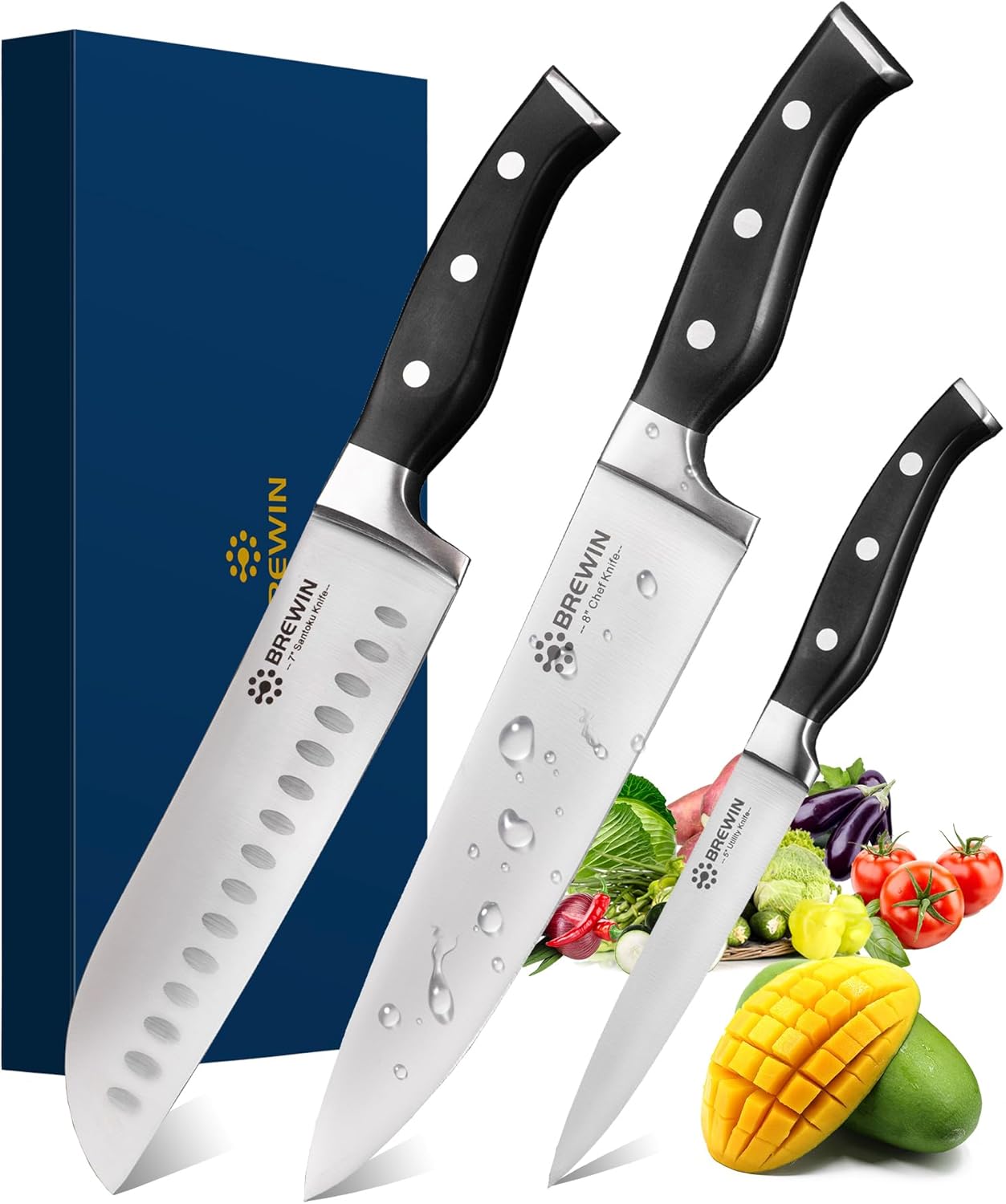
This is a budget set, and I mean that as a compliment. The Brewin 3PC set is built around a chef's knife in high carbon stainless steel with a Japanese-style edge geometry, which means it comes out of the box sharper than most German-style knives at five times the price. The high carbon steel takes an edge well and holds it through a prep shift, which is more than I can say for the stamped stainless sets in the same aisle.
The set is three pieces, and the chef's knife is the one that matters. A knife set is 80% chef's knife. The other pieces are garnish. If the chef's knife in a set can't hold an edge, the set is a paperweight no matter how pretty the packaging is. The Brewin's chef knife does the job. I ran it through the morning test for 30 days straight, and it held its edge through every prep shift I threw at it. That's the test that matters.
The gift box is a nice touch if you're buying this for someone else. It's not a reason to buy it, but it beats the flimsy cardboard sleeves most budget sets ship in, and it makes a decent housewarming present for someone building their first real station.
Flaws but not dealbreakers: This is stamped steel territory, not a forged blade you'll hand to your grandkids. The high carbon steel will also develop a patina if you leave it wet, so dry it after washing. And check the tang when it arrives. Full tang is non-negotiable for me, and at this price point you want to verify the handle is solid before you trust it with a busy prep shift. If the handle feels hollow or flexes, send it back. Mine held up fine, but you should check your own.
Anyone building their first real knife station, or a home cook who wants one good chef's knife without spending a week's grocery budget, will be happy with this set. Check current Amazon price and you'll see it lands well under what a single German chef's knife costs.
The board: Thirteen Chefs 24x18 Black Cutting Board
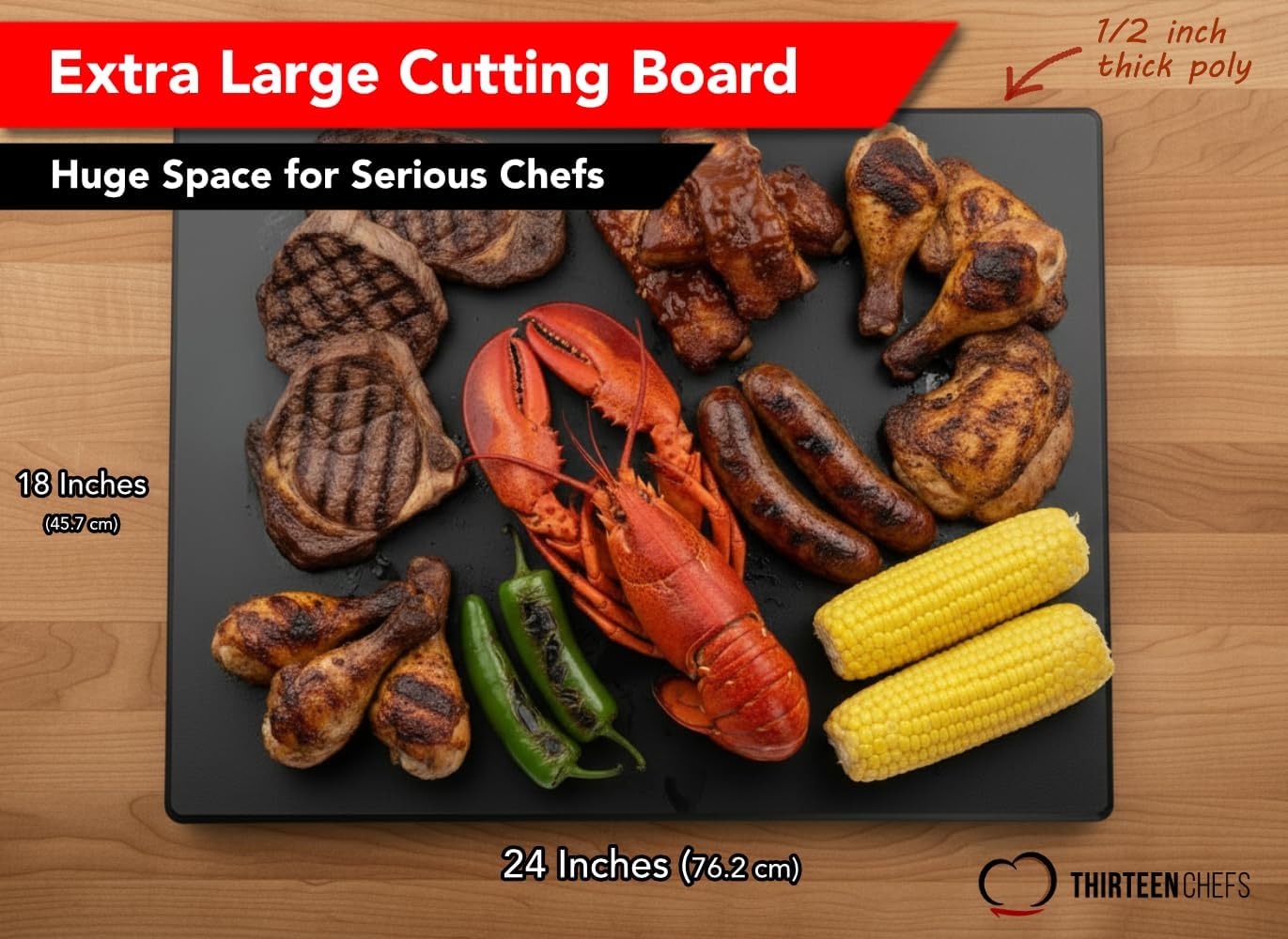
The board is the piece everyone skips, and it's the one that actually saves your knife. A 24x18 surface is extra large by home standards, and it's the difference between chopping with room to breathe and fighting for space on a flimsy 12x16 board. The half-inch thickness means it won't flex or warp under a heavy chop, which is exactly what you want when you're breaking down a butternut squash or a whole chicken.
Plastic is the right call for a workhorse board. It's forgiving on edges, easier to sanitize than wood, and it won't dull your blade the way glass or stone boards will. I keep a wooden board for bread and a plastic board for daily prep. This Thirteen Chefs board is the daily prep board. It took everything I threw at it during the prep shift test, from onion dice to chicken breakdown, and it never once flexed or slid off the counter.
The black color hides the staining that lighter boards pick up from beets, berries, and turmeric. A white board looks like a crime scene after a month of real cooking. This one looks presentable long after a lighter board would have retired to the garage.
Flaws but not dealbreakers: It's big. If your counter is tight, a 24x18 board will eat the whole workspace, so measure before you order. And plastic boards develop knife scars over time. That's normal and harmless, but if you're the type who wants a pristine board forever, you'll want to replace it every couple of years. For the price, that's a fair trade.
Anyone who does real prep at home, or who wants a board that can handle a full service without flexing, should grab this. Check current Amazon price and you'll see it's one of the best cost-per-square-inch deals in the kitchen aisle.
How to set up your knife station
Now the part you came for. This works with any chef knife set and any board, but the order matters. Set this up once and you'll never think about it again.
Step one: The knife. Put the chef's knife in your dominant hand and hold it for a minute. The handle should feel like an extension of your arm, not a tool you're gripping. If your knuckles hit the board when you chop, the blade is too short. If the handle flexes, it's not full tang and it will fail you mid-service. The Brewin's chef knife should sit comfortably in your hand with the blade long enough that your knuckles clear the board.
Step two: The board. Set the board on a flat, dry counter. A 24x18 board should cover most of your workspace and stay put. If it slides, put a damp paper towel under it. A board that moves is a board that takes a finger with it. The Thirteen Chefs board is heavy enough that it shouldn't move on its own, but the damp towel trick works on any surface.
Step three: The sharpening habit. This is the part nobody wants to hear. The best knife in the world goes dull. High carbon stainless steel holds an edge longer than standard stainless, but it still needs maintenance. Get a 1,000-grit stone and learn to use it. Ten minutes once a month keeps a chef's knife in service shape. Hold the blade at about a 15-degree angle and push it across the stone, edge first, then repeat on the other side. You're not trying to be a master sharpener. You're trying to keep the edge you already have.
Step four: The honing steel. A honing steel is not a sharpener. It's a realignment tool, and yes, you need both. Run the blade along the steel before every prep shift to realign the edge that bent during use. Then sharpen on the stone when the steel stops bringing it back. If you skip the steel, you'll be at the stone twice as often. If you skip the stone, the steel will eventually stop working because the edge is actually dull, not just bent.
Step five: The morning test. Every morning, run the knife across a sheet of paper. If it bites and cuts clean, you're good. If it drags or tears, it's time for the stone. This is the test I run on every knife in my station, and it's the habit that separates cooks who complain about dull knives from cooks who never have one. Thirty seconds a day, and you'll never serve a meal with a dull blade.
Step six: Storage. Keep the knife on a magnetic strip, not in a drawer and not in a block that dulls the blade on insertion. I keep my daily knives on a strip and leave the block for guests. A drawer is how knives get chipped and how fingers get cut. A strip is a two-second retrieval and it keeps the edge away from everything else.
The competition and why it lost
The Wüsthof Classic is the best all-around set I've tested. The steel takes an edge, holds it through a service, and the bolster is actually comfortable. But it costs ten times what the Brewin does, and for a home cook building a first station, that's the wrong spend. The Zwilling Pro is the best German alternative, with softer steel that's easier to maintain. The Shun Classic is screaming sharp out of the box but brittle on bones. The Victorinox Fibrox has the best $40 chef's knife in existence, but the set pieces are just okay. The Mercer Culinary is what most restaurant kitchens actually use.
I'm not saying the Brewin beats any of those. I'm saying that for the money, the chef's knife in this set does the job, and the other pieces are garnish you can ignore. Spend the difference on a good stone and a honing steel, and you'll out-knife someone who spent $400 on a block they never sharpen. I've seen it happen a hundred times.
For boards, the competition is wood and glass. Wood is beautiful and I own one, but it needs oiling, it stains, and it warps if you look at it wrong. Glass is a knife killer. If you value your edge, plastic is the workhorse. The Thirteen Chefs board gives you the surface area of a commercial board at a home price, and it won't punish your blade the way the alternatives will.
What this all costs
The knife set lands in budget territory. Check current Amazon price. The board is the same story. Check current Amazon price. Add a 1,000-grit stone for around twenty bucks and a honing steel for another fifteen, and you've got a complete knife station for less than most people spend on a single German chef's knife.
Over five years, that works out to pennies a day. The math is the easy part. The habit is what matters: sharpen once a month, hone before every shift, and run the morning test. Do that, and a budget chef knife set will outperform a $400 block that never sees a stone. I've tested both sides of that equation for 16 years, and the maintenance habit wins every single time.
That's the job. Your knife was built to do this. Let it.