Related: Knife Sharpening Basics: Angles, Stones, and Steels
Most people build a cutting setup backwards. They buy the knife set first, then a board that fits the drawer, then a sharpener in a panic when everything in the block goes dull in the same week. Sixteen years in professional kitchens, six of them on a fine dining line and four running a butcher shop, taught me the order runs the other way. The board takes the abuse, the blade does the work, and the sharpening habit is the thing that keeps both of them honest. A knife set and cutting board setup is not really a purchase. It is a routine with equipment attached to it.
So here is the setup I would actually put on a home counter, in the order I would buy it. One board you can beat on, one board for carving, one sharpener that removes the excuse, and a small set of blades to learn on. That is the whole list. Everything else in a knife block is garnish, and you already know it.
Best Overall: John Boos R-Board Series Maple Cutting Board
If you only buy one thing off this page, buy the board. The John Boos R-Board Series is a 20 by 15 inch rectangle of edge-grain maple, 1.5 inches thick and about 12 pounds of it. That thickness matters more than the footprint. A heavy board stays put when you rock through onions, it does not ring hollow under a cleaver, and it does not skate across a damp towel.
It is reversible, which doubles the usable surface, and the finger grips at the ends make it easy to lift when you need to scrape underneath it. Edge-grain maple is the forgiving choice for a working kitchen. End-grain boards are prettier and kinder to an edge, but they cost more, weigh more, and want more oil. Maple edge-grain is the board I would hand a home cook and still expect to see in ten years.
Two things to know. First, it is heavy, and a board this size eats counter space. Measure before you commit. Second, wood moves. Oil it monthly with food-grade mineral oil or a board butter, never soak it, never put it in the dishwasher, and it will stay flat. Made in the USA matters here too, because a board this thick will eventually want resurfacing, and you want a board worth sanding rather than replacing.
Best Value: Teakhaus Carving Board with Juice Groove
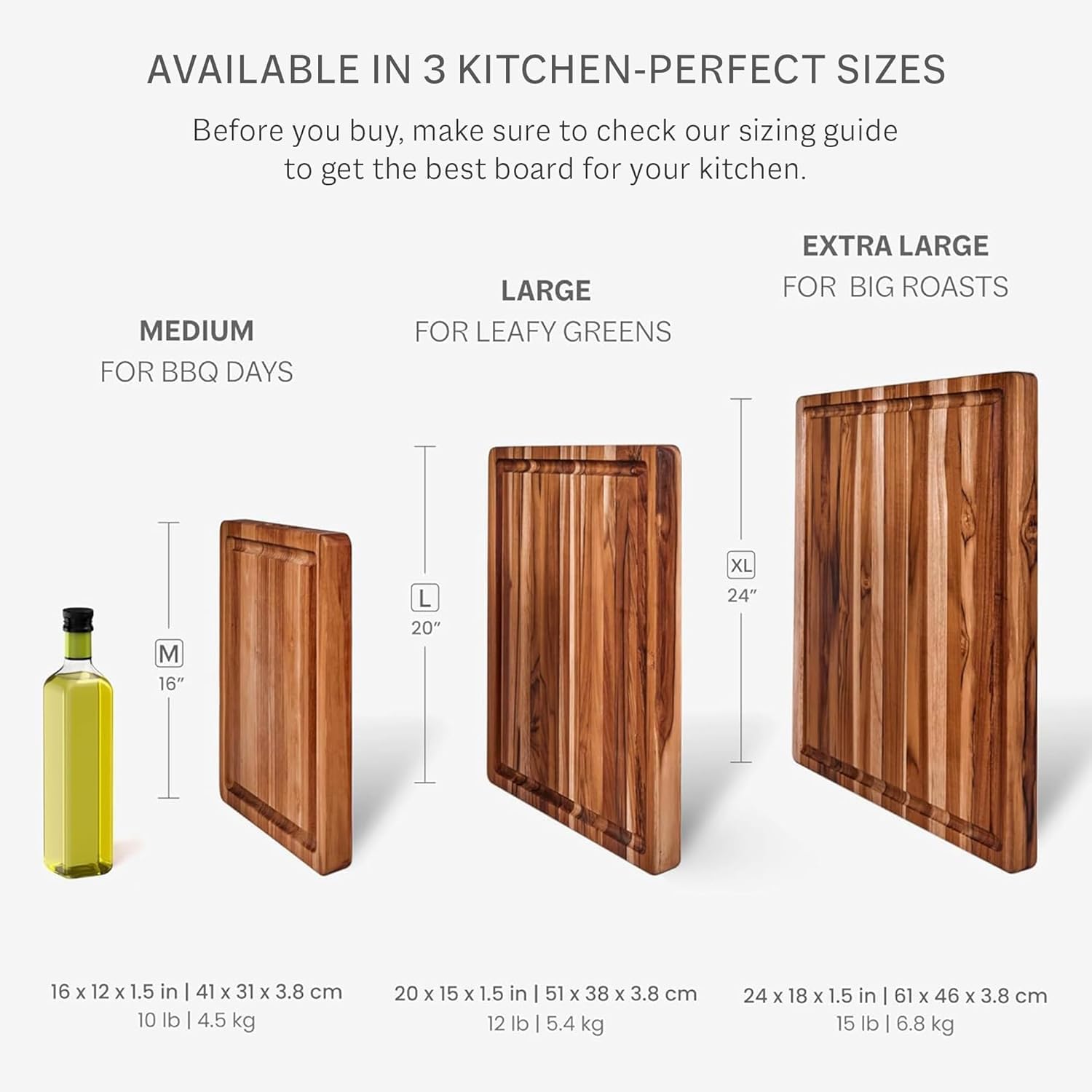
This is the second board, and it earns its place for one reason: the juice groove. The Teakhaus Carving Board is small at 16 by 12 inches and 1.5 inches thick, cut from sustainably harvested teak with FSC certification and finished with beeswax oil. Teak carries natural oils that make it more water resistant than maple, which is exactly what you want in the board that catches the runoff from a rested roast.
The groove is the feature. Carve a chicken or a pork loin on a flat board and you get a puddle spreading across the counter. Carve it in a groove and the juices stay put, which means you can spoon them back over the meat instead of wiping them off the floor. The small size is deliberate. This is a board you keep beside the stove for carving and quick jobs, not the board you break down a case of onions on.
Teak also suits cooks who are rough on gear. It takes oil well, resists staining, and the beeswax finish is food safe out of the box. Because it is compact, it is the carving board I would recommend to someone who is not willing to surrender half the counter for it.
Best for the Edge: Chef'sChoice 15XV EdgeSelect
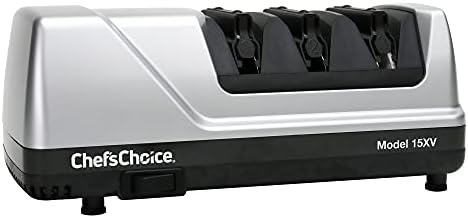
Here is the part most people skip, and it is the part that decides whether the rest of this list works. A honing steel is not a sharpener. It is a realignment tool. It straightens a rolled edge between uses and you should use it, but it cannot cut a new edge into dull steel. That job needs abrasive, and the Chef'sChoice 15XV EdgeSelect is the least fussy way I know to get it done at home.
It runs three stages with 100 percent diamond abrasives, and the precision angle guides are the whole point. You are not holding a blade at a guessed angle against a stone and hoping. The guides hold the knife for you, which is the difference between a sharp knife and a scratched one. It handles straight edge knives and serrated knives, which matters, because a serrated bread knife is the one blade in the drawer that nobody knows how to sharpen.
Where it fits in a routine: hone before every session, sharpen when honing stops bringing the edge back. For most home kitchens that is a few times a year, more if you cook daily. A knife that gets touched up on a schedule outperforms a more expensive knife that never does. That is not a marketing line. That is just what dull steel does.
Best Starter Blades: the Three-Piece Kitchen Knife Set
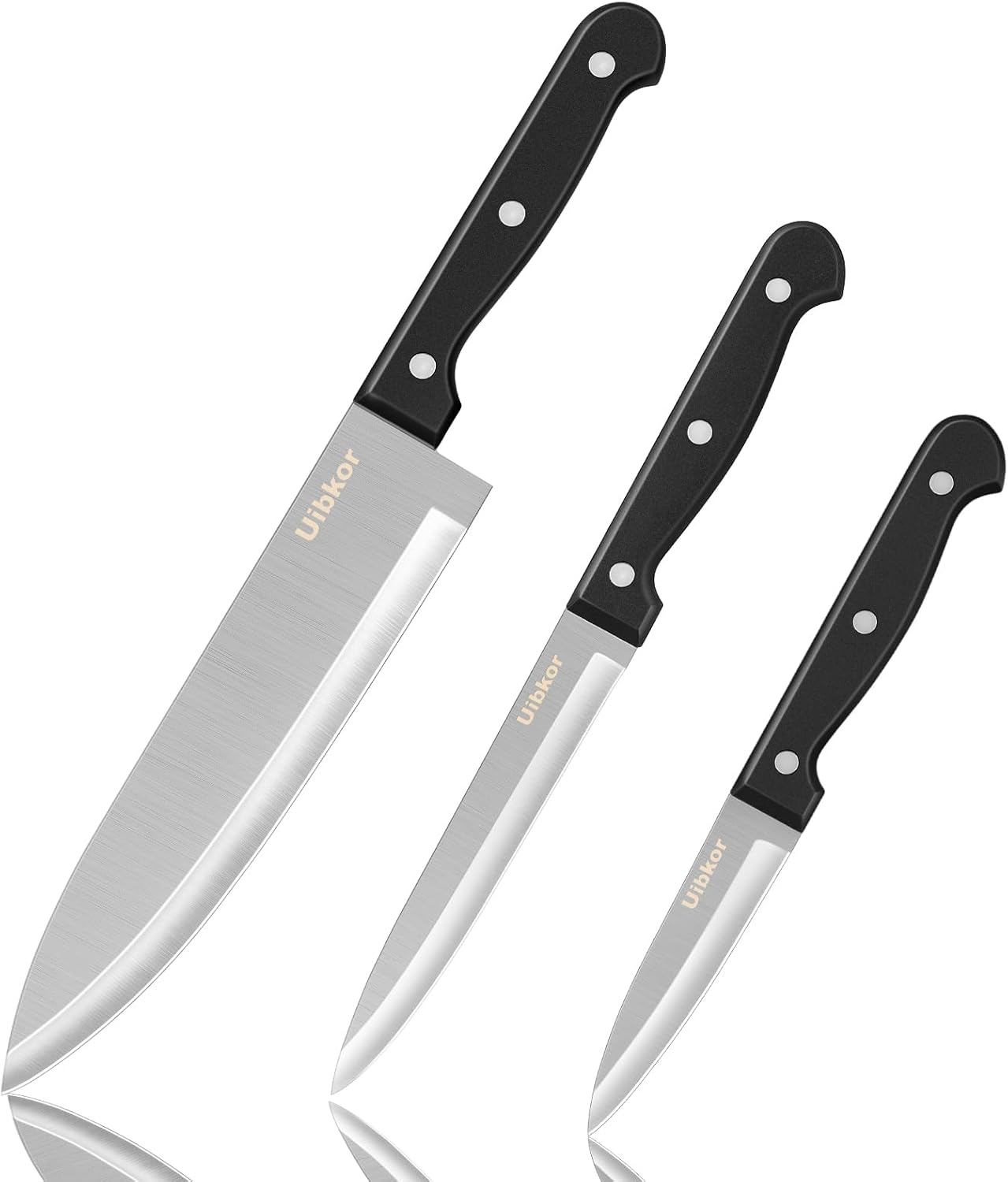
A three-piece set is a reasonable place to start, and this one is built around the two blades that matter: an 8 inch chef knife and a 5 inch utility knife, with a third piece rounding out the set. The chef knife is the workhorse. The utility knife is the petty, the one you reach for when a chef knife is too much blade for a shallot or a piece of chicken.
The rule about any set is that it is 80 percent chef knife. The other pieces are garnish. So judge this one, and every other set, on the big blade first. Does the steel run the full length of the handle? Full tang is non-negotiable for me, because a bolted handle is a knife that will fail you mid-service. Does the bolster sit comfortably under your index finger? Does the handle still feel right after 200 cuts, not two? Those three questions tell you more than any spec sheet.
A set at this level is a learning set. It is what you buy to figure out what you actually like holding, and it is what moves to the guest drawer once you know. That is not a knock. Everyone starts somewhere, and starting with three blades you can sharpen beats starting with fifteen you cannot.
How I judge a cutting setup
I do not evaluate a knife by looking at it. I cook with it. A full prep shift is the only honest test: onions, carrots, a pile of chicken, then service. The blade either holds an edge through that or it does not, and you find out fast.
For boards, the questions are simpler. Does it stay put? Does it dull the blade on contact? Does it survive a month of being oiled and washed? A board that is too hard is worse than a board that is too soft, because hard boards chip edges and soft boards only scar. Maple and teak both sit in the sweet spot.
For a sharpener, the question is whether you will actually use it. Any tool that needs fifteen minutes of setup gets used twice and then lives in a cabinet. The angle guides on the Chef'sChoice exist because the hardest part of sharpening is consistency, and consistency is exactly what human hands are bad at.
For the whole setup, the test is a morning habit. I run the edge across a paper towel before I cook anything. If it grabs, I cook. If it slides, I hone. If honing does not fix it, I sharpen. That loop is the entire secret. Sharpness is a maintenance habit, not a purchase.
What the details actually tell you
Thickness on a board is not vanity. A 1.5 inch maple board absorbs impact and deadens sound, and it carries enough material to be resurfaced more than once over its life. Thinner boards cup, slide, and end up in the camping bin.
Steel hardness is a trade. Harder steel holds an edge longer and fights you when you sharpen it. Softer steel loses the edge sooner and comes back quickly on a steel or a stone. Neither is wrong. What matters is that you know which one you own, because it changes how often you hone and how often you sharpen.
The juice groove on the teak board is a small feature with an outsized effect on how often a board gets used. Anything that removes a step from cleanup gets reached for more often.
The electric sharpener is the piece people argue about. I own a 1,000 grit stone and I use it. A stone gives you a better edge if you have the patience to learn the angle. The Chef'sChoice gives you a good edge tonight, on a serrated knife, with no learning curve. For most home kitchens that trade is worth taking. Learn the stone later if it interests you. A dull knife on a beautiful board is still a dull knife.
The reference table
| Setup piece | What it is | Where it fits | Notes |
|---|---|---|---|
 Visit on Amazon → Visit on Amazon →John Boos R-Board Series Maple Cutting Board |
Edge-grain maple, 20 x 15 in, 1.5 in thick, 12 lb | Everyday prep and big batches | Reversible, two working faces; oil monthly |
 Visit on Amazon → Visit on Amazon →Teakhaus Carving Board with Juice Groove |
Teak, 16 x 12 in, 1.5 in thick, juice groove | Carving roasts and juicy proteins | FSC certified, beeswax oil finish |
 Visit on Amazon → Visit on Amazon →Chef'sChoice 15XV EdgeSelect |
3-stage electric, 100 percent diamond abrasives, precision angle guides | Bringing back a dull edge, including serrated | Hone between sessions, sharpen when honing fails |
 Visit on Amazon → Visit on Amazon →Three-piece kitchen knife set |
8 in chef knife, 5 in utility knife, third piece | First knives and the guest drawer | Judge the set on the chef knife |
Four pieces, one loop: cut, hone, sharpen, repeat. The board is what you stand on. The sharpener is what keeps you honest. The knives are the part everybody talks about.
Should you buy the John Boos R-Board Series?
Yes, if you have the counter for it and you are willing to oil it once a month. It is 12 pounds of edge-grain maple at 1.5 inches thick, reversible, with finger grips, made in the USA. It stays put, it does not chip your edges, and it has enough material to be resurfaced when it needs it. If your counter is tight, or you know you will not maintain wood, this is the one item on the list you should skip.
Should you buy the Teakhaus carving board?
Yes, if you roast and carve with any regularity. The juice groove is the reason to own it, and the teak is water resistant enough to shrug off drippings. It is small, so it supplements a main board rather than replacing one. If you never carve meat, you can pass on it and put the money toward the sharpener instead.
Should you buy the Chef'sChoice 15XV EdgeSelect?
Yes, and it is the purchase most home kitchens are missing. Three stages, 100 percent diamond abrasives, precision angle guides for straight edge and serrated blades. It is the difference between owning dull knives and owning sharp ones, and it removes the two excuses that keep knives dull: not knowing the angle, and not wanting to learn it. If you already sharpen freehand on a stone and enjoy it, you do not need this. Everyone else does.
Should you buy the three-piece knife set?
Yes, as a starting point. An 8 inch chef knife and a 5 inch utility knife handle nearly everything a home cook does, and a third piece fills out the set. Buy it to learn what you like holding, then judge it on the chef knife: full tang, comfortable handle, a bolster that does not fight you at the sharpener. Three blades you actually sharpen will outcut fifteen you never touch.