Related: How to Hone a Knife Without Rolling the Edge
Sixteen years in kitchens, six of them on a fine dining line and four running a butcher shop, and the most useful thing I can tell you about knife shopping is this: a knife set is 80 percent chef's knife. The other pieces are garnish. That is why I never start with a block of fifteen tools. I start with one blade and the two things that keep it cutting.
The kitchen knife set and sharpener combination most home cooks end up with is a block they never rotate and a gadget they use twice a year. That is backwards. Sharpness is a maintenance habit, not a purchase, and the best knife in the world goes dull. So here is how I think about the four tools below: one chef's knife to build the whole kitchen around, one compact set for a first apartment or an RV, one sharpener for the drawer knives and the scissors, and one honing rod to keep an edge aligned between real sharpening sessions.
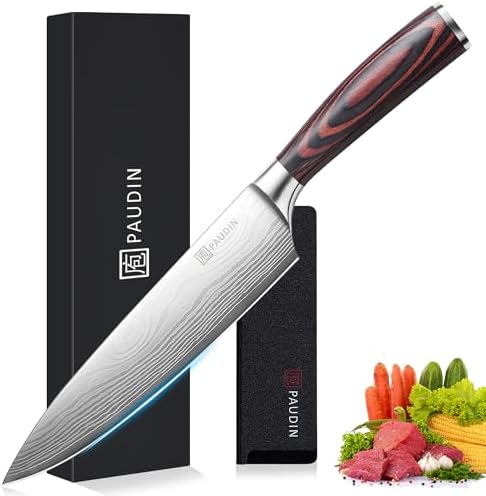
Best Chef's Knife to Build Around: PAUDIN 8 Inch
An 8 inch blade is the right length for almost everything a home kitchen does: breaking down a chicken, slicing a roast, dicing an onion, mincing garlic. This PAUDIN is a high carbon stainless chef's knife with an ergonomic handle, and it arrives in a gift box, which matters more than it sounds if you are buying for someone setting up a first kitchen or moving into a new place.
What I care about at this tier is the shape of the blade and the shape of the handle. A chef's knife should have a gentle belly so you can rock through herbs, and a flat enough section near the heel that you can push cut through a carrot without the blade skating. The handle should fill your palm without forcing your wrist into an angle. This knife is built for the home cook who wants one blade to do the work of five, and that is the correct instinct. One good chef's knife beats a block of fifteen tools every single time.
If you are building a kitchen from zero, start here and add the maintenance tools below. A knife you cannot maintain is a knife you will stop using.
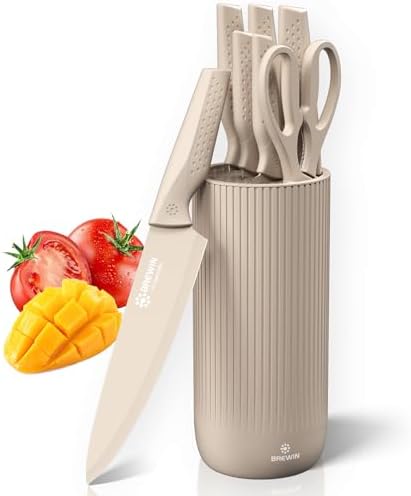
Best Set for a First Kitchen: Brewin Knife Set with Universal Block
Not everyone wants to build a kitchen one blade at a time, and that is where a set earns its place. This Brewin set is the new apartment and RV answer: a compact lineup of kitchen knives with a universal block that accepts whatever you add later.
The universal block is the part I would pay attention to. Most blocks are cut for a specific set, so the moment you buy a better chef's knife, the block becomes a paperweight. A universal block is a storage decision that survives upgrades, and it keeps knives off the counter and out of a drawer where edges bang against each other.
The trade-off with any set in this category is that the pieces you use least are the ones you paid for. Four steak knives and a bread knife are not a reason to buy anything. Buy the set for the knives you will actually pick up, and treat the rest as a starter kit for a household that is still figuring out what it cooks. If you already know you want one great blade, skip the set and put the money into the chef's knife. If you are outfitting a rental kitchen, a camper, or a first apartment, a compact set with a universal block is a sensible way to get from zero to cooking.
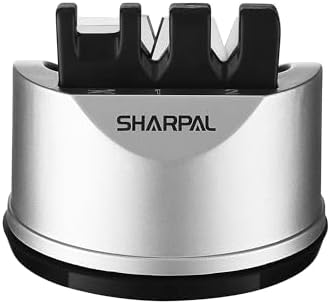
Best Maintenance Tool: SHARPAL 191H Knife and Scissors Sharpener
A sharpener is the tool that turns a drawer of dull knives back into usable ones. This SHARPAL 191H handles knives and scissors in one unit, and the scissors part is not a gimmick. Kitchen shears get abused more than any blade in the house, and most people have never sharpened a pair in their lives.
Here is how I think about a tool like this. It is not a replacement for a stone, and it does not pretend to be. It is what you reach for when a knife you like has gone past what a rod can fix and you are not ready to spend twenty minutes at the sink with a water stone. It is also the tool you hand to a roommate or a partner who is never going to learn freehand sharpening, which means it is the tool that actually gets used.
My rule stands: hone often, sharpen when the rod stops working. This is the sharpen step, and it belongs in the drawer next to the knives, not in a box in the garage.
The Other Half of the Habit: 13 Inch Carbon Steel Honing Rod
Thirteen inches of carbon steel, and the most misunderstood tool in the kitchen. A honing rod does not sharpen. It realigns. During normal cutting, the fine edge of a blade folds over microscopically, and the knife starts sliding off tomato skin even though the steel underneath is perfectly fine. Ten strokes on a rod, alternating sides at a consistent angle, brings that edge back into line in about fifteen seconds.
Length matters here. A 13 inch rod gives you room to run the full length of an 8 inch chef's knife without your knuckles hitting the counter, and carbon steel cuts faster than the smooth ceramic rods that come bundled with most sets. Hold the rod tip down on a cutting board or a folded towel, and draw the blade from heel to tip. Fifteen degrees per side for a thin Japanese style blade, twenty for a heavier German one.
Use it before a session, or at least a few times a week. A knife that gets honed regularly goes months between real sharpening sessions. A knife that never gets honed goes dull in a way no rod can fix.
How I test knives
Every knife that comes through my kitchen goes through the same routine. First, the morning sharpness test: a ripe tomato, a sheet of printer paper, and a chicken breast. If the blade slides through the tomato without bruising the skin, folds the paper cleanly, and takes the chicken in one pass, it passes. Second, a full prep shift. Fifty pounds of onions, carrots, squash, and potatoes across a day of cooking, with the knife doing everything from breaking down a whole chicken to mincing shallots. If my hand is cramping at the end, or the edge is skipping off onion skin, the knife has told me something.
Third, the stone test. I sharpen every blade on a 1,000 grit water stone and finish on a finer one. A knife with a fat, aggressive bolster fights the stone and makes sharpening a chore, and a knife that is a chore to sharpen is a knife that stays dull. Fourth, the 30 day morning test. I check the edge every morning for a month before I say a word about how it holds up. That is the only way I know to separate marketing from steel.
I do not run a lab. I run a kitchen, and that is the standard I hold every blade to.
What the testing actually tells you
Two things decide whether you will still like a knife in a year: steel hardness and handle geometry. Harder steel takes a finer edge and holds it longer, but it chips if you use it on bones and it is a fight on a stone. Softer steel will not win a sharpness contest, but it comes back to life in a minute on a rod, and for a home cook that matters more than any number on a spec sheet.
The second thing is the handle. A knife that feels fine for ten cuts can be miserable for two hundred. Full tang construction is non-negotiable for me: the steel should run the full length of the handle. A bolted handle is a knife that will fail you mid-service, and a loose handle is the first sign it is happening. On any set, look at where the handle meets the blade and whether you can feel a seam.
Then there is maintenance, which is where most kitchens fall apart. A honing rod is not a sharpener. It is a realignment tool. It straightens an edge that has folded over during normal cutting and buys you weeks between real sharpening sessions. A sharpener removes metal and puts a new edge on a blade that has genuinely gone dull. You need both, in that order: hone often, sharpen rarely, and never sharpen a knife that just needs five strokes on a rod.
Finally, the block. A block that grips blades by the edge or scrapes them on insertion will dull a knife faster than any cutting board. That is a real design flaw, and it is worth checking before you buy anything that comes with one.
The knife and sharpener reference table
This is the same breakdown I keep in my head when someone asks what to buy first. Work down the list in order if you are starting from nothing: the chef's knife first, then the maintenance tools that keep it working, and the set only if you need a whole kitchen in one purchase.
| Tool | What it is for | Edge work | Notes |
|---|---|---|---|
 Visit on Amazon → Visit on Amazon →PAUDIN 8 Inch Chef Knife |
90 percent of home prep | Sharpened on a stone | Buy this first |
 Visit on Amazon → Visit on Amazon →Brewin Knife Set with Universal Block |
Getting a kitchen from zero to cooking | Starter edges | The universal block is the point |
 Visit on Amazon → Visit on Amazon →SHARPAL 191H Knife and Scissors Sharpener |
Restoring a genuinely dull blade, plus kitchen shears | Removes metal | The sharpen step, not the hone step |
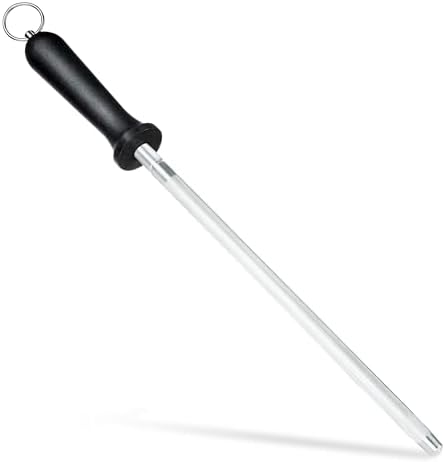 Visit on Amazon → Visit on Amazon →13 Inch Carbon Steel Honing Rod |
Realigning an edge between sharpenings | Does not remove metal | Use it several times a week |
The order in that table is the order I would buy in. A knife you cannot maintain will not stay sharp no matter what you paid for it, and a rod that never gets used is a rod that should have been a sharpener.
Should you buy the PAUDIN chef knife?
Yes, if you are building a kitchen from zero. An 8 inch chef's knife is the right length for almost everything a home cook does, this one is high carbon stainless with an ergonomic handle, and it comes in a gift box, which makes it an easy answer for a housewarming or a first apartment. Buy it first, then buy the tools that keep it sharp. One good chef's knife beats a block of fifteen tools every single time.
Should you buy the Brewin knife set?
Yes, for a first apartment, a rental kitchen, or an RV, where you need to get from zero to cooking in one purchase. The universal block is the reason to choose it over most sets, because it accepts whatever knife you upgrade to later instead of becoming a paperweight the moment you do. Just go in knowing that the pieces you use least are the ones you paid for, and buy it for the knives you will actually pick up.
Should you buy the SHARPAL 191H?
Yes, as the sharpen step in a two tool habit. It handles knives and scissors in one unit, and kitchen shears get abused more than any blade in the house. It is not a replacement for a water stone, and it does not pretend to be. Pair it with the rod, hone often, sharpen when the rod stops working, and your knives will outlast the block they came in.