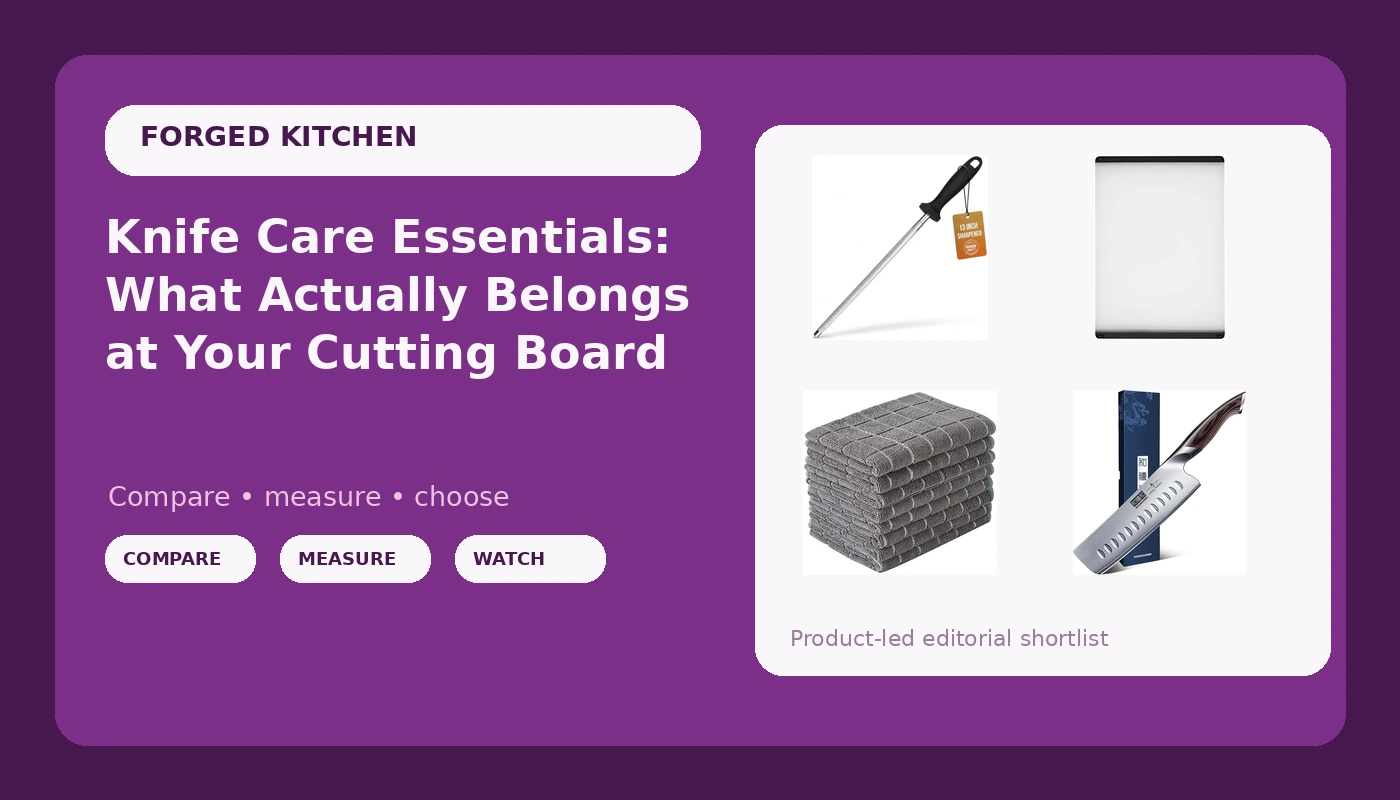
Most kitchens fail at the same spot, and it is not the stove. It is the board. You buy one decent knife, cut on a surface that fights the edge, wipe the blade on a towel that leaves lint in the dice, and never touch the edge with anything between sharpenings. The fix is not another knife. It is a small, unglamorous set of knife care essentials that live within arm's reach of the cutting board: the blade that does the cutting, a rod that realigns the edge, a board that gives instead of fights, and towels that dry steel fast enough to keep water off it. Four items, one station, and a habit that decides whether your knife is still worth owning in two years.
Related: How to Hone a Knife Without Rolling the Edge →
Quick answer
A working knife station is four things: a nakiri or a chef's knife for the cutting, a honing rod for realigning the edge between sharpenings, a utility cutting board sized to the job in front of you, and a stack of lint-free towels for drying. None of these replaces sharpening on a stone. The rod buys you time, the board protects the edge, the towels keep water off the steel, and the blade is the only part that actually cuts.
Four useful options
| Model | Best fit | What stands out |
|---|---|---|
| HOSHANHO 7 Inch Nakiri Knife, Ultra Sharp Japanese Kitchen Chef Knife | Vegetable-heavy prep | 7-inch rectangular nakiri blade with a flat edge for push and chop cuts |
| Knife Sharpener Rod, 13 Inch Carbon Steel Honing Rod for Kitchen Knives | Edge maintenance between sharpenings | 13-inch carbon steel rod surface sized for a full-length stroke |
| OXO Good Grips Plastic Utility Cutting Board | Small prep jobs and quick trims | Utility-size plastic board that rinses clean instead of absorbing |
| Microfiber Dish Towels, 8 Pack, 26 x 18 Inch | Drying blades, boards, and hands | Eight lint-free towels at 26 by 18 inches in a gray lattice pattern |
The blade: HOSHANHO 7 Inch Nakiri Knife, Ultra Sharp Japanese Kitchen Chef Knife
The nakiri is a vegetable knife and it is honest about it. The blade is tall and rectangular, the edge runs nearly flat from heel to tip, and there is no belly to rock on. That shape does two things well: it lets you push straight down through an onion or a head of cabbage without the blade skating off course, and the tall face gives you something to scoop with, so product moves from board to pan in one motion instead of three.
The trade-off is everything a chef's knife does that a nakiri does not. No tip means no fine work: no breaking down a chicken, no trimming silverskin, no piercing. If a gyuto or a Western chef's knife already lives in your drawer, the nakiri becomes the second knife you reach for on a vegetable night and the one you leave alone when there is protein on the board. If you own exactly one knife, a nakiri is a specialist's choice, not a generalist's.
The realignment tool: Knife Sharpener Rod, 13 Inch Carbon Steel Honing Rod for Kitchen Knives
A honing rod is not a sharpener, and confusing the two costs people a lot of steel. Sharpening removes metal to create a fresh apex. Honing realigns an edge that has folded over from contact with the board. A 13-inch rod gives you enough length to run a full blade across it in one stroke without stopping halfway, and that matters more than most people think, because stopping mid-stroke is how you roll an edge instead of straightening it.
A carbon steel rod surface cuts faster than a smooth steel, which is useful and also the reason to use light pressure. Angle discipline beats force every time. Hold the blade at roughly 15 to 20 degrees, lock the wrist, and let the rod do the work. Ten seconds on each side before you start cutting is the whole habit.
The board: OXO Good Grips Plastic Utility Cutting Board
The board question is simpler than the knife question. Plastic does not absorb liquid, it rinses clean, and it does not dull an edge the way glass or stone does. A utility-size board is the one you grab for a shallot, a lemon, or a quick trim, and it is small enough to wash by hand in the time it takes the pan to heat.
The trade-off is real estate. Utility means utility: a full head of cabbage, a roast, or a big batch of mirepoix will crowd it, and crowding is how people start rocking a blade and slipping. Pair it with a larger board for volume work, or accept that you will cut in batches and keep your knuckles out of the pile.
The towels: Microfiber Dish Towels, 8 Pack, 26 x 18 Inch
Drying is the least glamorous part of knife care and the part that causes the most damage when it goes wrong. Water left sitting on a blade is what rusts it, and lint left on a board ends up in your food. Microfiber towels that are soft, absorbent, and lint-free do the job in one pass, and eight towels at 26 by 18 inches means you always have a dry one while the rest are in the wash.
The trade-off is that microfiber is not a heavy cotton bar towel. It will not soak up a spilled quart of stock the way a thick weave will, and it has no business on a pan straight off the burner. Keep it for steel, boards, and hands, and keep one cotton towel for the mess.
Prices and availability may change. Product images, names, and retailer links are matched to verified listings. No current price, rating, stock status, or measured result is stated here without current evidence.
Why the board and the angle decide how long an edge lasts
An edge is a wedge of steel, and everything that touches it either preserves the geometry or destroys it. Sharpening sets the angle. Honing keeps the apex aligned. The board decides how often the apex folds in the first place. Cut on glass, ceramic, or stone and you are folding the edge with every stroke. Cut on a surface with a little give, and the same knife goes weeks longer between sharpenings.
Angle is the other half of the equation. A thin Japanese-style edge, which is what a nakiri like this one is built around, wants something in the 15-degree range. German and budget stamped knives generally tolerate 20 degrees. The number matters less than the consistency: a wobbly 18 degrees dulls faster than a steady 20. If you cannot feel the angle, lay the blade flat on the stone or rod, lift the spine until the edge sits down, and count from there.
Two habits do most of the work. First, never scrape food off the board with the edge; turn the blade over and use the spine. Second, do not let a knife sit dirty and wet. Rinse, dry, and put it away, because the twenty minutes a blade spends damp in a sink is what turns a spot into pitting.
The honing habit, step by step
- Hold the rod vertically with the tip resting on a dry board or a folded towel, and keep your non-dominant hand above the handle, never in the path of the blade.
- Set the heel of the blade against the rod at roughly 15 to 20 degrees, which is about the width of two stacked coins under the spine.
- Draw the blade down and across in one smooth stroke, finishing at the tip, so the whole edge sees the rod once.
- Alternate sides, three to five strokes per side, with light pressure. If you are pressing hard enough to flex the rod, you are doing it wrong.
- Wipe the blade clean, test it on a ripe tomato or a sheet of paper, and stop. If it still will not bite, the edge needs a stone, not more rod.
Do this before a long prep session and you will feel the difference in the first onion. Do it once a month and wonder why your knife feels tired.
What a weeknight knife station looks like
- Keep the blade, the rod, the utility board, and a dry towel within one arm's reach of each other, so maintenance is faster than ignoring it.
- Hone before you cut, not after. A realigned edge cuts cleaner, and a cleaner cut means less bruising on herbs and tomatoes.
- Dry the blade the moment you finish, then set it on a magnetic strip or in a drawer with a blade guard, never loose with other steel.
- Use the utility board for aromatics and the big board for volume, and never cut on the countertop as a shortcut.
- Replace the towel before it gets wet enough to smear. A damp towel on a blade leaves water in the exact places rust starts.
- Wash plastic boards in hot soapy water and let them air dry standing on edge, so both faces dry instead of trapping moisture underneath.
Which option should you choose?
Choose the HOSHANHO 7 Inch Nakiri Knife when your prep is mostly vegetables and you want a blade that pushes straight through an onion and scoops it into the pan. Choose the Knife Sharpener Rod, 13 Inch Carbon Steel Honing Rod when you already own a knife you like and want to keep its edge alive between sharpenings. Choose the OXO Good Grips Plastic Utility Cutting Board when you need a small, non-absorbent surface for aromatics, fruit, and quick trims. Choose the Microfiber Dish Towels, 8 Pack when the thing standing between you and a rust-free blade is simply not having a clean, lint-free towel at the board.
A caveat worth stating plainly: none of these four items is a substitute for a sharpening stone, a guided sharpener, or a professional sharpening once or twice a year. A rod realigns an edge, it does not rebuild one. A plastic board protects an edge, it does not restore one. And no towel ever saved a knife that was left wet in a sink overnight. This article describes what each tool is for, not a measured performance result, because a claim about edge retention only means something after a full prep shift and a morning test.
The bottom line
Knife care is a habit built out of small, cheap parts. The nakiri handles the vegetables, the honing rod keeps the apex aligned between sharpenings, the utility board gives the edge something softer than glass to land on, and the lint-free towels make drying a two-second motion instead of a chore you skip. Buy the blade that matches what you actually cook, then spend the rest of your attention on the ten seconds of honing and the twenty seconds of drying that decide whether that blade is still worth carrying next year. Check current Amazon price on each piece, and put the money you save on the block set toward a sharpening stone.