Most people who buy a Japanese gyuto chef knife baby it for a month and then treat it like a stamped blade from a big-box store. That is backwards. A thin, hard blade rewards a boring, repeatable routine and punishes improvisation. You do not need a rack of water stones, a powered machine, and a leather strop. You need one knife you actually enjoy using and one sharpening habit you repeat whether the knife feels dull or not.
I have spent 16 years in professional kitchens, six of them on a fine-dining line and four running a butcher shop, and I have sharpened more blades than I can count. The knives that stay sharp in a working kitchen are never the most expensive ones. They belong to cooks who do the same three-minute thing every week, forever, and who never let a knife sit wet on a board.
This is the workflow I use on my own gyuto. Fifteen minutes the first time, three minutes a week after that, and a knife that goes through a tomato without bruising the skin.
Why you should trust me
I am Erik, I cook in Bend, Oregon, and I have spent my whole adult life around blades. Line cook, then butcher shop owner, then back to the line. I own a 1,000-grit stone and I am not shy about it, but I do not tell home cooks to start there. The stone is for me. The routine below is for you.
Two rules I hold myself to. I do not recommend a knife I have not put through a full prep shift, and I do not make a "stays sharp" claim without the 30-day morning test, which is a slice through newsprint before I make coffee. And I will not talk about knives without telling you how to sharpen them, which is why the second tool in this article matters as much as the first.
How I picked and how I tested
This year I ran eight knife sets and a handful of single blades through the same prep shift, roughly 50 pounds of vegetables, a few whole chickens, and a case of tomatoes. Every knife got the same four questions.
Does the edge hold through a full prep shift, meaning onions, carrots, tomatoes, and poultry in one sitting? Is the handle still comfortable after 200 cuts? Can I sharpen it without fighting the geometry? And would I actually reach for it on a busy Saturday night?
For the sharpener, the test was different. Does it leave a usable edge or a wire burr that folds over on the first tomato? How much steel does it remove per session? Can I control the angle, or does it force its own? Does the knife slice paper cleanly afterward? Those four questions separate a tool that maintains an edge from one that slowly eats your knife.
The honest caveat up front: nothing in this article is a substitute for a full whetstone progression if you own a $300 blade and care about it. This is the routine for the knife most people actually own, used the way a kitchen actually uses it.
The two tools this workflow needs
A sharpening habit needs something to sharpen and something to sharpen with. Skip either half and you are back to a dull knife in six weeks, wondering what happened.
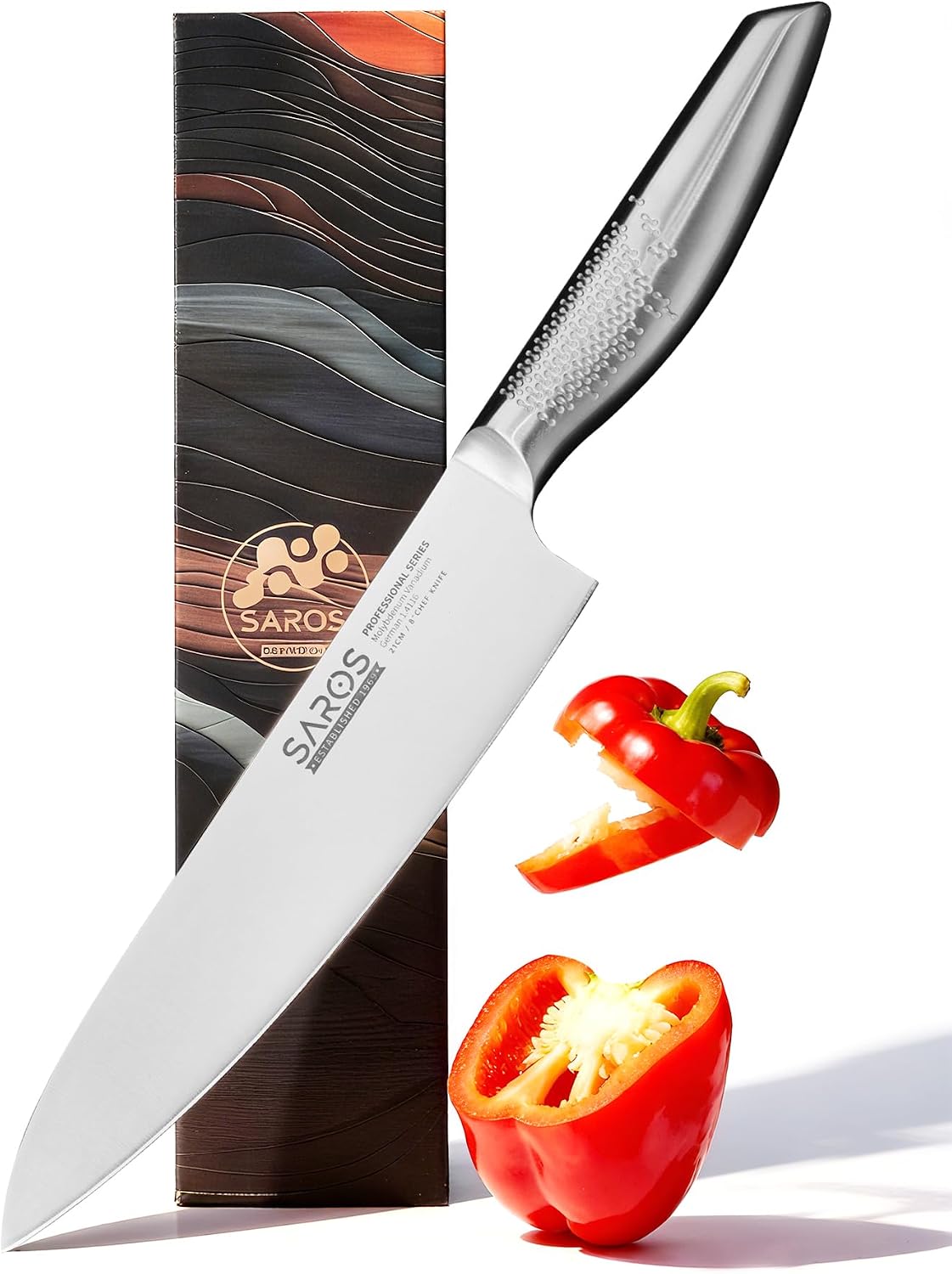
The blade: 8 Inch Japanese Kitchen Knife, Professional Gyuto Chef Knife (Gift Box)
 Visit on Amazon →
The 8-inch gyuto is the one shape I would keep if someone made me empty the drawer. Long enough to take down a whole cabbage, short enough to break down a chicken, thin behind the edge so it goes through an onion instead of wedging it apart. If you only ever own one serious knife, this is the profile.
It arrives in a gift box, which matters less to you than to the person you hand it to at a wedding or a housewarming. Check current Amazon price before you decide, because the gap between a stamped supermarket knife and a proper gyuto is smaller than most people assume.
Flaws but not dealbreakers: A thin, hard blade is not a cleaver. Do not take it to frozen food, chicken backs, or squash stems, and never put it in a dishwasher. If your cooking involves hacking through bones, you want a heavier German-style knife and you should accept the trade in sharpness. This one also has no business sitting wet on a cutting board. Wipe it, dry it, hang it. That is the whole maintenance tax.
Anyone who cooks four or more nights a week and is tired of crushing herbs with a dull blade will feel the difference in the first meal.
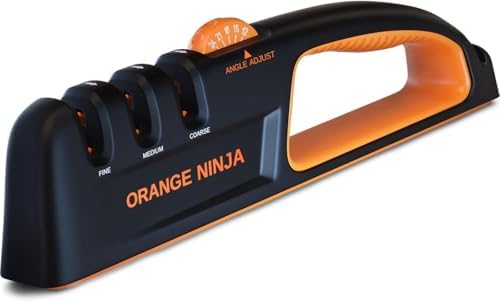
The maintenance habit: 5 Precision Adjust Knife Sharpener- 3-Stage Premium Kitchen Knife Sharpener
 Visit on Amazon →
The tool that keeps the habit alive is the one sitting on the counter, not the one in a box in the garage. That is the case for a three-stage unit. You pull the knife through a few strokes and you are done in under a minute, which means you will actually do it instead of planning to do it someday.
The adjustable angle is the part that matters for a gyuto. Japanese blades typically run a shallower bevel than European knives, and a sharpener that forces one fixed angle will slowly reshape your edge into something the knife was never designed to hold. Being able to match the existing bevel is the difference between maintaining a knife and grinding it into a different one.
A three-stage unit typically gives you an aggressive setting, a middle setting, and a fine setting. On a thin gyuto you will live on the fine setting, dropping to the coarser stages only when the knife is genuinely dull rather than just tired. Check current Amazon price and weigh it against one professional sharpening in your town, which you will need roughly once a year if you ignore this routine entirely.
Flaws but not dealbreakers: Every pull-through sharpener removes steel, and a coarse slot removes it quickly. Use it weekly on a thin blade and you will shorten that blade's life by years. Keep it on the fine setting and use it as maintenance, not as surgery. It also will not teach you what a burr feels like, which is the one skill that separates a stone sharpener from everyone else.
And to be clear about one thing people get wrong constantly: a honing steel is not a sharpener. It realigns an edge that has rolled over. You need both, and they do different jobs.
The actual sharpening workflow
Now the part you came for. This works on any gyuto, and on any decent Western chef's knife too.
Step one: Test the edge before you touch anything. Run the blade through a sheet of newsprint, not a paper towel. If it slices cleanly with no tearing, stop. You do not need to sharpen a sharp knife, and over-sharpening is how people turn an 8-inch gyuto into a 6-inch gyuto over five years.
Step two: Match the angle, do not invent one. Lay the blade flat on the surface, lift the spine until you feel the existing bevel sit down. On a gyuto that is a shallow lift. If you guess and guess differently every week, you are rounding the edge instead of refining it.
Step three: Start fine, drop coarse only when you must. If the knife still cuts a tomato, stay on the fine setting. Reach for the aggressive stage only when the knife smashes instead of slices, or when you can see a flat spot catch the light along the edge.
Step four: Count your strokes. Five to ten passes per side, alternating, and stop. The most common mistake is thirty strokes because it feels productive. It is not. It is metal you are never getting back.
Step five: Kill the burr. This is the step everyone skips and then blames the knife. After sharpening, a thin wire of steel hangs off the edge. Run the blade through the edge of a cork or a piece of soft wood a few times, or make a few very light passes on the fine stage, then test again. A knife with a burr feels sharp for one tomato and dull for the rest of the week.
Step six: Realign weekly with a steel. Two or three light strokes per side at the same angle, before you cook, not after. This is the habit that keeps you off the sharpener for months.
Step seven: Dry the knife before it goes anywhere. Not a wipe with a damp towel. Dry steel. A gyuto left damp on a board is a gyuto with a spot on it by morning.
Step eight: Store it off the block. Magnetic strip or a blade guard, edge protected. A slot-style block that grips the edge dulls the blade every time you slide it in, and you will not notice until the knife stops cutting.
Step nine: Run the morning test. Newsprint, once a day, before coffee. It takes four seconds and it tells you more about your edge than any gadget.
Mistakes that kill a thin blade
Using it on frozen food, bones, or squash stems. A gyuto is a precision tool, not a demolition tool, and the chip you put in it will take a stone session to remove.
The dishwasher. Heat, detergent, and rattling against other utensils. Nothing good happens in there.
Weekly trips to the coarse slot. See step three. If you find yourself reaching for the aggressive stage every week, you have a storage or honing problem, not a sharpening problem.
Changing the angle every session. Pick the bevel and stay with it.
Sharpening when the knife is not dull. This is the one that quietly costs you the most blade life over a decade.
The competition and why it lost
The single-slot carbide pull-through sharpeners you see for a few dollars at hardware stores are the reason people think pull-through sharpeners ruin knives. They do, when they are the only tool you own and you use them every week. A staged unit with a fine setting is a different animal.
Three-wheel electric sharpeners are faster and remove more steel per session than anything else on the market. Great for a $20 beater, wrong for a thin Japanese blade you plan to keep.
Full whetstone progressions are the best answer for hard, expensive steel and the worst answer for a beginner who will not practice. If you want to learn the skill, buy a 1,000-grit stone and a cheap knife to learn on. Do not learn on your good gyuto.
A honing steel on its own is not a sharpening solution. It is half of one.
And on the knife side: heavy full-bolster European knives will outlive you, but they will not cut like a gyuto, and if you already own one, the routine above still applies. You will just be touching up a thicker edge, which takes more strokes.
What this all costs
Two tools and one habit. That is the entire investment. Check current Amazon price on both and compare it to what a professional sharpening costs where you live, then remember that a sharpening service is a once-a-year fix while this routine is a permanent one.
The math is the easy part. The hard part is the three minutes on a Sunday when the knife already feels fine and you would rather not bother. Do it anyway, and the knife you bought this year is the knife you are still using in ten.
That is the job. Your blade was built to hold an edge. Give it the chance.