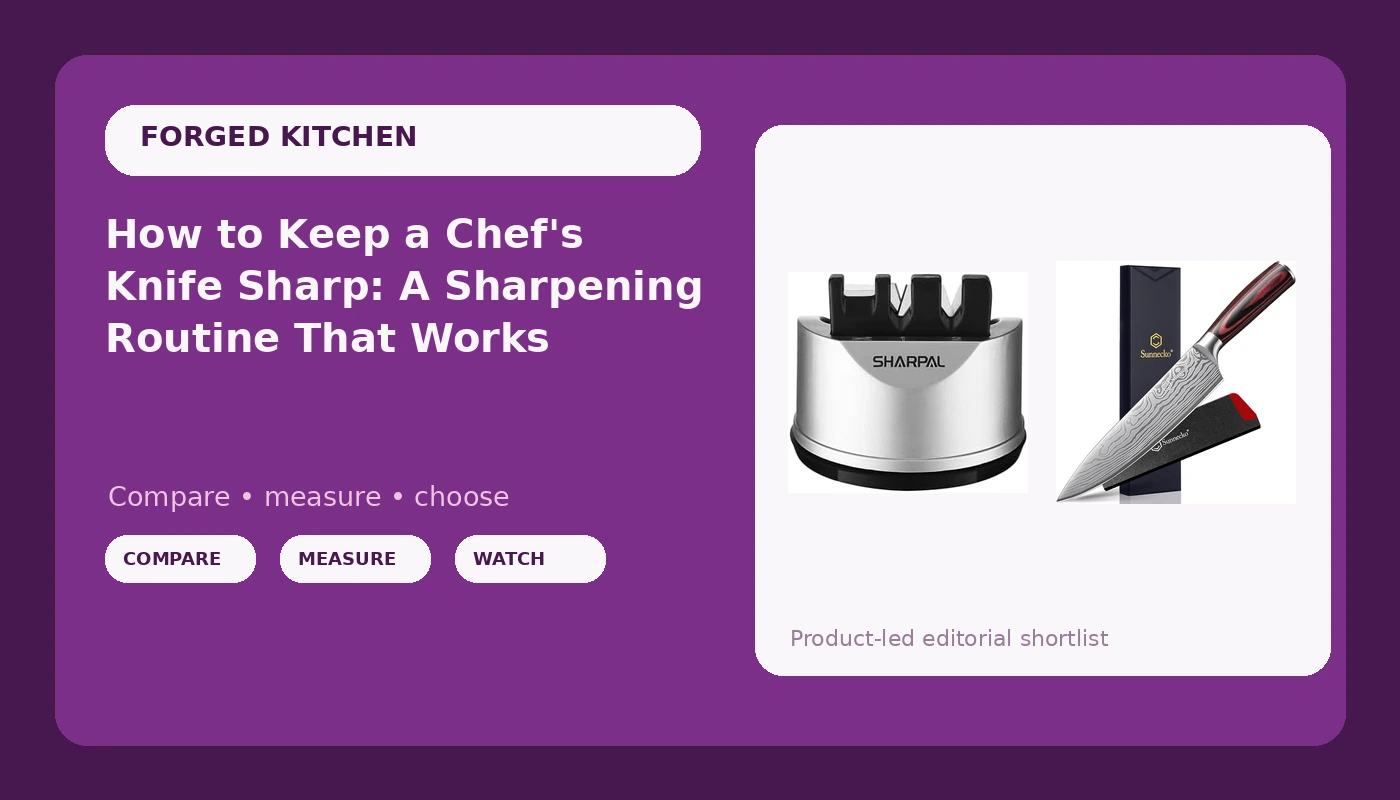
A dull knife is a confession. An old butcher said that to me the first week I worked his counter, and sixteen years later I still have not found a shorter way to put it. When your blade skids across a ripe tomato instead of biting in, nothing about the tomato is at fault. You have a maintenance gap, and it is the most common thing wrong with the home kitchens I walk into.
What follows is the chef knife sharpening routine I have run since my line cook days: five minutes a week, one knife, one sharpener, and a few habits that matter more than the gear. I have sharpened thousands of blades, from twenty dollar stamped knives to four hundred dollar Japanese gyutos, and the pattern never changes. The people with sharp knives are not the people with expensive knives. They are the people who sharpen on a schedule.
You need two things to start. A chef's knife worth maintaining, and a way to put an edge back on it. That is the entire list. Everything else in a knife block is garnish.
Why you should trust me
I cooked for sixteen years. Six of those were on the line in fine dining, four were running a butcher shop, and the rest were every station in between. I keep a 1,000 grit stone on the bench in my shop in Bend, Oregon, where I test knives and knife sets the way a kitchen actually uses them: prep work, a service rush, and the sharpness test I run every morning before I cook anything.
Two rules I do not break. I will not tell you a knife stays sharp without running it through a full prep shift, and I will not talk about a knife without telling you how to sharpen it. That second rule is why this article has two products in it instead of ten. Links here earn a small commission, which pays for stones and vegetables and does not change a single recommendation.
How I picked and how I tested
This is a how-to, not a shootout, so the standard is different. I am not asking you to buy the best knife on the market. I am asking you to own one knife you can keep sharp and one tool that puts an edge back on it, then skip everything else until those two things are habits.
The test any knife has to pass in my kitchen, whether it costs a little or a lot:
- Does it hold an edge through a full prep shift, or go soft halfway through an onion pile?
- Is the handle comfortable after two hundred cuts, not two?
- Can I sharpen it without fighting a bolster or hunting for the bevel?
- Would I reach for it on a busy Saturday service?
For a sharpener, the questions are narrower: does it leave a consistent bevel, does it eat more steel than it needs to, and does it handle the other dull things in the drawer, because kitchen shears go dull too and almost nobody sharpens them.
The two tools below are what I would hand a home cook who has never sharpened anything. Neither is the last knife you will ever buy. Both are honest starting points, and both are cheap enough that what you save goes toward the stone you will eventually want.
The two tools to start with
One knife, one sharpener. If you already own a chef's knife you like, skip ahead to the sharpener and then go straight to the routine. If your current knife is a serrated thing from a set, start with the knife.
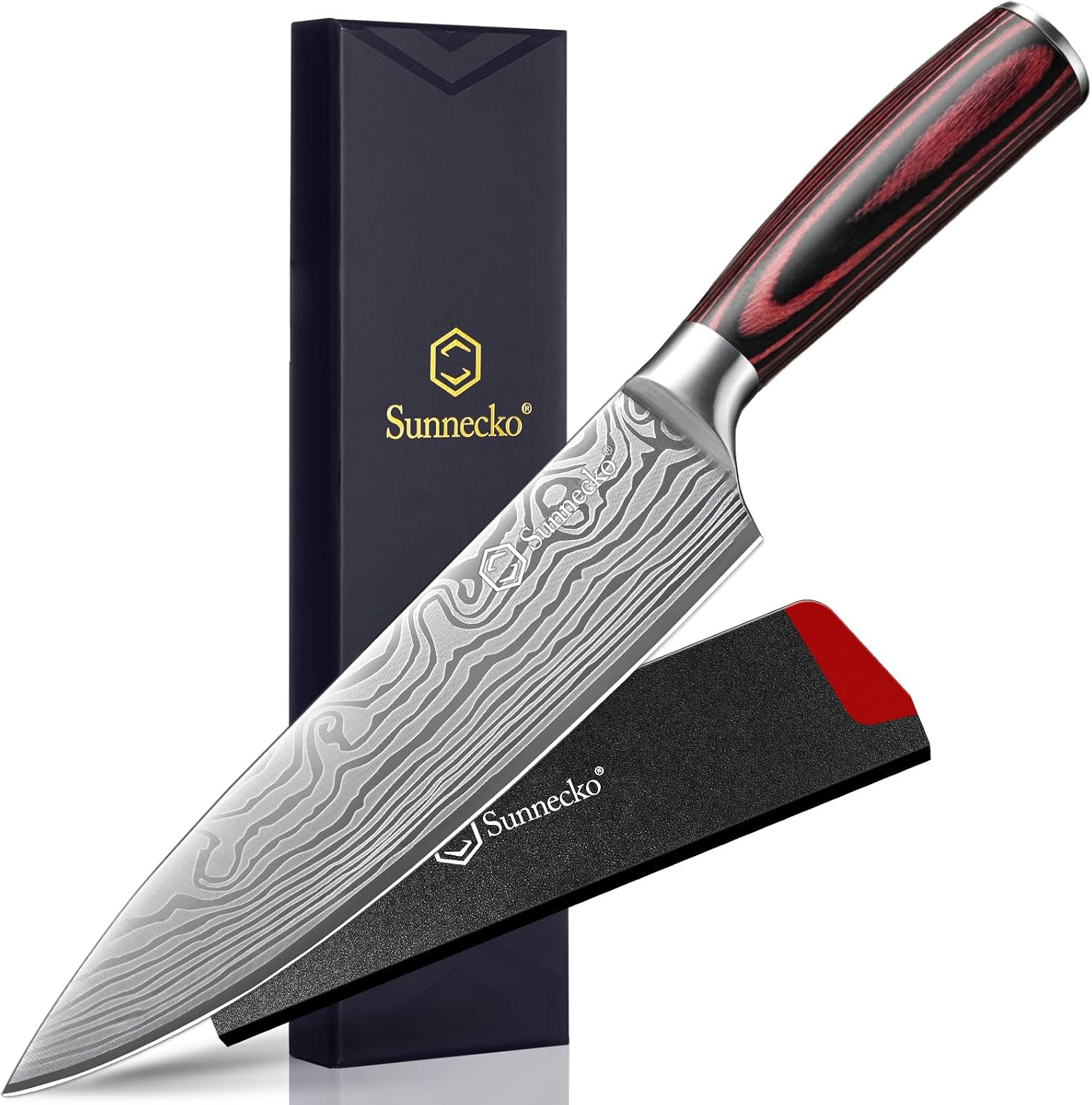
The knife: Sunnecko 8 Inch Chef Knife - Ultra Sharp Vegetable Kitchen Knife
 Visit on Amazon →
An eight inch chef's knife is the right size for almost every hand. Long enough to break down a head of cabbage, short enough that you still control the tip on a shallot, and if you only ever own one blade, this is the shape to own. The Sunnecko is built around a thin, vegetable-forward profile, which is exactly what you want for onions, peppers, carrots, and herbs. Thin geometry cuts with less effort, and less effort means better knife skills faster, because you are not muscling through every cut.
This sits at the entry end of the market, and that matters for a different reason: it is the knife you learn to sharpen on. What to check the day it arrives: hold the handle and look for any gap where it meets the blade, flex the spine lightly and make sure nothing shifts, then sight down the edge to confirm the tip lines up with the heel. A straight knife sharpens predictably. A bent one fights you forever. Then cut an onion. If it bites without crushing, you have a working knife.
Where it will let you down is bones, frozen anything, and the twisting you do when you are in a hurry and pry instead of cut. A thin blade rewards a light hand and punishes a heavy one. Treat it as your vegetable knife first and your everything knife second, and it will hold up.
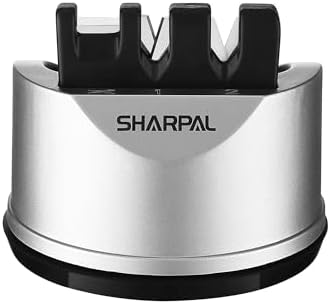
The sharpener: SHARPAL 191H Knife Scissors Sharpener
 Visit on Amazon →
Here is where I have to be straight with you, because I have spent years telling people that a pull-through sharpener is not the answer. It is not the best edge you will ever get. It removes steel fast, it fixes the angle for you, and it leaves an edge that is toothy rather than polished. On a hard Japanese blade, that is the wrong tool and I will not pretend otherwise.
On a knife at the entry end of the market, and on kitchen shears, it is exactly right. That is the honest case for the SHARPAL 191H. It sharpens knives and scissors in the same small unit, which solves the two dullest objects in most kitchens, and the fixed slots take the guesswork out of the angle for someone who has never sharpened anything in their life. A beginner who uses this every few weeks cooks with a sharper knife than the person who owns a two hundred dollar gyuto and never touches it.
Use it when the edge stops coming back with a honing steel, not every day. Three to five light passes per side is plenty. If you find yourself leaning into it, you are grinding, not sharpening, and you are taking years off the blade. Keep it for the knives it suits. When you eventually buy a hard, thin Japanese knife, that one goes on a stone.
The chef knife sharpening routine, step by step
Five minutes a week. That is the whole commitment, and it is less time than you spend waiting for water to boil.
Step one: hone before you cut, not after. A honing steel is not a sharpener. It realigns an edge that is already there, which is why it works wonders for a week and does nothing at all once the edge is genuinely gone. Five or six light passes per side, blade drawn down and across the steel at roughly the angle you sharpen at, alternating sides, no pressure. If you can hear a scrape, you are pushing too hard.
Step two: sharpen on a schedule, not on a feeling. Once every four to eight weeks for a home cook who cooks most nights. Every two weeks if you cook like I do. Mark it on a calendar if you have to. People who complain that their knife "went dull" are usually people who never sharpened it, only honed it, for two years.
Step three: find your angle and keep it. Western knives want about twenty degrees per side. Japanese knives want closer to fifteen. If you are eyeballing it, two stacked coins under the spine gets you in the neighborhood. With the SHARPAL, the slot sets the angle, so your job is to hold the blade level and draw it through without rocking.
Step four: three to five passes, then test. Light pressure, equal passes on both sides. Then the paper test: hold a sheet of printer paper by the corner and push the blade down through it. A sharp knife glides. A dull one tears and catches. My morning test is a ripe tomato, because a tomato tells the truth that paper sometimes hides.
Step five: stop when it is sharp. This is the step nobody follows. More passes do not make it sharper, they make it smaller. When it cuts paper cleanly, put the tool down.
Step six: wash by hand, dry immediately, never use the dishwasher. Heat, moisture, and detergent are three separate ways to ruin a knife, and the dishwasher delivers all three at once. Dry the blade, the spine, and the spot where the handle meets the steel, because that is where rust starts.
Step seven: store it off the edge. A magnetic strip on the wall or an edge guard in a drawer. Knife blocks that hold blades by the edge dull them every time you pull one out, which is a slow, stupid way to lose an edge you paid for.
Step eight: repeat. Sharpness is a habit, not a purchase. The best knife in the world goes dull, and a modest knife with weekly honing and monthly sharpening will out-cut it in any kitchen in America.
Where most people get it wrong
They think a steel sharpens. It realigns. You need a steel and an abrasive, or a sharpener that does the abrasive part for you.
They run a pull-through every day. That is a steel's job. Daily passes on carbide chew through a blade in a year. Every few weeks is the right cadence.
They cut on glass, ceramic, or stone. Those surfaces are harder than your edge and they win every time. End grain wood or a quality plastic board, nothing else.
They sharpen the wrong side of a serrated knife. Serrated blades get sharpened on the flat side with a rod, one light pass per tooth. Almost nobody does it, which is why bread knives in most kitchens saw instead of slice.
They buy a fifteen piece set instead of one knife and a sharpener. A set is a block, four steak knives, and a bread knife that cannot slice bread. Your chef's knife does eighty percent of the work. Spend your money there.
What this costs, and what it saves
I am not going to quote you prices, because they move and because the math is not really about the purchase. It is about the replacement. A dull knife leads to a heavy hand. A heavy hand leads to a crushed tomato, a slipped blade, and a cut. The most expensive knife in your kitchen is the dull one, and that cost shows up as a trip to urgent care rather than a line on a receipt.
Check current Amazon price on both of these and compare it to one professional sharpening, which is a per-knife charge, or to one decent whetstone, which costs more than a manual sharpener and comes with a learning curve attached. The honest sequence: buy the knife and the sharpener, learn the routine, then decide whether you want the stone. Most home cooks never need it. Some of us fall in love with the process, and that is how you end up with a 1,000 grit stone and opinions about slurry.
The short version
- One chef's knife, eight inches, thin blade, comfortable handle.
- One sharpener that also handles your kitchen shears.
- Hone weekly. Sharpen every four to eight weeks.
- Test the edge on paper, or on a tomato, before you trust it.
- Hand wash, dry immediately, store off the edge, skip the dishwasher forever.
That is the routine. Five minutes a week, two tools, and a knife that bites instead of skidding. Do it once and you will never go back to sawing through an onion with a blade that should have been sharpened a month ago.