A knife sharpening setup is not one purchase. It is three separate jobs that get mistaken for each other constantly: the knife that does the cutting, the tool that holds the edge between full sharpenings, and the abrasive that rebuilds the edge once maintenance stops being enough. Then there is a fourth job almost nobody plans for, which is keeping the abrasive itself flat so it keeps cutting. Buy these in the wrong order and you end up with tools that fight each other. Buy them in the right order and a modest set of knives will outlast most of what sits on a kitchen store display wall.
I have spent sixteen years on the line and behind a butcher counter, and the same conversation happens every week. Someone buys a knife set, uses it hard for two months, decides the knives are junk, and buys another set. The knives were rarely the problem. The missing pieces were the stone and the habit.
Related: Honing Steel vs Whetstone: What Each Tool Actually Does →
Quick answer
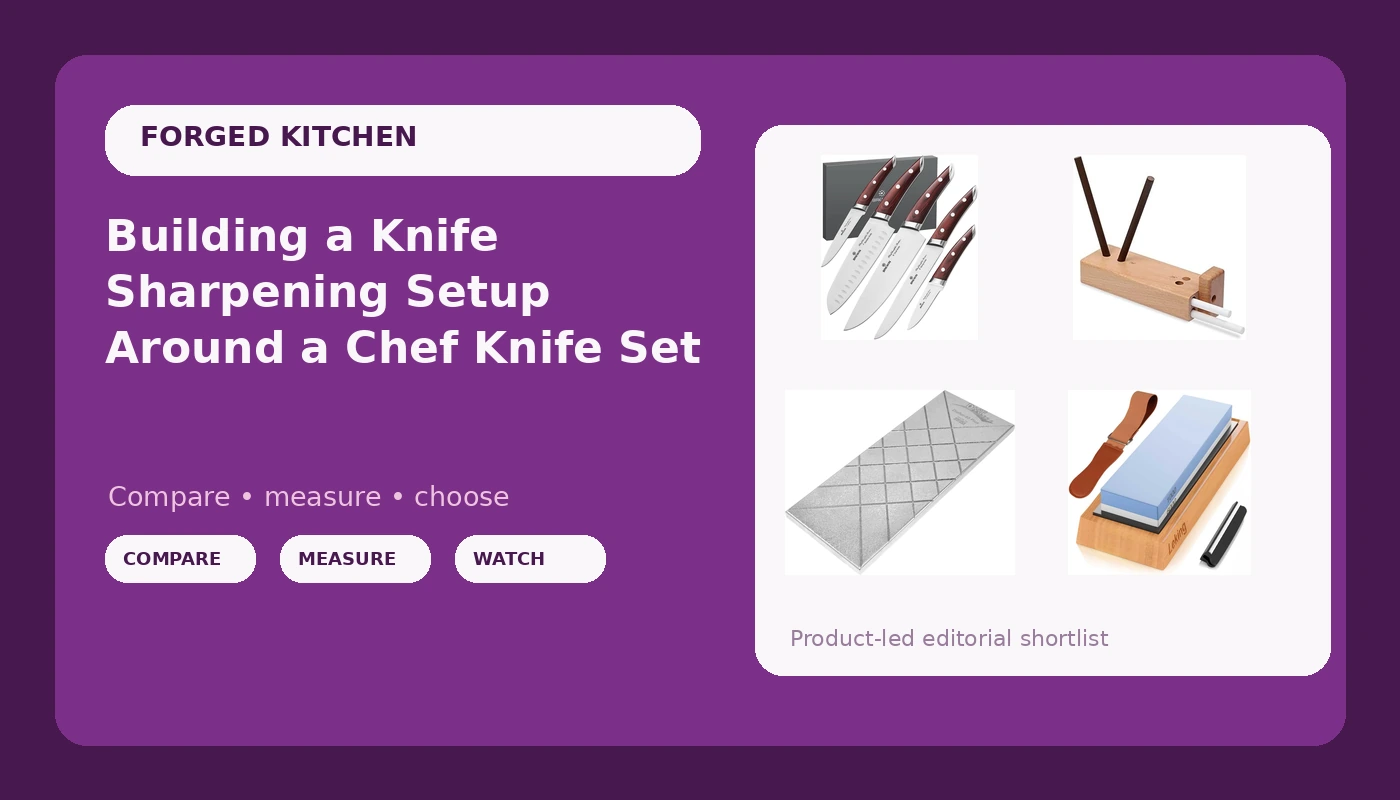
Four items cover the full cycle. The Brewin CHEFILOSOPHI chef knife set does the cutting, the 4-rod ceramic sharpener box handles fast touch-ups, the dual-sided 1000/6000 whetstone does the actual sharpening, and the DMT diamond lapping plate keeps that whetstone flat. If you are buying in stages, start with the knife set and the whetstone. The ceramic box and the lapping plate are support tools you add once you notice you need them. None of these replaces another, and none of them replaces learning to hold a consistent angle.
4 useful options
| Model | Best fit | What stands out |
|---|---|---|
| Brewin CHEFILOSOPHI Japanese Chef Knife Set 5 PCS with Elegant Red Pakkawood Handle Ergonomic Design, Professional Ultra Sharp Kitchen Knives for Cooking High Carbon Stainless Steel | A first complete set of knives | Five pieces, red pakkawood handles, high carbon stainless steel |
| 4-Rod Ceramic Sharpener Box for Kitchen Knives and Cutlery Sharpening Tool | Fast touch-ups between sharpenings | Four ceramic rods held in a box housing |
| DMT DIAFLAT-95-PLUS Diamond Lapping Plate, 95 Micron Flattening Stone for Water, Oil & Arkansas Stones, 0.0005” Precision Whetstone Flattening Stone with Durable Hardcoat Technology, 10"L x 4"W | Keeping a whetstone flat | 95 micron diamond surface on a 10 by 4 inch plate |
| Knife Sharpener & Sharpening Stone Set: 1000/6000 Grit Dual-Sided Whetstone | Learning to sharpen on stone | Two grits on one stone, 1000 for the edge and 6000 for refinement |
The knife set: Brewin CHEFILOSOPHI Japanese Chef Knife Set 5 PCS with Elegant Red Pakkawood Handle Ergonomic Design, Professional Ultra Sharp Kitchen Knives for Cooking High Carbon Stainless Steel
A set in this shape lives or dies on the piece you reach for forty times a shift. In a five piece set that is the chef's knife, and everything else is garnish. Two things are worth checking on any set before you commit: whether the tang runs the length of the handle and is pinned rather than glued into a hollow shell, and whether the blade gives you enough heel height to rock through a pile of herbs without your knuckles hitting the board. High carbon stainless is a middle path. It takes an edge more readily than the softest German steel, and it forgives a missed drying better than a very hard Japanese blade. That forgiveness matters in a set that more than one person will use.
The quick touch-up: 4-Rod Ceramic Sharpener Box for Kitchen Knives and Cutlery Sharpening Tool
Ceramic rods are an abrasive, not a magic wand. You draw the blade through them and they remove a thin sliver of steel while nudging a slightly rolled edge back toward straight. That is genuinely useful, and it is also easy to overdo. Twenty passes a day on ceramic will eat a blade faster than most people expect. The right rhythm is a few light passes when a tomato starts to squish instead of slice, and a real session on a stone when those passes stop helping. What you want to avoid is the carbide style pull-through that gouges a deep groove into the edge, because that groove has to be ground out later.
The stone keeper: DMT DIAFLAT-95-PLUS Diamond Lapping Plate, 95 Micron Flattening Stone for Water, Oil & Arkansas Stones, 0.0005” Precision Whetstone Flattening Stone with Durable Hardcoat Technology, 10"L x 4"W
Every stone dishes. The middle wears faster than the edges because that is where you sharpen, and a dished stone quietly changes the angle you are holding without telling you. A knife sharpened on a hollow stone gets a convex, rounded edge that feels sharp for a day and then does not. The check is simple: lay a straightedge across the stone and look for daylight underneath, or draw a pencil grid on a dry stone, lap it, and see which squares survive. This plate is the specialist purchase on the list, and it is the one most home cooks skip for years. If you own water, oil, or Arkansas stones and they have gone concave, it is the fix.
The sharpening stone: Knife Sharpener & Sharpening Stone Set: 1000/6000 Grit Dual-Sided Whetstone
This is the item that actually changes what your knives can do. A 1000 grit face is coarse enough to raise a burr on a neglected blade and fine enough to leave a clean, toothy working edge. The 6000 grit face is a refinement step, and it is optional for most home kitchens. Here is the part people get wrong: a fine stone does not make a dull knife sharp. If you skip the 1000 grit work and go straight to the polish, you are polishing a rounded edge and wondering why nothing changed. Soak a water stone until the bubbles stop, keep it wet while you work, and let it dry slowly rather than sealed in a plastic tub.
Prices and availability may change. Product images, names, and retailer links are matched to verified listings. No current price, rating, stock status, or measured result is stated here without current evidence.
What "sharp" actually means at the edge
Sharpness is geometry, not a brand. A blade is two bevels meeting at a line so thin it disappears under anything but magnification. That line is the apex. It cuts when the apex is narrow and continuous, and it stops cutting for one of two reasons: the apex has worn away into a rounded shoulder, or it has folded and rolled to one side. Those are different problems with different fixes. A rolled edge responds to a honing steel or a few light passes on ceramic, because you are pushing steel back into alignment. A worn apex does not respond to either. It needs abrasive and it needs the bevel reset.
This is why the "sharpness is a maintenance habit" line is not motivational filler. A knife that cuts well is a knife that gets touched up on a schedule, and the schedule depends on what you cut. Breaking down chickens and cutting on glass boards punish an edge. Slicing vegetables on end grain wood barely touches it. Hardness plays into this too. Higher on the Rockwell scale means the edge resists rolling longer, but the steel also becomes more brittle, so a hard thin blade can chip on a bone or a frozen item where a softer one would simply roll. There is no free lunch, only a trade you pick on purpose.
Why grit numbers are not a ranking
Grit describes abrasive particle size, and lower numbers mean coarser particles. It is not a quality score, and a 6000 grit stone is not "better" than a 1000 grit stone any more than sandpaper is better than a saw. Coarse grits remove steel fast and leave scratches. Fine grits remove steel slowly and leave a polish. A full progression walks from coarse to fine, and a maintenance routine usually stays at the middle and skips the extremes entirely.
Two practical notes. First, grit scales are not universal. A Japanese Industrial Standards number and a European number for the same physical abrasive can look very different on the box, so comparing across brands by number alone will mislead you. Second, the flatness of the stone changes the angle you are cutting at far more than a jump from 1000 to 3000 does. That is why the lapping plate earns a place in this setup even though it never touches a knife.
- Count the knives you actually use in a normal week. If it is two, buy two good knives instead of a set with a block.
- Decide honestly who will maintain them. If the answer is nobody, a ceramic rod box is a realistic first step, not a compromise.
- Buy a stone in the 1000 grit range before you buy anything finer, because the working edge is the edge you use.
- Add the lapping plate the first time your stone stops cutting evenly across its full width.
- Replace tools, not technique. If a fresh edge dies within a week, the routine is the problem, not the steel.
Practical guidance for a home kitchen
- Dry blades by hand and keep them out of the dishwasher, which is where most knife sets quietly end.
- Store on a magnetic strip or in edge guards rather than dropping blades into a slot that dulls them on the way in.
- Hone before you cook, and sharpen when honing stops bringing the edge back.
- Soak a water stone until the bubbles stop, keep it wet while sharpening, and let it dry in open air.
- Flatten the stone every few sessions and check it with a straightedge, because a dished stone lies to your hands.
Which option should you choose?
Choose the Brewin CHEFILOSOPHI Japanese Chef Knife Set 5 PCS with Elegant Red Pakkawood Handle Ergonomic Design, Professional Ultra Sharp Kitchen Knives for Cooking High Carbon Stainless Steel when your drawer has nothing decent in it and you want one purchase that covers prep. Choose the 4-Rod Ceramic Sharpener Box for Kitchen Knives and Cutlery Sharpening Tool when you want a low-commitment way to keep an edge alive between real sharpenings. Choose the Knife Sharpener & Sharpening Stone Set: 1000/6000 Grit Dual-Sided Whetstone when you are ready to learn the actual skill and want a working grit and a refining grit on one stone. Choose the DMT DIAFLAT-95-PLUS Diamond Lapping Plate, 95 Micron Flattening Stone for Water, Oil & Arkansas Stones, 0.0005” Precision Whetstone Flattening Stone with Durable Hardcoat Technology, 10"L x 4"W when you already own water, oil, or Arkansas stones and want to keep them true.
One honest limitation applies to all of it. No listing tells you how a blade will feel in your hand, and handle fit is personal in a way that specifications cannot capture. Grit and micron numbers describe abrasives, not outcomes. The only result that matters is whether the edge still goes through a ripe tomato under its own weight after a normal week of cooking.
The bottom line
The set does the cutting, the stone does the sharpening, the ceramic box buys you time between sessions, and the lapping plate keeps the stone honest. That is the whole system, and the order matters more than the budget. Buy the knife set and the whetstone first, learn to hold a consistent angle on the 1000 grit face, and add the other two pieces when you can name the problem they solve. A sharp knife is not a purchase you make once. It is a habit you keep, and the tools above are simply the cheapest way to keep it.