Most kitchen knife storage is built to sell knives, not to keep them sharp. Walk into an average home kitchen and you will find the same scene: a handsome wood block on the counter, two empty slots, and a chef's knife that gets dragged across a honing steel every night but has not touched a stone in years.
The old butcher I worked under had a line for that. A dull knife is a confession. It tells everyone in the room that nobody has been paying attention, and nine times out of ten the storage did the damage long before the steel ever got a chance.
I have spent 16 years in professional kitchens, six of them on the line in fine dining and four running a butcher shop, and I have sharpened thousands of blades, from $20 stamped knives to $400 Japanese gyutos. Kitchen knife storage is the part nobody writes about, and it is where home cooks quietly lose their edge. A knife that rattles in a drawer, sits in a slot that pinches the blade, or lands in a sink full of plates loses more sharpness in a month than it does in a year of actual cutting.
The good news is that fixing it is a 20 minute project and not an expensive one. Get the blades off the counter, out of the drawer, and off each other, and you have solved most of the problem. Here is the setup I would build in any home kitchen, and the two pieces of gear that do the work.
Why you should trust me
I am Erik, I live in Bend, Oregon, and I have cooked for a living for 16 years. Six of those were on the line in fine dining, and four were behind the counter of a butcher shop, which is where I learned what a knife is actually for. I have sharpened more knives than most people will ever own, across every brand and every price point, and I keep a 1,000 grit stone on the bench and a honing steel within arm's reach of the board.
I have three rules for anything I recommend. No storage recommendation goes out without surviving a full prep shift, which in my world means 50 pounds of onions, carrots, and potatoes with a service rush on the other side. No claim about a knife staying sharp goes out without the 30 day morning test, which is a ripe tomato and a sheet of printer paper before the first coffee. And no knife conversation ends without a sharpening recommendation, because sharpness is a maintenance habit, not a purchase.
If a set or a strip cannot survive those rules, it does not make the list.
How I evaluate kitchen knife storage
Storage is not a display decision. It is an edge retention decision, and there are four questions I ask about any method before it earns wall or counter space.
First, does the cutting edge touch anything? On a magnetic strip, the blade lies flat against a magnet and the edge touches nothing but air. In a drawer, the edge touches other knives and the drawer bottom. In a block, the edge touches the slot, and some slots grip so tightly that every insertion rolls the edge a little more.
Second, can I grab it with wet hands during a rush? If the answer is no, the knife ends up in the sink instead, and the sink is where knives go to die.
Third, does it survive a bad day? A crowded drawer that works fine on a quiet Sunday is a drawer that chips a tip on Thanksgiving.
Fourth, does it fit the space I actually have? A wall strip needs about a foot of clear wall and 8 inches of clearance below it. A drawer tray needs a drawer deep enough to close with a chef's knife lying in it, which is a shorter list than people think.
Everything below gets measured against those four questions, and against the maintenance habit that has to come after.
The two pieces I would start with
You do not need a 15 piece set. A set is 80 percent chef's knife and the rest is garnish, and most of the big blocks under $100 are paying for four steak knives you will never use and a bread knife that cannot slice bread. What you need is one good daily knife, a couple of small ones, and somewhere to put them that does not grind the edge.
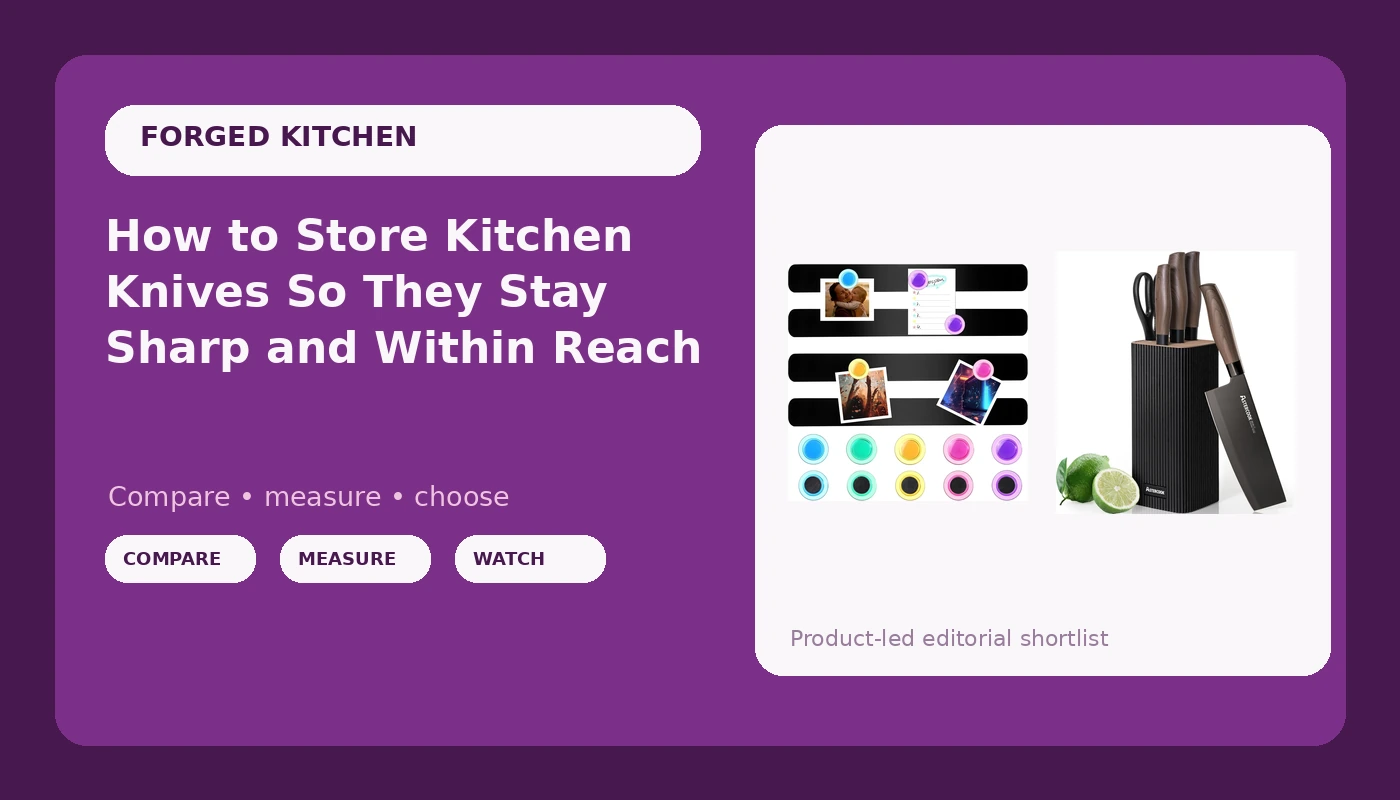
Daily knives: 4 Pcs Metal Magnetic Strips for Wall Adhesive Backing Memo Strip Black Bulletin Board with 10 Pcs Magnets for Home Office (26 x 300 mm)
 Visit on Amazon →
Four black strips, each 26 by 300 millimeters, with an adhesive backing and 10 small magnets in the box. The little magnets are for notes and photos, not for knives. The strip itself is the magnet, and that is the part that matters.
Here is the honest read. This is a memo strip, not a 12 inch knife magnet rated for a cleaver. At 300 millimeters, a paring knife, a utility knife, or a petty sits on it without drama. A full size chef's knife is longer and heavier than the strip, so the blade overhangs both ends and the hold depends entirely on how flat and how smooth your wall is. If you are mounting it over a counter where a dropped knife could land on a foot, put two screws into a stud and skip the adhesive entirely.
For a rental kitchen, a narrow apartment wall, or the side of a cabinet where the small knives live, this is the least expensive way to get blades off the counter and out of a drawer. Check current Amazon price.
Flaws but not dealbreakers: The adhesive backing is only as good as the paint it grabs, and a textured or freshly painted wall will let go. Give it the full cure time before you hang anything on it.
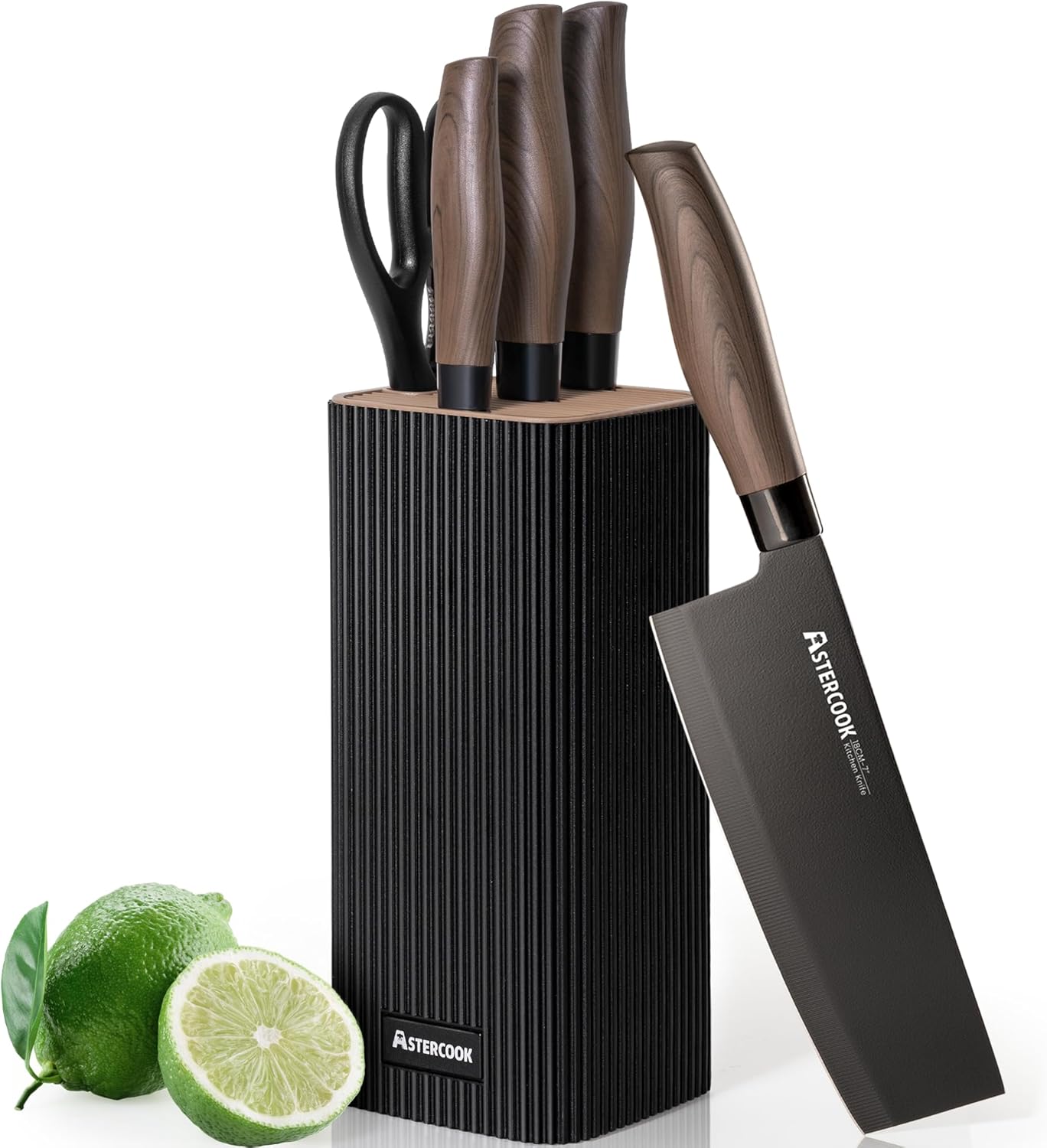
The starter set: Astercook Knife Set, 6-Piece Kitchen Knife Set with Block, High Carbon Stainless Steel Ultra Sharp Kitchen Knives, Wood Grain Handle, Dishwasher Safe Knife Block Set, Black, Kitchen Utility Knives
 Visit on Amazon →
Six pieces including the block: a chef's knife, a slicer, a utility knife, a paring knife, and the wood grain handled block they sit in, all in high carbon stainless with a black finish. The listing says dishwasher safe.
Read that as handle safe, not edge safe. Heat, detergent, and a blade banging against a dinner plate will roll an edge faster than any cutting board will. Hand wash it, dry it, and put it straight back. Dishwasher safe is a manufacturing tolerance, not a maintenance plan, and it is the fastest way to turn a working knife into a dull one.
The steel is stamped high carbon stainless, which is exactly what you want in a starter set. It will not hold an edge the way a forged German knife does, but it takes a fresh edge quickly on a 1,000 grit stone, and for a beginner that matters more. A knife you can sharpen in five minutes beats a knife you are afraid to touch.
Who this is for: a first apartment, a rental, a guest kitchen, a vacation house, or anyone who currently owns two dull knives and a bread knife that will not slice bread. Check current Amazon price.
Flaws but not dealbreakers: Stamped blades flex more than forged ones, so do not lean on it for splitting squash or hacking through chicken bones. Use the chef's knife for vegetables and proteins and let the block hold the rest.
How to mount a magnetic strip so it holds
Step one: pick the wall. You want a smooth, flat, painted surface at least a foot wide, with 8 inches of open space below the strip so you can lift a knife straight up and off. Keep it away from the stove, where grease and steam will coat the blades.
Step two: find the studs. If you are screwing it in, mark the studs first. If you are using the adhesive backing, skip this step but know the tradeoff: adhesive holds on paint and drywall paper, and screws hold on everything.
Step three: clean and degrease. Wipe the wall with rubbing alcohol and let it dry completely. Adhesive on dusty paint is adhesive on nothing.
Step four: level and mark. Use a level, not your eye. A strip that runs downhill looks like a mistake and puts uneven load on the mounting points.
Step five: mount it. Press the adhesive firmly across the whole length, or drive screws at both ends and the middle. Give the adhesive 24 to 72 hours to cure before you hang a single blade on it.
Step six: load it. Put the spine of the knife against the magnet and the cutting edge facing up, so the sharpened edge never contacts metal. Keep handles facing the same direction, and put the heaviest knife closest to a mounting point.
Step seven: test it. Press each knife gently toward the wall with the flat of your hand. If the strip flexes or the knife shifts, stop and add a screw.
How to load a knife and how to pull one off
Pull the knife straight away from the strip, then lift. Do not slide it sideways along the magnet, because sliding is how an edge gets rolled. When you put it back, set the spine against the strip first and let the blade settle, then release. If you have to fight the magnet to get the knife off, the strip is too strong for that blade and you should move the smaller knives there instead.
The first month with a new set
Wash it before the first cut. Factory oil and cardboard dust come off with warm water and dish soap. Dry it immediately, because high carbon stainless will spot if you leave it wet.
Hone weekly, sharpen monthly. A honing steel is a realignment tool, not a sharpener. Two or three light passes at the same angle keeps the edge straight between sharpenings. When honing stops helping, which for most home cooks is every four to eight weeks, it is time for the 1,000 grit stone.
Run the morning test. A ripe tomato or a sheet of printer paper, every morning for the first month. You are not testing the knife. You are building the habit of noticing when it changes, so you sharpen on your schedule instead of on a recipe's schedule.
Keep it out of the dishwasher. Every time. No exceptions, no matter what the box says.
What to do with the block in the box
The block is furniture, and it can be good furniture or bad furniture. Test it before you trust it. Slide a knife in, pull it out, and pay attention to what you feel. If the slot grips the spine and the blade hangs free, you are fine. If you feel the edge drag or catch on the way in or out, that block is dulling the knife every single day, and those knives should live on the strip instead. In my house the block holds the guest knives and the strip holds the ones I actually cook with.
The storage methods that lost
In-drawer trays are the next best option after a strip, but they need a deep drawer and they trap moisture if you put a knife away damp. Universal countertop blocks are hit or miss, because the slots are sized for nobody's knife in particular. Edge guards are fine for travel and useless at home, since a guarded knife still ends up in a drawer with everything else. Knife rolls are for cooks who carry their own tools to work. Sink racks are not storage, they are a hazard.
What this actually costs
The strip is the cheaper of the two pieces here, and it is the one that changes how you cook. Check current Amazon price on the strips, and Check current Amazon price on the set if you are starting from nothing.
The real math is not the purchase. It is the maintenance. A knife that lives on a wall strip and gets honed weekly needs a full sharpening every month or two. The same knife thrown in a drawer with a can opener and a pair of tongs needs sharpening every couple of weeks, and eventually it stops taking an edge at all. That is the cost of bad kitchen knife storage: not the money, but the blade.
Hang the knives you use. Block the ones you do not. Sharpen on a schedule, hone in between, and hand wash everything. That is the whole system, and it will outlast the knives.