Most knife blocks are sold by piece count, and piece count is the least useful number in a kitchen. Knowing how to choose a knife set really comes down to one question: which blade do you reach for at 6 p.m. on a Tuesday, when there is an onion, a chicken breast, and a sink full of dishes waiting?
I have spent 16 years in professional kitchens, six of them on the line in fine dining and four running a butcher shop. I have sharpened more knives than most people will own in a lifetime. The set that fails at home is almost never the set with bad steel. It is the set with too many pieces and no plan for keeping any of them sharp.
There are two honest answers for a home cook. Buy one good chef's knife and learn to maintain it, or buy a set that includes a sharpener so maintenance is built into the block. Everything else is marketing.
Why you should trust me
Sixteen years in kitchens taught me that a knife is a tool with a maintenance schedule, not a trophy. I keep a 1,000-grit stone on the counter and run the same sharpness test every morning: paper first, then a ripe tomato, then a hard look at the edge under a light. A knife that fails that test does not get used that day, and it gets fixed before it goes back into rotation.
I have sharpened thousands of blades across every brand you can name, from twenty-dollar stamped knives to four-hundred-dollar Japanese gyutos. I do not trust a "stays sharp" claim that has not survived a month of mornings, and I do not trust a set that cannot handle a full prep shift.
What I cannot do from here is put a knife in your hand. That is why this guide is about the decision and the habit, not about a score I invented.
Decide what you actually cut
Before you look at a single block, spend one week noticing your own cooking. Keep a scrap of paper on the counter and tally what you chop.
- Onions, garlic, peppers, carrots: a chef's knife or santoku does all of it.
- Whole chickens, racks of ribs, squash: you need weight and a stiff spine, or a cleaver.
- Bread: a serrated knife, and only if you actually bake or buy loaves.
- Steak at the table: steak knives, which is where most big sets pad their numbers.
Most home cooks do 80% of their work with one knife. If that is true for you, everything else in the block is garnish, and you should shop accordingly. A knife set is 80% chef's knife. The other pieces are there to fill slots.
The two honest answers
Path one: one good chef's knife, one small paring or petty knife, and a sharpening habit you actually keep. That is the whole set, and it costs less than a mediocre block.
Path two: a complete set with a built-in sharpener, for a household that wants everything in one purchase and will not learn a stone. This is a legitimate choice. It is not the choice I make, but it is honest, and it solves the real problem, which is dull knives.
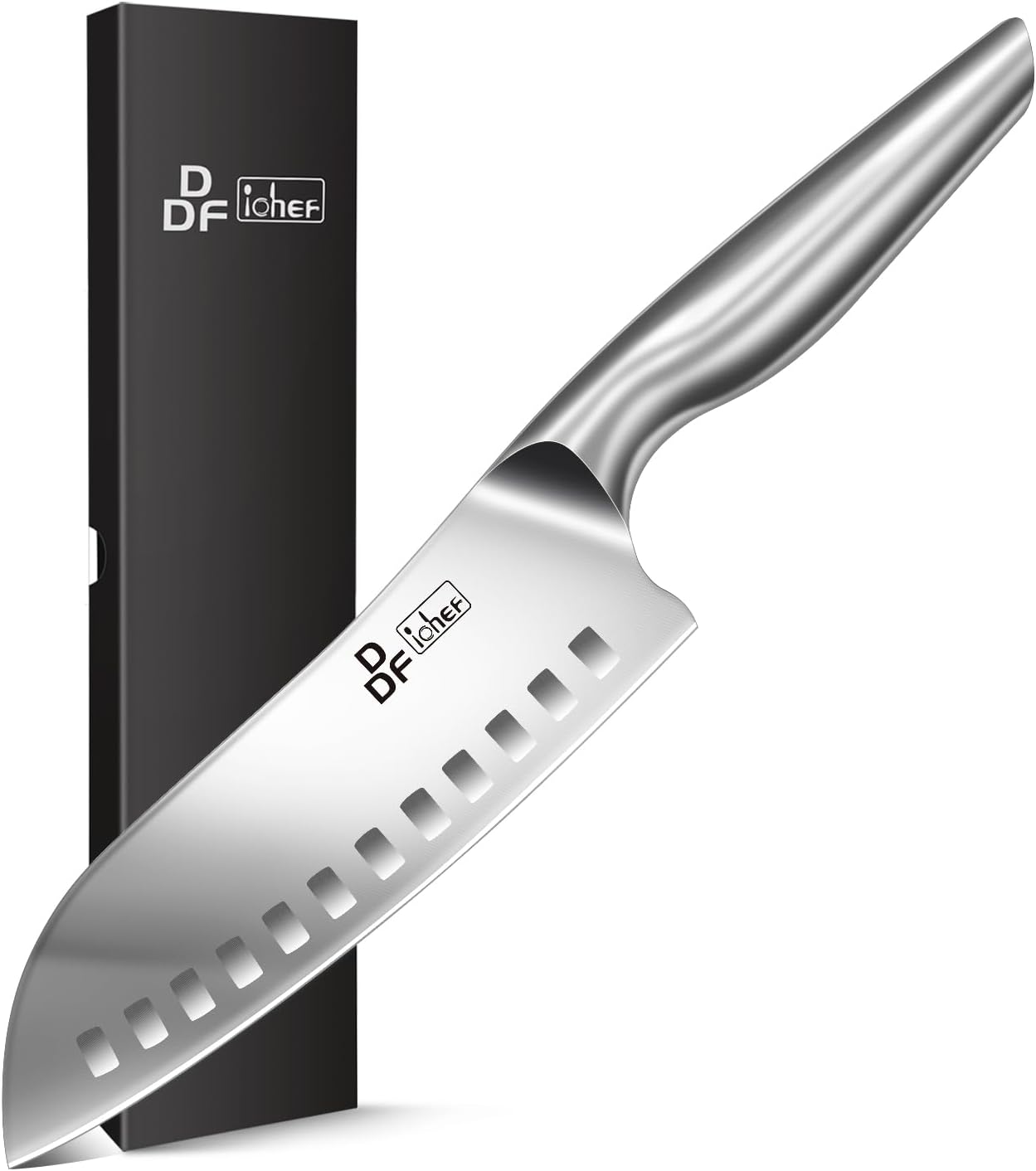
The workhorse: Chef Knife 7 Inch, High-Carbon Stainless Steel Santoku, Dishwasher Safe
 Visit on Amazon →
If you are buying one knife and one knife only, this is the profile to look for: a 7 inch santoku in high-carbon stainless steel. The santoku shape has a flatter belly and a taller blade than a Western chef's knife, which makes it forgiving for anyone who rock-chops nervously or pushes the blade straight down through an onion. Seven inches is the sweet spot for a home board. Eight inches feels long to a lot of people, six feels cramped the first time you break down a cabbage.
Two things to know before you commit. The maker lists it as dishwasher safe, and I would still hand wash it, every time. Heat, detergent, and the rattle of a rack against other dishes are how edges and handles die early. Thirty seconds at the sink is cheaper than replacing a knife.
The second thing is that this is one knife, not a set. You will still want a serrated blade if you cut bread, and you will still need a way to sharpen. Buy this plus a stone, or buy this and add the sharpener separately. What you should not do is buy this and assume the edge is forever. It is not.
Flaws but not dealbreakers: A single knife means a single point of failure. If it is dirty or dull, you have no backup, which is exactly how people end up hacking at a tomato with a steak knife.
Anyone who wants one blade that handles vegetables, proteins, and herbs without a learning curve should start here.
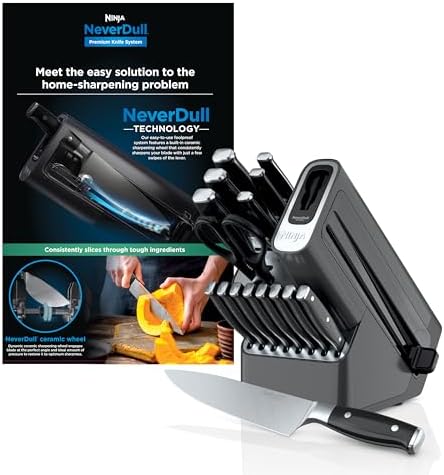
The set that solves maintenance: Ninja® NeverDull™ 17-Pc Knife Block Set, Built-in Sharpener, Black, K32017
 Visit on Amazon →
This is the second path, and the built-in sharpener is the entire reason it works. Every knife set I see fail in a home kitchen fails for one reason: nobody sharpens. A block with a sharpener in it turns maintenance into a two-second habit you cannot forget, and that matters more than any spec on the box.
Seventeen pieces is a lot, and I want you to read that number honestly. Count the steak knives and the pieces you will use once a year before you compare it to anything else. A big count is not a bad thing when the block and sharpener come with it, but you should know what you are buying.
The practical advice here is about placement. Keep the block on the counter where you prep, not in a drawer or a cabinet, because a set you have to fetch is a set you stop using. And whatever block you end up with, check that the slots hold the blade without grinding the edge on the way in. A block that dulls knives on insertion is worse than no block at all.
Flaws but not dealbreakers: Sets include pieces you may never touch, and those pieces take up counter space forever. If you already own a good chef's knife, this is a convenience purchase, not an upgrade.
Households where more than one person cooks, and where nobody wants to learn a whetstone, get the most out of this route.
How to choose a knife set, step by step
Step one: count your prep. Write down what you cut in a normal week. That list, not the showroom, decides how many knives you need. Two people who cook five nights a week need two knives, not seventeen.
Step two: pick the blade you will use most. For most people that is a 7 to 8 inch chef's knife or a santoku in the same length. Buy the best version of that one blade your budget allows, and treat everything else as secondary.
Step three: check the tang and the handle construction. Full tang means the steel runs the full length of the handle. That is the difference between a knife and a toy. Look for riveted scales and a handle that does not flex when you squeeze it.
Step four: understand the bolster before you pay for one. A bolster is the steel collar between the blade and the handle. It protects your fingers and adds balance, and it also makes stone sharpening harder, because the heel never quite touches the stone. A bolsterless knife is fine for a home cook if the handle geometry supports a safe pinch grip. What is not fine is a molded plastic handle with no tang being sold as professional.
Step five: match the steel to your habits, not the spec sheet. Harder steel takes a finer edge and holds it longer, and it chips if you hack through bones or frozen food. Softer German-style steel takes an edge faster, rolls instead of chipping, and forgives a honing steel. A thin, hard gyuto is a wonderful vegetable knife and a terrible bone knife. Be honest about what you cook.
Step six: decide how you will sharpen before you buy anything. A honing steel is not a sharpener. It is a realignment tool. If you will learn a stone, buy the knife you want. If you will not, buy a set with a built-in sharpener or a decent pull-through and accept the trade-off. Buying a beautiful knife with no sharpening plan is how good steel ends up in a drawer.
Step seven: get the handle into your hand if you can. Pinch grip, thumb and index finger on the blade, three fingers wrapped on the handle. If the knife feels tail-heavy, or the handle is too fat for your hand, you will reach for something else. Shopping online, buy from a seller with an easy return policy and return it if the balance is wrong.
Step eight: subtract the filler before you compare. Count the steak knives, the shears, the "boning" knife you will use twice a year. Compare sets on the pieces you will actually pick up, and the numbers get a lot clearer.
How to keep it sharp, the part nobody sells you
Sharpness is a maintenance habit, not a purchase. The best knife in the world goes dull.
Hone weekly. Five or six passes per side on a honing steel, light pressure, before you start cooking. This straightens a rolled edge and buys you time.
Sharpen on a schedule. For a home cook, a 1,000-grit stone every few weeks of regular cooking is plenty. You will know it is time when the blade slides off a tomato skin instead of biting in.
Run a test. Paper first, then a ripe tomato. If the knife cannot start a cut on its own weight, it is dull, and no amount of honing will fix a genuinely dull edge.
Wash and dry by hand. Even when a listing says dishwasher safe, the rack is where edges chip and handles crack. Dry immediately, because standing water is what pits steel.
Store it off the edge. A magnetic strip, a blade guard, or a block that holds the spine and not the edge. Knives rattling against each other in a drawer is the fastest way to undo a good sharpening session.
What to skip
Skip the giant cheap sets. When a set is padded with four steak knives and a bread knife that cannot slice bread, you are paying for a block and a slot count.
Skip bolsterless knives marketed as professional. Without a tang and a real handle, there is nothing professional about it.
Skip any block that grips the blade by the edge. Pulling a knife out of a slot that clamps the cutting edge dulls it a little every single day, and that adds up to a knife that never holds an edge no matter how often you sharpen.
Skip the idea that more pieces means more capability. A set is 80% chef's knife, and the other 20% is garnish.
What this all costs
The two paths cost very different amounts up front and roughly the same amount per year after that. A single knife plus a stone is the lowest total outlay and the highest ceiling, because you can keep upgrading your skill instead of your inventory. A full set with a built-in sharpener costs more once and asks almost nothing of you afterward.
Check current Amazon price on both paths before you decide, and do the math per year, not per purchase. Divide the up-front cost by the years you expect to keep the knife, and the difference between the cheap option and the right option usually shrinks to a rounding error.
The cost that actually matters is the replacement cost of a dull knife, which is a drawer full of blades you avoid. That is the expensive outcome.
The bottom line
If you will learn to sharpen, buy one 7 inch chef's knife or santoku and a 1,000-grit stone, and you are done. If you will not, buy the set with the built-in sharpener and keep the block on the counter where you prep.
Either way, buy fewer knives than you think you need, and sharpen them more often than feels necessary. That is the whole decision, and it is the only one that changes how your kitchen actually works.