Most people buy a kitchen knife set the way they buy a mattress: once, under pressure, with a salesperson talking. You walk past a wall of blocks, you pick the one with the most pieces and the shiniest box, and five years later you are still using the same two knives out of seventeen.
I have spent 16 years in professional kitchens, six of them on the line in fine dining and four running a butcher shop, and I have sharpened thousands of blades in that time, from twenty dollar stamped knives to four hundred dollar Japanese gyutos. Here is what that taught me: a kitchen knife set is not a collection. It is a chef's knife with accessories, and most of what fills the block exists to make the box look generous.
The two sets below sit at opposite ends of that reality. One is a block set that gets a home cook started with a full drawer of tools. The other is a butcher's roll for someone who actually breaks down meat. Both are legitimate purchases. Neither one replaces knowing what you are buying, which is what this guide is about.
Why you should trust me
I ran a butcher shop for four years and worked the line for six before that, and the habit that stuck is the morning sharpness test. Every knife I own or borrow gets used on a case of onions, a bag of carrots, and whatever protein is on the board that day, and then it gets honed and checked again the next morning. That is how I learned that most "razor sharp out of the box" claims have a shelf life of about two weeks in a real kitchen.
I own a 1,000 grit stone and I use it. I do not care what a knife looks like. I care whether it holds an edge through a full prep shift, whether the handle is still comfortable after 200 cuts, and whether I can sharpen the thing without fighting a steel collar. Those three questions have saved me more money than any sale ever has.
Right now I am working through 2026 knife sets one prep shift at a time, which is a slow way to do it and the only honest one. The criteria below come from that process, not from a spec sheet.
What I check before I recommend any set
Four things, in this order.
Full tang or nothing. The steel should run the full length of the handle. A handle held together by bolts and hope is a knife that will loosen up on you mid service, and no amount of tightening brings it back. This is the single fastest way to sort a real set from a display piece.
What the block actually does to the blade. A lot of blocks grip the edge in a slot that is too tight, which dulls a knife every time you put it away. If the knife slides in and out without dragging, the block is fine. If it scrapes, you are sharpening for the block's benefit instead of your own.
The handle in a wet hand. Fingers get slick with chicken fat and onion juice. A handle that feels great dry can turn into a bar of soap the moment you are breaking down a bird. Grip matters more than finish.
Whether the extra pieces are tools or padding. Four steak knives and a bread knife that cannot slice bread are not value. They are filler that pushed the piece count to a number that looks good on a box. Count the pieces you will touch in a normal week. That is your real set size.
Steel hardness matters too, but not the way marketing suggests. Harder steel holds an edge longer and chips more easily. Softer steel dulls faster and is far kinder to sharpen at home. There is no free lunch, only a trade you should make on purpose.
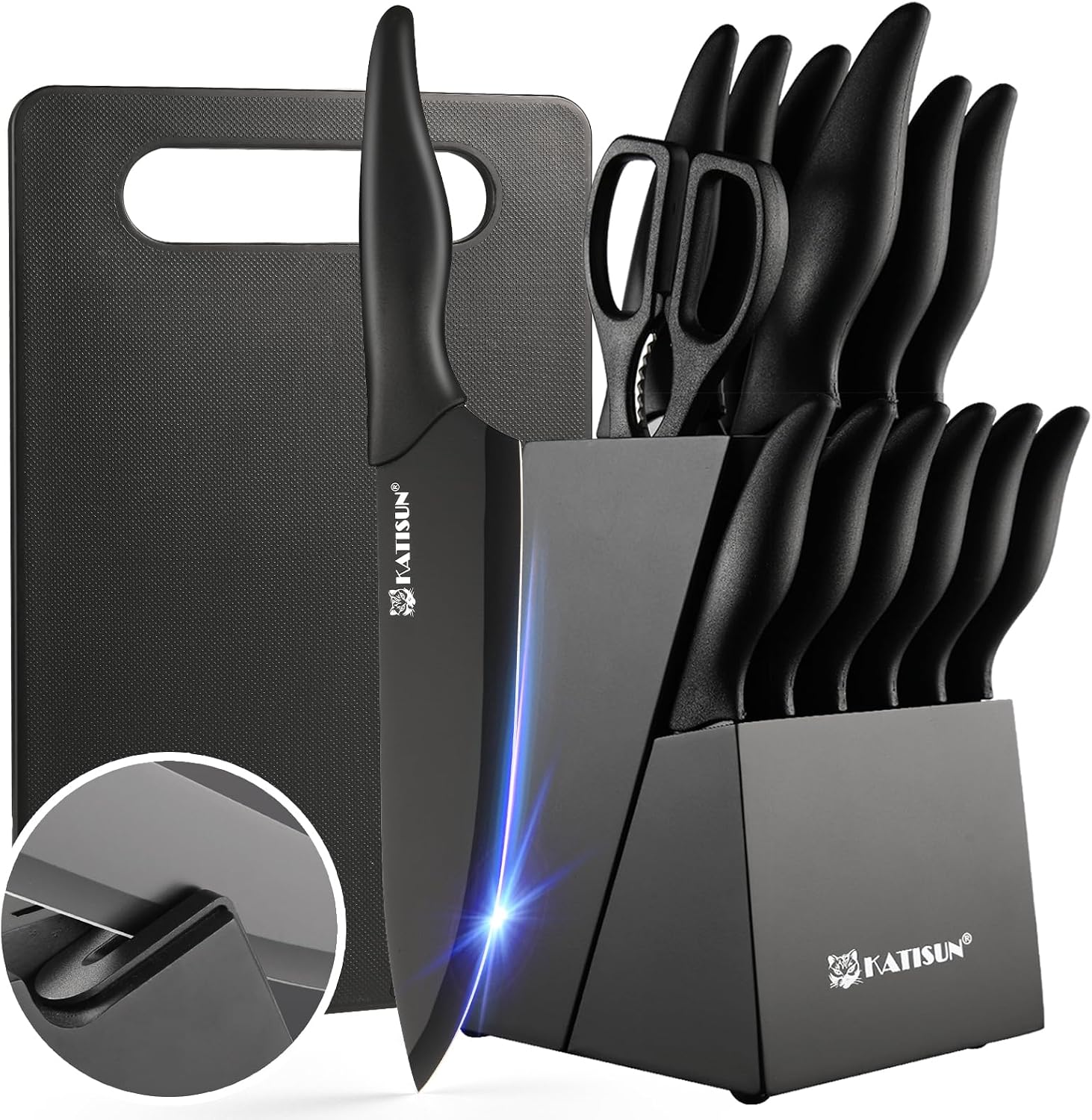
The entry-level block pick: 17-Piece Black German Steel Kitchen Knife Block Set
Check current Amazon price
This is the set I would point a first apartment at, with one honest caveat attached. A block set at this level is a starter kit, not an heirloom, and the piece count is doing some marketing work. Seventeen pieces means you are getting a block, a handful of cutting tools, and a stack of steak knives. That is fine. Just go in knowing that the chef's knife is the purchase and everything else is a bonus.
German style steel in a set like this typically means a softer, more stain resistant alloy, which is the right call for a home cook. It takes an edge without a fight, it tolerates a honing steel, and it will not chip if you look at it wrong. That is a category trait, not a promise about any single blade, and I would not repeat a "stays sharp" claim about any knife I have not run through my own morning test.
Flaws but not dealbreakers: The block itself is the weak point in most sets at this tier. Check that the slots do not pinch the blades, and if they do, store the two knives you use most on a magnetic strip instead. The steak knives are the pieces most likely to sit untouched, so if you already own steak knives, you are paying for duplicates.
Anyone furnishing a first kitchen who wants one box that covers the basics, and who understands that the chef's knife is the whole point, will be happy here.
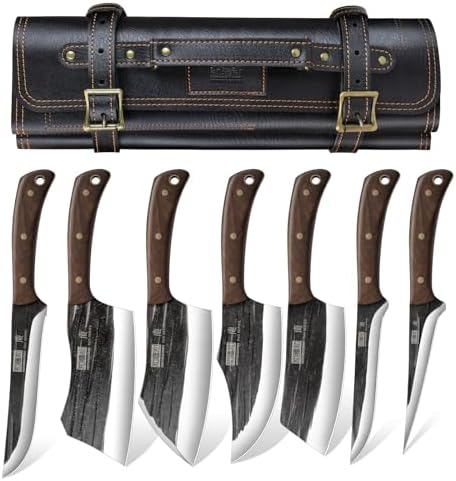
The upgrade pick: HOSHANHO Butcher Knife Set, Sharp Kitchen Knife Set & Roll Bag Gift for Men
Check current Amazon price
This is a different animal entirely, and I want to be clear about who it is for. A butcher knife set is task specific. These are heavier blades built for breaking down primals, portioning roasts, and working through a deer or a side of pork. If your cooking is mostly vegetables and chicken breasts, this is more knife than your board needs, and you should spend the money on a chef's knife and a stone instead.
If you do break down meat, a roll bag is a smarter storage decision than a block. Nothing pinches the edge, the knives travel if you hunt or cook at a friend's place, and the blades are not sitting in the open collecting kitchen grease. A roll also forces you to keep the set small, which is a feature.
Flaws but not dealbreakers: A roll bag needs to be dried out before it gets zipped closed. Put a damp knife into fabric storage and you are inviting rust onto an edge you just paid for. Lay the knives out to air dry first, every single time.
Anyone who butchers their own game, buys meat in bulk, or wants a dedicated heavy blade for roasts should look here first. Everyone else should not.
How to build the set you actually need, step by step
Step one: pick the chef's knife first, and pick it alone. Everything else in a set is negotiable. The chef's knife is 80 percent of the work in a normal kitchen. If you are choosing between a set with a great chef's knife and mediocre extras, and a set with a mediocre chef's knife and great extras, take the first one every time.
Step two: add a paring knife. A small blade for shallots, strawberries, and trimming. You will use it more than you expect and it costs almost nothing in the context of a set.
Step three: add a serrated bread knife, but only if it cuts bread. This sounds absurd until you have used a set bread knife that smears a crust instead of slicing it. Test the serrations on a tomato before you commit. A serrated knife that cannot cut a ripe tomato is a decoration.
Step four: decide on storage before you buy the block. Three options, and they are not equal. A magnetic strip keeps edges in the open air and is what I use for my daily knives. A roll bag protects blades and travels. A block looks tidy on the counter and is the option most likely to dull your knives on insertion. If you want a block because it looks right in your kitchen, fine, just check the slots first.
Step five: budget for maintenance in the same purchase. A honing steel and a sharpening stone are not accessories. They are the difference between a set that works for two years and a set that works for twenty. If you buy a set and no way to maintain it, you bought a display piece.
Step six: give the set a two week trial in your own kitchen. Cook everything you normally cook. If you reach for the same two knives every night, that tells you what your next purchase should be, and it tells you which pieces in the block you can hand off without guilt.
The maintenance habit that decides everything
Sharpness is a habit, not a purchase. The best knife in the world goes dull, and a modest knife that gets honed and sharpened on schedule will outcut an expensive blade that never gets touched.
A honing steel is not a sharpener. It is a realignment tool. You use it before you cook, a few passes per side, to push a rolled edge back into line. It buys you time between real sharpenings.
A stone is the sharpener. It removes metal and cuts a fresh edge. For German style steel, a 1,000 grit stone is where I would start, and most home cooks do not need anything finer. Learn one angle, hold it steady, and stop worrying about the number. Fifteen degrees per side is a thinner, slicier edge. Twenty degrees is more durable. Pick one and be consistent, because consistency beats precision every time.
Two rules that save knives. Never put a knife in the dishwasher, because the heat and the detergent will ruin the edge and the handle. And dry the blade the moment you are done with it, because water sitting on steel is how you get pitting on a blade you just sharpened.
What to skip when you are standing in the aisle
Skip any set whose value is mostly steak knives. Four of them count as four pieces on the box and zero pieces of actual cooking capability.
Skip a block with slots so tight the knife drags on the way in. You are sharpening for the furniture at that point.
Skip a bread knife you cannot test on a tomato.
Skip claims that a knife "never needs sharpening." Nothing true fits in that sentence.
And skip the urge to buy the biggest set you can afford. Buy the smallest set that covers the work you actually do, then put the savings into a stone.
The short version
A kitchen knife set is a chef's knife, a paring knife, a serrated knife, and storage, in that order of importance. If a set gives you those and a way to keep them sharp, it is a good set, whether it costs what the block set costs or what the butcher roll costs.
Buy the set that matches your cooking, buy the stone in the same order, and then use the morning test on yourself. If you reach for the same blade every day, you bought well. If you do not, you learned something cheaper than a new set would have taught you.