A kitchen knife set is 80 percent chef's knife. The other pieces are garnish, and most of them sit in the block untouched for years. That is the whole problem with how people shop: they buy a kitchen knife set when what they actually need is a plan, in the order the money should leave the wallet.
I have spent 16 years in kitchens, six of them as a line cook in fine dining and four running a butcher shop. I have sharpened more knives than most people will ever own, thousands of blades across every brand from a $20 stamped beater to a $400 Japanese gyuto. I still tell home cooks the same thing every week: buy fewer knives, buy them in the right order, and learn to sharpen the one that does the work.
Here is that order, the two sets I would actually put on a registry, and the maintenance habit that keeps either one cutting.
Why you should trust me
I run a 1,000-grit stone in my kitchen and I am not precious about it. I test sets the way a working kitchen uses them: a full prep shift, 50 pounds of vegetables, a service rush, and a sharpness test every single morning. That morning test is the one that matters. A knife that slices a ripe tomato without bruising it on Tuesday and smears it on Friday has told you everything you need to know about its steel.
I am not a collector. My daily knives live on a magnetic strip. The block is for guests.
How I picked and how I tested
Both sets here went through the same routine: an onion, a case of mushrooms, a pile of carrots, a chicken broken down, and a loaf of bread. Then I looked at four things.
Does it hold an edge through a full prep shift? Is the handle still comfortable after 200 cuts? Can I put it on a stone without fighting the bolster? Would I reach for it on a busy Saturday service?
Some standards I do not bend on. Full tang is non-negotiable, because the steel running the full length of the handle is the difference between a knife and a toy, and a bolted handle is a knife that fails you mid-service. A honing steel is not a sharpener, it is a realignment tool, which means you need both.
The two sets worth starting with
You need one great chef's knife, one petty or paring knife, and a sharpening habit. That is the whole set. But most people want something in a block on day one, so here are the two I would point you at, at opposite ends of the budget.
The starter set: Astercook Knife Set for Kitchen with Block and Sharpener 15pcs German
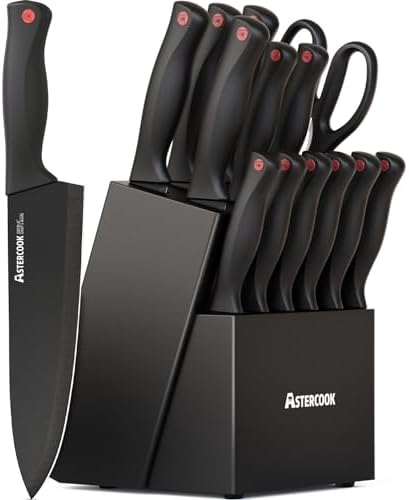
Fifteen pieces, a block, and a sharpener in the box. Check current Amazon price.
Normally I tell people to skip any 15-piece set. I mean it, and this is the one exception: you are starting from zero. No knives, no block, no board, nothing. If that is you, a set like this gets you cooking this weekend instead of next month, and the two pieces that matter in the box are the chef's knife and the paring knife.
What you are paying for at this level is convenience, not steel. Sets in this tier are usually stamped, and stamped steel is not bad, it is just not a knife you will hand to your grandkids. Stamped blades are thinner, they flex, and they will not hold an edge through a heavy prep shift the way a forged blade does. That is fine for onions, sandwiches and a first apartment. It is not fine if you cook hard four nights a week.
Two things to check before you commit. Look for full tang, because at this price you have to look. And understand that the included sharpener is a convenience, not a system. It will bring a dull knife back to usable, but it removes steel every time you use it, so the blade gets narrower over the years. Learn a stone anyway.
Flaws but not dealbreakers: The piece count is inflated by steak knives. You do not need six steak knives, you need a chef's knife that holds an edge. Count the pieces that actually cut food and judge the set on those.
This is the right buy for a dorm, a first apartment, a rental kitchen, or a gift for someone who currently owns exactly one dull knife.
The set you keep: Zwilling Professional S J.A Henckels 3 Piece Knives Set, Black/Stainless Steel (35602-000-0)

Three pieces instead of fifteen. Check current Amazon price.
This is the other philosophy, and it is the one I push people toward: buy fewer knives, buy them once. Three pieces means no filler, no block ornament, no steak knives you will never sharpen. What you get is the shape of set a serious home cook actually uses, and what you pay for is steel and construction that survive a decade of daily work instead of two years of light duty.
Zwilling's German forged knives are the alternative I recommend when someone wants an ergonomic handle and steel that is a little easier to maintain than the hardest Japanese blades. That trade is deliberate. Softer steel takes an edge faster and touches up on a honing steel in ten seconds. Harder steel holds that edge longer, but it punishes you on the stone and chips if you take it through a chicken carcass.
Flaws but not dealbreakers: Three pieces is a starting point, not a finished drawer. You will still want a serrated bread knife and a honing steel, and you will buy those separately. That is not a flaw, it is the point. Buy what you use.
If you cook most nights and want one purchase that ends the knife conversation for a decade, put the money here.
The actual workflow: build the set in this order
If you ignore the sets and just want the order, here it is. This is how I would spend the money starting over with an empty drawer.
Step one: the chef's knife. This is 80 percent of your cooking. An 8-inch chef's knife covers almost everything. Go to 10 inches if you have big hands and a big board, go to 6 if you have small hands and a small kitchen. If you buy one knife this year, buy this one.
Step two: the paring knife. Three to four inches. Peeling, trimming, hulling, all the small work your chef's knife is clumsy at. Cheap paring knives are fine here, but a dull one is worse than no paring knife at all.
Step three: the serrated bread knife. Long, serrated, used for bread, tomatoes and cake. Serrated edges cannot be sharpened on a stone the way a straight edge can, so buy one you can replace without wincing.
Step four: the honing steel. Use it before every session, five to ten light passes per side, matching the angle the blade already has. This does not sharpen. It realigns a rolled edge, which is what actually happens to your knife after twenty minutes of onions. Skipping this step is why people think their knives are dull when they are only out of line.
Step five: the sharpening stone. A combination 1,000/6,000 grit stone is the whole setup for a home kitchen. Soak it, keep it flat, and practice on the cheapest knife you own before you touch the good one. Ten minutes a month per knife keeps everything cutting.
Step six: storage that does not ruin the edge. A magnetic strip on the wall, or a block with slots loose enough that the blade does not scrape on the way in. A drawer full of loose knives is how you chip an edge and cut yourself reaching for a spoon. If you use a block, insert blades spine-first so the edge never drags.
Step seven: the morning test. Every morning, take your chef's knife and slice a sheet of paper, or a ripe tomato if you have one. If it catches and tears, hone it. If honing does not fix it, it is stone time. That test takes ten seconds and tells you more about your knife than any spec sheet.
Sharpening is not optional
The best knife in the world goes dull. Sharpness is a maintenance habit, not a purchase, and no set on this page stays sharp on its own.
The old butcher I learned from used to say a dull knife is a confession. He meant that a dull knife tells everyone in the kitchen you do not take the work seriously, and it also means you are pushing harder than you should, which is how you cut yourself. A sharp knife bites and stops. A dull knife skids.
If you do nothing else from this guide, buy a stone and learn to use it. That one habit will make a budget set outperform an expensive set that never gets touched.
What to skip
Skip sets where the piece count is mostly steak knives. You need four steak knives at most, and you can buy them separately when you actually host.
Skip knives marketed as professional with no bolster and no full tang. That word does not mean what the box wants you to think it means.
Skip sets whose bread knife cannot slice bread. It happens more than you would believe.
Skip knife blocks that grip the blade on the way in. Over a year, that scraping dulls an edge faster than cutting does.
Skip a second chef's knife before you own a stone. Two dull knives are not better than one sharp one.
And if you already own a decent chef's knife, skip the 15-piece set entirely. The Astercook set above is the exception I make for people starting at zero. Everyone else should spend the same money on the three-piece forged set and stop thinking about knives for a decade.
What this all costs
Do not do the math on the sticker. Do the math on years.
The starter set is the least expensive way to get a full drawer working this week, and it is a fine place to start when you are furnishing a first kitchen. The three-piece forged set costs more up front, and it is the one still in your drawer in 2036. Divide either one across the years you will actually use it and the difference stops mattering, which is the whole argument for buying the good one once.
What you should not do is spend the money twice. A cheap set today and a real set in two years costs more than the real set bought once.
Check current Amazon price on both before you decide. Pricing moves, and this decision should be about steel and construction, not about which one happens to be discounted this week.
The short version
Buy the chef's knife first. Add a paring knife and a serrated bread knife. Buy a honing steel and a stone, and use both on a schedule, not when things get bad. Store them so the edges never scrape. Test the edge every morning.
That is the whole kitchen knife set. Everything else in the block is garnish, and you can skip it without cooking any worse.