Most knife buying advice is written by someone who has never stood at a board for six hours. I have. Sixteen years in professional kitchens, six of them on the line in fine dining, four running a butcher shop, and I still take my blades to a 1,000-grit stone every week. Knowing how to choose a kitchen knife stops being a mystery the moment you strip away the packaging and look at three things: the tang, the handle, and whether you are willing to maintain the edge.
Here is the short version, and it is the version I give every line cook who asks. A knife set is 80 percent chef's knife. The other pieces are garnish. Stamped steel is not automatically bad, it is just not a knife you hand to your grandkids. And a bolted handle is a knife that will fail you mid-service.
Everything below is about picking the right blade for the way you actually cook, plus the maintenance habit that decides whether it still cuts in two years.
Why you should trust me
I spent six years as a line cook in fine dining and four running a butcher shop before I moved to Bend, Oregon and started writing about this stuff. Along the way I have sharpened more knives than most people will ever own, thousands of blades across every brand, from twenty-dollar stamped knives to four-hundred-dollar Japanese gyutos.
I do not write about knives I have not put through prep. My test is boring and repetitive: a full prep shift, a pile of vegetables, a hundred-plus cuts per knife, and the same sharpness check I run every morning before service. The knives that come out the other side are the ones I recommend. The ones that do not, I say so.
How I picked and how I tested
I evaluate every knife with four questions, and I do not skip any of them. Does it hold an edge through a full prep shift? Is the handle still comfortable after 200 cuts? Can I sharpen it on a stone without fighting the bolster? Would I reach for it on a busy Saturday service?
Those four questions filter out most of what is sold as a "professional" set. A knife can look right in a photo, balance badly in the hand, and go dull halfway through a case of onions. Nobody notices that in a showroom. You notice it at 7 p.m. on a Friday with a full rail.
What I will not do is pretend a budget set cuts like a two-hundred-dollar gyuto. It does not. What a good budget knife does is cut well enough to cook dinner every night, stay comfortable in the hand, and take an edge when you sharpen it. That is a much lower bar than the packaging suggests, and two knives clear it.
What a home kitchen actually needs
You need fewer knives than the block in the store suggests. A chef's knife does the onions, the carrots, the chicken, the garlic, and the herbs. A paring knife handles the small work. A serrated knife handles bread and tomatoes. Everything past that is a spare.
Full tang is non-negotiable for me. That means the steel runs the full length of the handle rather than stopping short and being glued or bolted in. A full tang knife with three rivets is a tool. A knife with a hollow plastic handle is a disposable, and it will separate on you at the worst moment.
After that, the deciding factor is maintenance. A honing steel is not a sharpener, it is a realignment tool, and yes, you need both a steel and a stone. Budget for them before you budget for a fourth knife.
The two knives I would put in a home kitchen
One is a starter set for a kitchen that has nothing. One is a single blade that does the work of the set. Both are honest tools, and neither one is pretending to be a hand-forged Japanese knife.
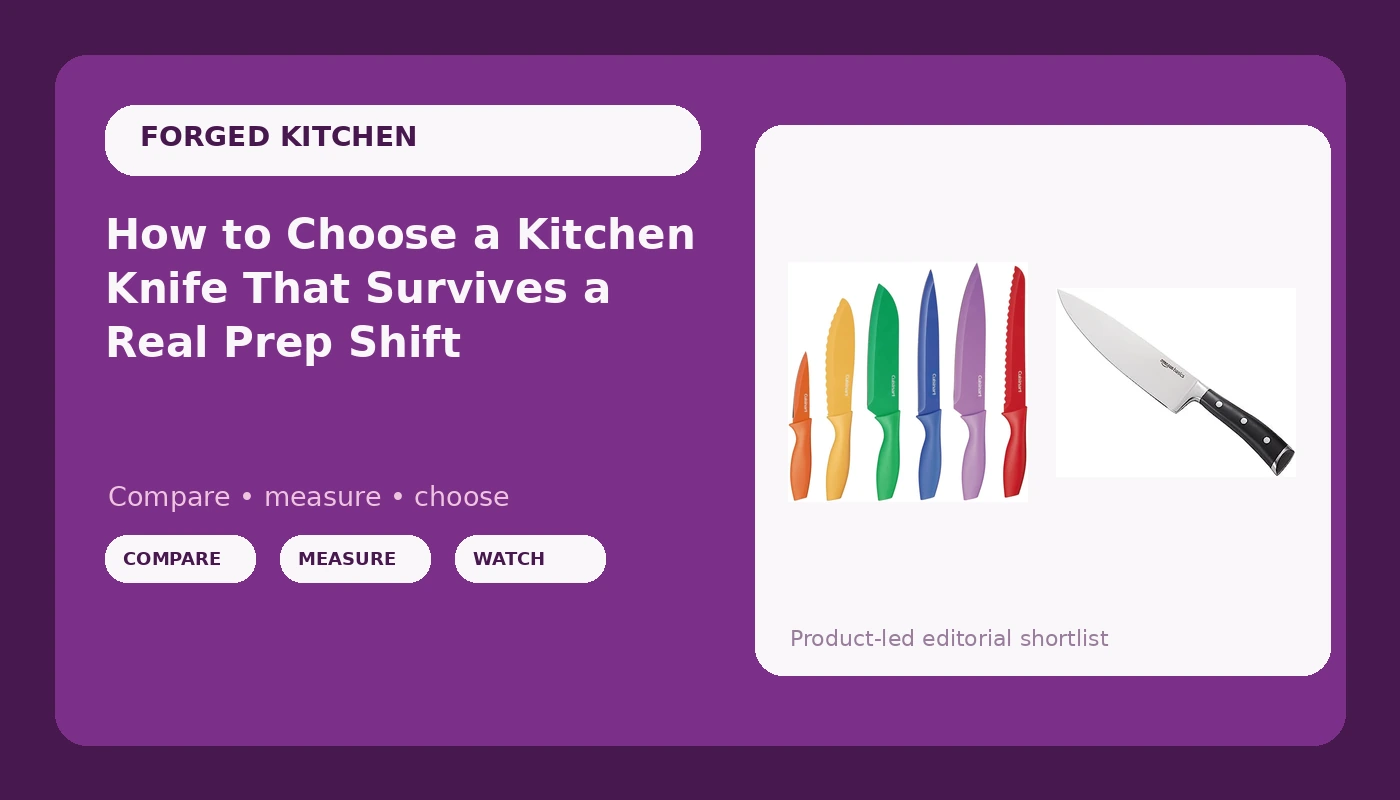
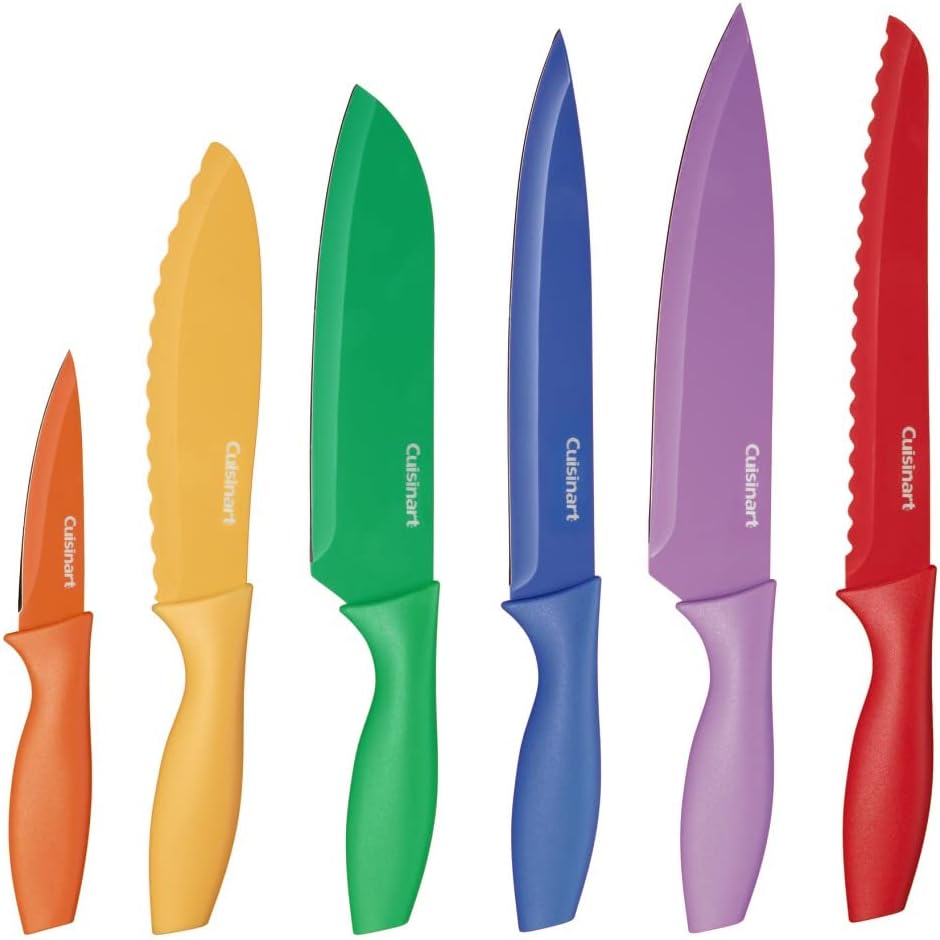
Budget pick: Cuisinart C55-01-12PCKS Collection 12-Piece Knife, Multicolor Advantage-Cutlery-Set, Multi-colored
 Visit on Amazon →
This is the set I point at when someone is outfitting a first apartment, a rental, or a college kitchen and needs a block on the counter by the weekend. Twelve pieces with color-coded handles, which sounds like a gimmick until you are cooking with someone who grabs the wrong knife and cross-contaminates the cutting board. The color coding earns its keep in a shared kitchen.
The chef's knife in this set is the piece that matters, because it will do 80 percent of the work. Treat that one knife well, keep it honed, sharpen it when it needs it, and the rest of the block is backup. The smaller knives handle paring and detail work, and there is enough here to cook a full meal without stopping to wash a blade mid-recipe.
Check current Amazon price before you buy, because this band moves around a lot and it is frequently discounted.
Flaws but not dealbreakers: Sets in this price range are stamped rather than forged, and the steel is softer than what a pro kitchen runs. That means it will need honing more often, and a careless run through the dishwasher will punish the edge. Hand wash these and they will last far longer than the price suggests.
Anyone starting from zero, or outfitting a second kitchen, will get real value here.
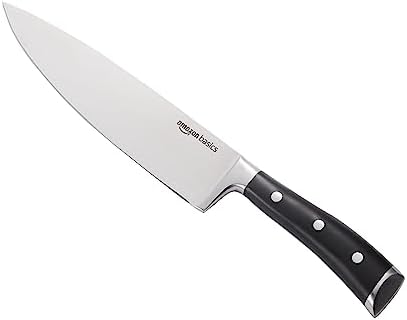
Our pick: Amazon Basics Classic 8-inch Full Tang High Carbon Stainless Steel Chef's Knife, Multipurpose Kitchen Knife with Three Rivets, Silver
 Visit on Amazon →
If you already own a drawer of mediocre knives and you want the single upgrade that changes how you cook, this is the one. It is an eight-inch chef's knife with a full tang and three rivets, which is exactly the specification I tell people to look for and exactly the specification most cheap knives skip.
Eight inches is the right length for a home cook. It is long enough to break down a chicken and short enough to mince a shallot without feeling like you are swinging a machete. The full tang means the balance point sits where your hand wants it, not out at the tip, and the riveted handle will not loosen the way a molded plastic handle does after a few years of hot water.
High carbon stainless is the sensible middle ground for a home kitchen: it takes an edge more willingly than a soft stainless blade and it will not rust if you dry it after washing. That combination is what makes this knife worth owning over a set full of blades you never touch.
Check current Amazon price, since a single knife at this specification is usually the better dollar-per-cut decision than a twelve-piece block.
Flaws but not dealbreakers: It is a plain knife. No fancy cladding, no exotic handle wood, no dramatic curve to the blade. If you want a knife that looks like a piece of art on a magnetic strip, this is not that knife. If you want one that does the work, it is.
Anyone who cooks four or more nights a week and wants one blade to carry the load should start here.
The actual workflow: how to choose a kitchen knife
This is the process I run in a store, and you can run it from a product page if you know what to look for.
Step one: Decide what the knife has to do. Write down the four things you cook most. If it is onions, chicken, garlic, and salad, you need one chef's knife and a paring knife. If it is bread and roasts, you need a serrated knife too. Buy for the food you actually cook, not the food in the marketing photos.
Step two: Check the tang. Look for the words "full tang" and a photo of the handle from above. You should see steel running the length of the handle with rivets through it. If the handle is described as "molded" or you cannot see the tang in any photo, move on.
Step three: Check the handle length and shape. A handle that is too short forces your hand onto the blade, which is how you cut yourself. A handle that is too long puts the balance point past your grip and tires your wrist. You want roughly a hand's width of handle and a shape that fills your palm without a ridge digging into your fingers.
Step four: Think about the bolster. A thick forged bolster protects your fingers, but it also creates a shoulder that makes sharpening harder, because the stone cannot reach the heel of the blade without grinding the bolster down. If you sharpen on a stone, a knife with a slimmer bolster or no bolster at all is easier to maintain. Know which trade you are making.
Step five: Count the knives you will actually use. This is where sets go wrong. A fifteen-piece set with four steak knives is four knives you use twice a year and eleven you never touch. Twelve pieces is only worth it if the block itself is something you want on the counter.
Step six: Budget for maintenance before you buy the knife. A honing steel and a 1,000-grit water stone cost less than a mid-range knife and they are the difference between a blade that cuts for a decade and one that goes dull in a drawer.
Step seven: Stop shopping. The most common mistake I see is a home cook who owns six mediocre knives and no good one. Buy the knife, sharpen it, cook with it, and ignore the next sale.
Sharpening and honing: the part nobody budgets for
A honing steel realigns an edge that has rolled over. It does not remove metal and it does not create a new edge. Run your knife over a steel a few strokes on each side before you cook, and you will feel the difference immediately.
A stone sharpens. A 1,000-grit water stone is the right starting point for a home kitchen. Soak it, hold a consistent angle, and work in sections from heel to tip. Fifteen minutes once a month is enough for most home cooks. If you own a knife with a thick bolster, this is the moment you will understand why I warned you about it in step four.
Do not put good knives in the dishwasher. The heat and the detergent attack the edge and the handle, and the basket knocks the blade against everything else in there. Thirty seconds at the sink is the whole maintenance routine.
The competition and why it lost
If you want to spend real money, the Wüsthof Classic is the best all-around set I have used. The steel takes an edge, holds it through a service, and the bolster is actually comfortable. The Zwilling Pro is the best German alternative, with an ergonomic handle and slightly softer steel that is easier to maintain. The Shun Classic is the best Japanese entry point: screaming sharp out of the box, brittle on bones, and expensive to sharpen.
At the value end, the Victorinox Fibrox chef's knife is the best forty-dollar blade in existence, even though the rest of the set is just okay. The Mercer Culinary line is the professional sleeper, the brand most restaurant kitchens actually buy.
None of those are the two knives above, and that is the point. If your budget is a set, the Cuisinart gets you cooking. If your budget is one knife, the Amazon Basics full tang chef's knife is the better tool. And if you are considering any fifteen-piece set under a hundred dollars, skip it. You are paying for a block and a bread knife you will never use.
What this all costs
Both knives here sit in the entry-level band, so check the current price on each before you decide. The math that matters is not the sticker, it is the cost per use.
A single chef's knife that you sharpen monthly for five years is a few cents per dinner. A twelve-piece set that covers a first kitchen, including the block, is cheaper per piece than buying those knives separately. A hundred-and-fifty-dollar set you never sharpen is the most expensive option on this page, because you will replace it in two years and then buy the good knife anyway.
That is the whole decision. Pick the knife that fits your hand and your budget, buy the steel and the stone with it, and spend the money you saved on vegetables. The cutting is the job. The knife is just the tool you bring to it.