Related: How to Sharpen a Kitchen Knife Without Ruining the Edge
I have spent 16 years in kitchens, six of them on a fine dining line and four running a butcher shop, and the knife I reach for at 4:45 on a Friday is never the knife a catalog wants to sell you. Sets get built around piece counts and a block. Cooks get built around one blade they trust. So when I look at kitchen knife sets, I am not counting pieces. I am asking whether the chef's knife in the box would still be in my hand after a full prep shift, and whether everything else earns its slot or just fills a hole in the block.
The four items below are what I am working with right now: a forged Cuisinart block set, a stamped Amazon Basics color-coded set, an Arcos paring trio, and one item that is not a knife at all. I will tell you which ones I would put in my own kitchen, which ones I would hand to a roommate, and where each one gives up ground.
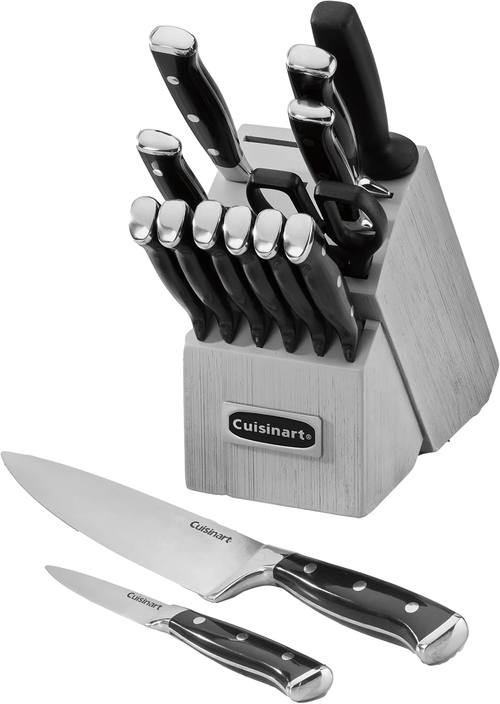
Best Overall: Cuisinart Classic Forged Triple Rivet 15-Piece Set
This is the one set in this group I would actually cook with. Two words do the work: forged and rivet. A forged blade is denser than a stamped one, and it takes an edge that holds through a service instead of folding over halfway through a case of onions. Triple rivets tell you the tang runs into the handle, which is the line between a knife and a toy. High-carbon stainless is the steel you want if you plan to sharpen on a stone yourself, because it will give you an edge without fighting you for it.
The honest math of a 15-piece block set is that you will use four of the pieces. Chef's knife, paring knife, utility knife, and a bread knife if it actually slices bread. The rest are guest knives and steak knives, and that is fine as long as you know it going in. I keep my daily blades on a magnetic strip and let the block hold the ones I touch twice a month, mostly because I do not like pulling a chef's knife out of a slot with wet hands.
Buy it if you want one purchase that covers a home kitchen and you are willing to keep the chef's knife sharp.
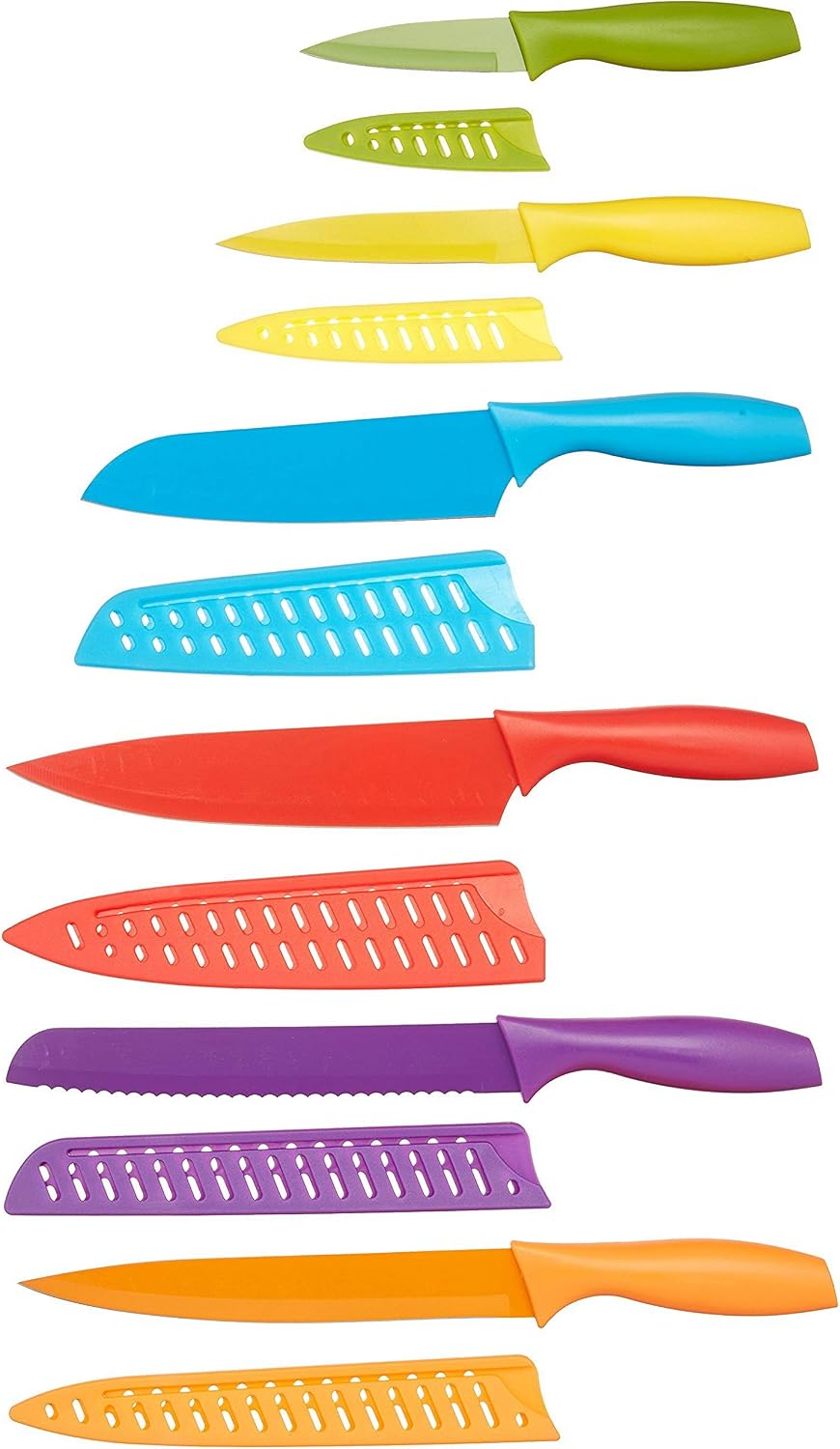
Best for Shared Kitchens: Amazon Basics Color-Coded 12-Piece Set
This is six knives and six blade guards, with non-stick coated blades and color-coded ergonomic handles. Stamped steel, and I want to be straight about that. Stamped is not bad. It is a different tool. A stamped blade flexes more and loses its edge faster than forged steel, and the non-stick coating means you are not going to build a long relationship with a whetstone. What stamped steel is very good at is being light, forgiving, and cheap to replace, and that is exactly what a shared kitchen needs.
The color coding is the real feature here. Six handles in six colors means the knife that broke down raw chicken does not come anywhere near the strawberries, and in a house with roommates that alone justifies the purchase. The blade guards mean you can store them in a drawer instead of leaving them loose in a sink, and dishwasher safe matters when you are not the person washing dishes.
Buy it for a first apartment, a rental, a dorm, a camp box, or a kitchen where three people cook and nobody wants to talk about knife care.
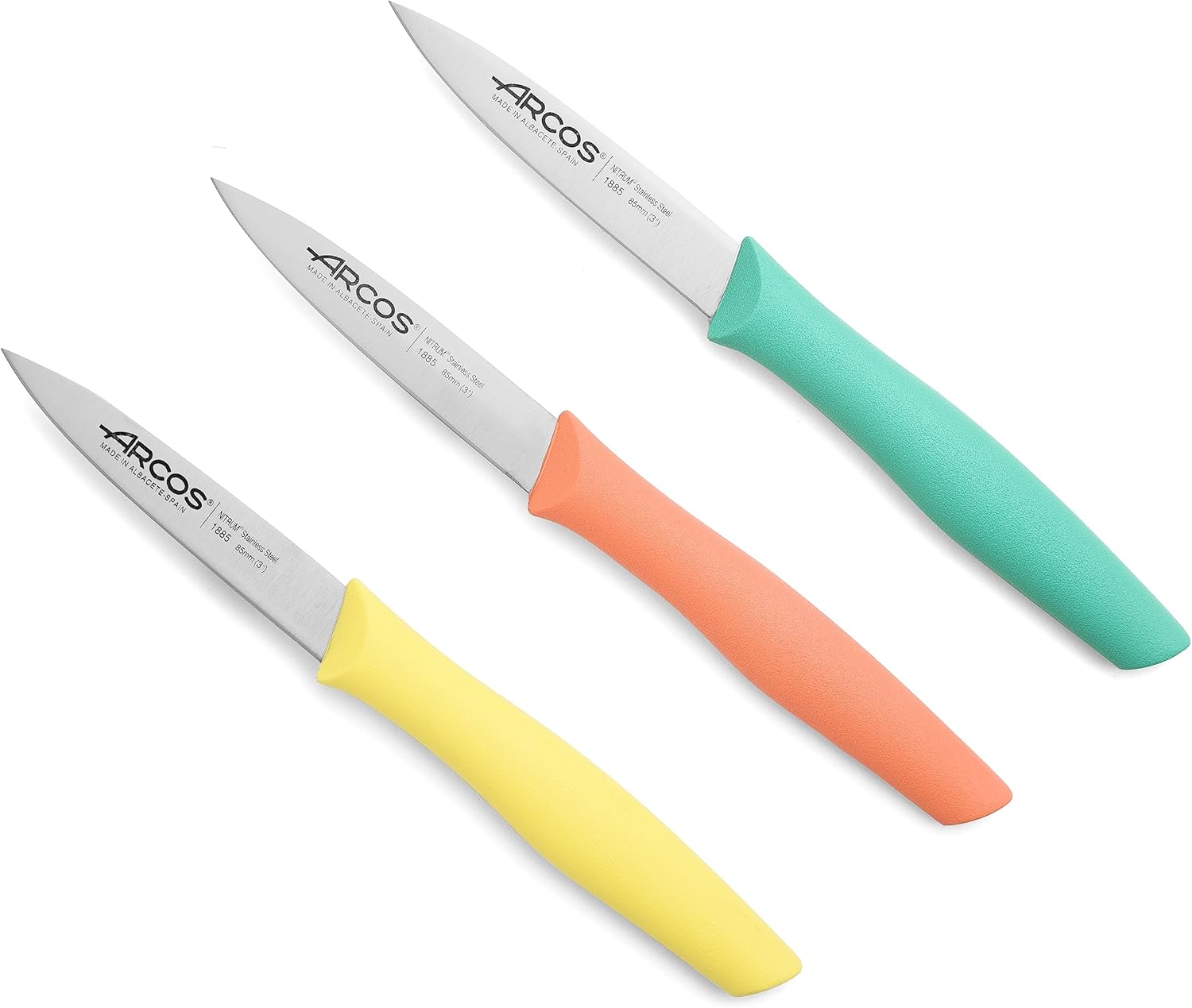
Best for Detail Work: Arcos Nova Paring Knife Set of 3
Paring knives are the second most used blade in any kitchen and the most neglected. This is three 4 inch stainless steel paring knives with ergonomic polypropylene handles in orange, yellow, and blue, from the Arcos Nova series. Polypropylene is a working handle material: light, grippy when wet, and it shrugs off being left in a sink overnight.
Three of them in three colors is a smarter setup than one paring knife. I keep one for fruit, one for alliums, and one for trimming protein, and the color tells me which is which without me thinking about it. Shallots, strawberries, apple skin, shrimp veins. That is the whole job description.
What it is not is a chef's knife, and it is not a substitute for one. Buy this alongside a main blade, not instead of one.
The Non-Knife Item Worth Adding: Soft Corner Protectors
Not a knife. I am including it because this is the guide where it belongs. It is a 2 inch by 13.12 foot clear soft strip that you cut to length for table corners, counter edges, window sills, and the sharp corner of an island that sits exactly at toddler head height. If you keep a knife block on the counter and a small kid in the house, the furniture corners around that block are the injury you have not thought about yet. Clear strip, so it does not look like a nursery in your kitchen.
Cut it with scissors, press it on, replace it when it yellows. That is the whole product. It will not make you a better cook, but it keeps a bad afternoon from turning into a worse one.
How I Judge a Knife Set
Every set that comes through my kitchen gets the same treatment, and none of it is glamorous. The prep shift test: a shift's worth of vegetables, which is where a blade either holds an edge or tells you it will not. The 200 cut test: how the handle feels after 200 cuts, not after five. The morning sharpness test: slice a tomato before coffee, and if it crushes instead of cutting, the knife is dull and I note it. The stone test: can I sharpen it without fighting the bolster, because a bolster that runs to the edge turns a five minute job into a twenty minute one.
Then the boring questions. Does the handle stay grippy when it is wet? Does the blade sit in the block without pinching the edge? Would I reach for it on a busy Saturday service, or would I reach past it for the gyuto I have owned for a decade? That last question decides everything. If a knife cannot survive being reached past, it is a drawer decoration.
What the Construction Actually Tells You
Steel hardness is a tradeoff, not a scoreboard. Higher on the Rockwell scale means the edge lasts longer, but the blade is more brittle and it fights you on a stone. German style steel is softer and easier to maintain, which is why it is the right answer for most home kitchens. Japanese style steel is harder and thinner, screaming sharp out of the box, but it chips if you look at a chicken bone wrong. A Cuisinart forged set sits on the German side of that line, and for a home cook that is the correct place to be.
Coating is a different conversation. A non-stick coated stamped blade is easy to live with and hard to sharpen well, because every pass on a stone takes a little coating with it. That is a fine trade for a shared kitchen and a bad one for someone who wants to own a knife for twenty years.
Blocks deserve more suspicion than they get. Some hold a blade so the edge never touches anything, and some pinch the edge every time you slide a knife in. If you are buying a set for the block, look at how the slots hold the blade, and consider keeping your daily chef's knife out of it entirely.
Full tang, forged or not, is the line I do not cross. A bolted handle is a knife that will fail you mid service, and it will do it at the worst possible moment.
The Reference Table
Here are the same four items side by side, with what each one is actually for. Prices move constantly, so check the listing before you decide.
| Product | Best for | What it is | Price |
|---|---|---|---|
 Visit on Amazon → Visit on Amazon →Cuisinart Classic Forged Triple Rivet 15-Piece Set |
One set for a home kitchen | Forged high-carbon stainless, triple rivet handles, block included | $129.95 |
 Visit on Amazon → Visit on Amazon →Amazon Basics Color-Coded 12-Piece Set |
Shared kitchens, first apartments | 6 stamped knives with 6 blade guards, non-stick coated, dishwasher safe | $14.25 |
 Visit on Amazon → Visit on Amazon →Arcos Nova Paring Knife Set of 3 |
Fruit, alliums, trimming protein | Three 4 inch stainless paring knives, polypropylene handles, orange, yellow, blue | $25.95 |
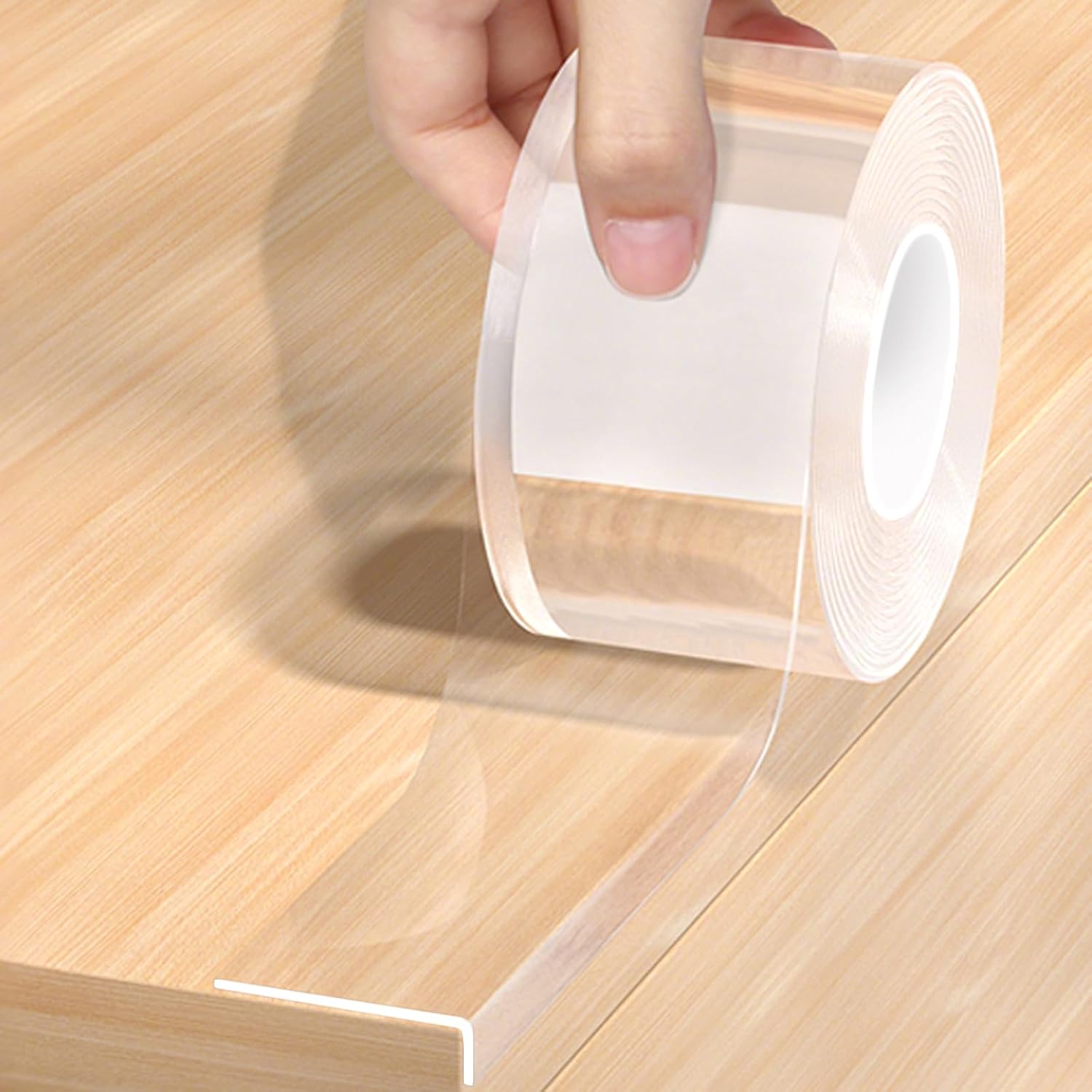 Visit on Amazon → Visit on Amazon →Clear Soft Corner Protector Strip |
Counter, table, and window edges | 2 in x 13.12 ft clear soft strip, cut to length | $18.99 |
The Sharpening Habit That Comes With Any Set
A honing steel is not a sharpener. It realigns an edge that has rolled over, and you should use it before every session. A stone is a sharpener, and a 1,000 grit stone is where most home cooks should start. Learn on the cheapest knife in the drawer, not the forged one. Ten minutes a month is the whole maintenance plan, and it matters more than which set you bought. The best knife in the world goes dull. That is not a flaw in the knife, it is the nature of steel.
Should you buy the Cuisinart Classic Forged Triple Rivet set?
Yes, if you want one forged block set that covers a home kitchen and you are willing to keep the chef's knife sharp. Forged high-carbon stainless takes an edge, the triple rivets mean the tang runs into the handle, and the pieces you actually use are the pieces that matter. The steak knives and the extra slots are filler, and the block takes counter space you may not have. Neither of those changes my answer.
Should you buy the Amazon Basics color-coded set?
Buy it for a shared kitchen, a rental, a dorm, or a camp box. Stamped blades with a non-stick coating and dishwasher safe handles are forgiving in exactly the ways a shared kitchen needs forgiving, and the color coding prevents the raw chicken problem. It is not the set you hand down to anyone, and it is not the set you spend an evening sharpening, but that was never the job it was hired for.
Should you buy the Arcos Nova paring set?
Yes, as a companion to a chef's knife. Three paring knives in three colors covers fruit, alliums, and trimming, and the polypropylene handles survive a sink. If you are building a kitchen from nothing, buy the paring trio and put the rest of your budget toward one good chef's knife instead of a bigger block.