Most knife sets are sold by piece count, which is the least useful number printed on the box. A 14-piece set and a 10-piece set can each contain exactly one knife you will reach for on a busy night, and the rest is filler: steak knives, a slicer you use twice a year, a bread knife that cannot slice bread. If you are shopping for a forged knife set, the real question is not how many slots the block has. It is which single blade you will actually pick up, whether the handle will survive a thousand washes, and where the knives will live between uses.
Related: How to Hone a Knife Without Rolling the Edge →
Quick answer
Buy the set whose chef's knife you would use for a full prep shift, then decide storage separately. If you want one set to cover everyday cooking, the block set with forged, triple-riveted handles is the practical pick. If your kitchen is shared and you want blades that are easy to tell apart, the color-coded ceramic-coated set covers that. If you want a single heavy hand-forged blade instead of a drawer of options, the Serbian-style set fits. If your problem is a crowded drawer or counter, the magnetic strip is the fix, and it works with whatever knives you already own.
Four useful options
| Model | Best fit | What stands out |
|---|---|---|
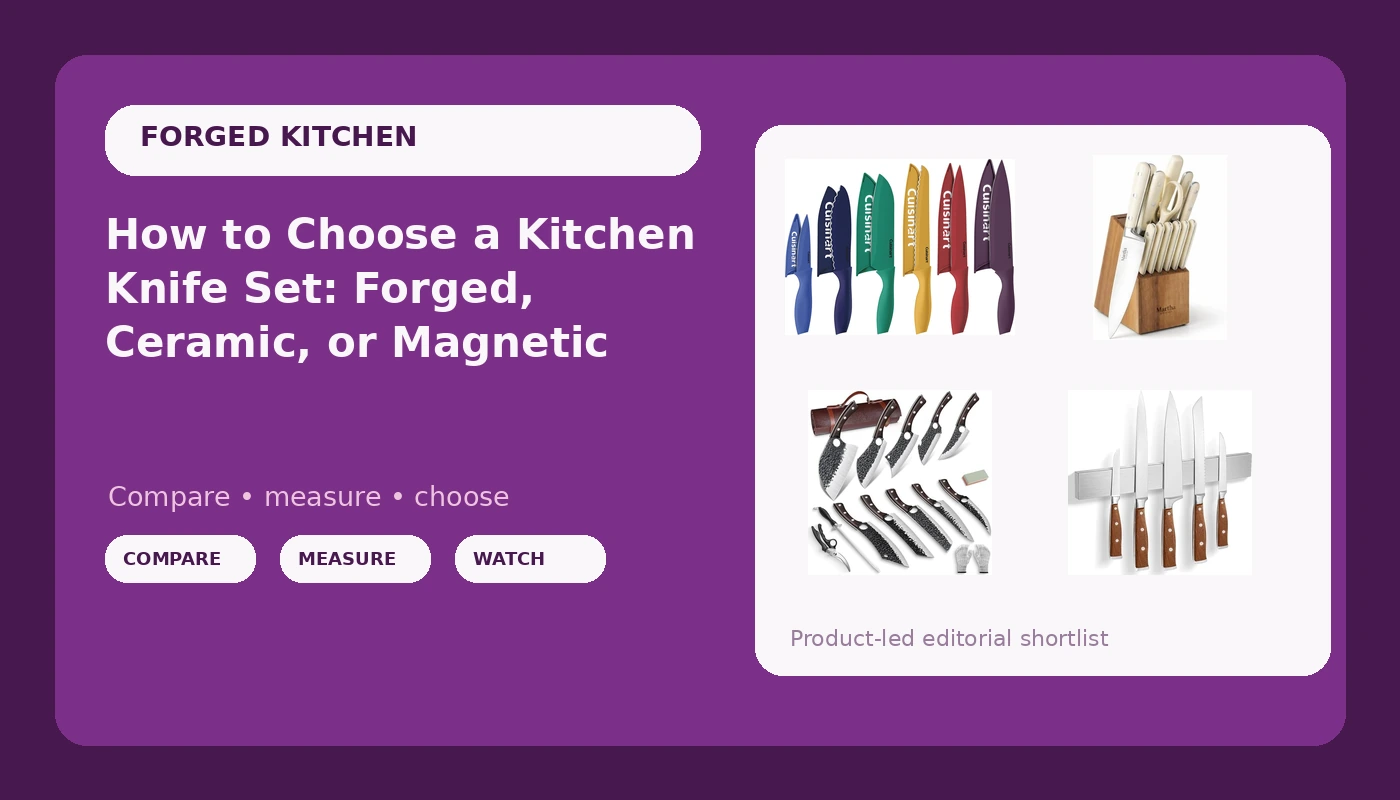
| Cuisinart C55-12PCKSAM 12-Piece Ceramic Coated Stainless Steel Knives | Shared kitchens and color-coded prep | Six blades with six matching guards, handles color coded to reduce cross contamination risk |
| MARTHA STEWART Eastwalk 14 Piece High Carbon Stainless Steel Cutlery Kitchen Knife Block Set | One set for everyday cooking | Forged, triple-riveted ABS handles and an acacia wood block |
| DRGSKL Serbian Chef Knife Set, 10 PCS Hand Forged Knife Set with Bag | A single heavy hand-forged blade | Hand-forged construction, 10 pieces, storage bag included |
| Magnetic Knife Holder for Wall, 9.7 Inch | Freeing drawer and counter space | Wall or refrigerator mount, holds knives, utensils, or metal tools |
The color-coded starter set: Cuisinart C55-12PCKSAM
The value here is organization, not heft. In a house with roommates, kids learning to cook, or a small kitchen where counter space is a rumor, guards and colors solve a real problem: nobody has to guess which knife touched the raw chicken. A ceramic coating is a surface treatment on stainless steel, and it is often chosen to limit staining and reactivity with acidic ingredients rather than to change how the steel holds an edge.
The trade-off is that this is a light, thin family of blades. It is not the set you hand down, and the coating is a surface layer, so treat it accordingly. Wash and dry by hand, use a plastic or wood board, and keep the guards on. If you want the one-knife-that-does-everything experience, this is not that. If you want a tidy, low-drama set that keeps a shared kitchen from cross-contaminating, it is exactly that.
The forged block set: MARTHA STEWART Eastwalk 14 Piece
This is the shape most people picture when they think of a forged knife set: a block on the counter, a chef's knife in the front slot, steak knives along the top. The listing describes forged, triple-riveted ABS handles, which is the handle construction I care about most in a home set, because a handle that is pinned and riveted rather than glued and bolted is the difference between a knife that lasts and a knife that loosens.
Two honest caveats. First, a 14-piece count always includes pieces you will rarely touch, and that is normal at this level. Judge the set by its chef's knife and its utility knife, not by the total. Second, a wood block is convenient storage but it is not maintenance-free: slots that grip the blade tightly can drag on the edge every time you insert the knife, so set it down and draw it straight rather than wiggling it in. If your block feels tight, that is a sign to store the daily knives elsewhere and keep the block for the occasional pieces.
The hand-forged blade: DRGSKL Serbian Chef Knife Set, 10 PCS
Hand-forged knives are a different experience, and whether you like them comes down to your hands and your board. The Serbian chef knife pattern runs taller and heavier than a standard Western chef's knife, which some cooks find steadier for rocking through onions and others find tiring over a long prep. Hand forging also means individual variation between blades, which is part of the appeal and part of the risk.
Because a hand-forged blade may be finished differently from a mass-produced one, read the listing carefully for the steel type and any care instructions before you commit. If the steel is a high-carbon variety, it will want drying immediately after washing, and it may patina over time. The bag is a genuine plus if you cook away from home, camp, or travel with a knife roll. If you already own a good chef's knife and just want storage, this is not the purchase you need.
The storage fix: Magnetic Knife Holder for Wall, 9.7 Inch
This is the cheapest upgrade in this article in terms of what it changes about a kitchen. A magnetic strip keeps edges off hard surfaces, keeps blades visible so you actually use them, and frees the counter where a block would sit. It is also the honest answer to a set problem: if you own three knives you love, a strip plus a sharpening habit beats a 14-piece block every time.
Check the mounting surface and hardware before you buy, and mount it where nobody walks past with a shoulder bag. Hanging knives by the spine or the flat of the blade is the usual approach, and letting a blade snap onto the magnet is what dulls an edge over years, so place it gently. The 9.7 inch length suits a small rotation: a chef's knife, a petty, a serrated knife. If you own more than that, you need two strips or a smaller collection, and a smaller collection is the better answer.
Prices and availability may change. Product images, names, and retailer links are matched to verified listings. No current price, rating, stock status, or measured result is stated here without current evidence.
Forged, stamped, and full tang: what the label actually means
A forged blade is shaped from a heated bar of steel, pressed and hammered into form, then ground and finished. A stamped blade is cut from a flat sheet of steel, which is faster and cheaper and produces a lighter, thinner knife. Stamped steel is not bad steel. It is simply a different process, and it tends to mean a lighter knife that flexes more and holds an edge for less time.
Full tang means the steel runs the full length of the handle, so the blade and handle are one continuous piece rather than a blade glued or bolted into a handle shell. On a full tang knife you can usually see the steel between the handle scales, often pinned with rivets. Partial tangs exist and can work fine, but a full tang is the construction I look for in anything I plan to keep for years. The bolster is the steel collar between blade and handle. It protects your fingers and adds balance, and it also makes sharpening on a stone more fiddly, because you have to work around it.
Hardness is measured on the Rockwell scale, usually written as HRC. Higher hardness generally means an edge that lasts longer and a blade that is more brittle and harder to sharpen. Most Western kitchen knives sit in the mid to upper fifties, while many Japanese-style blades run higher. Neither number is a quality score on its own. A harder blade is not automatically better; it is a different set of trade-offs.
Coatings, storage, and the sharpening habit
A ceramic coating is a finish applied over a stainless blade. It is generally there to reduce sticking, limit staining, and cut down reactivity with acidic foods. It is not a steel upgrade, and it can wear with heavy use, aggressive scrubbing, or the dishwasher. Treat coated blades gently and they stay looking new longer.
Storage matters more than most buyers expect. A block looks tidy, but tight slots can drag across the edge every time you insert a knife, and moisture trapped in a block is not kind to steel. A magnetic strip holds blades in open air, which is easier on edges, provided you place knives on it gently instead of letting the magnet pull them in. Loose knives in a drawer is the worst option: edges knocking against each other and against metal utensils will roll and chip.
Finally, understand the difference between honing and sharpening, because it is the most common source of confusion in knife care. A honing steel realigns an edge that has rolled over in normal use, and it takes seconds. A sharpening stone removes metal and creates a new edge, and it is a skill worth learning. You need both, and neither one replaces the other. A weekly pass on the steel and a sharpening session when the steel stops working will keep any knife in this article usable.
- Pick the chef's knife first and let it decide the set, since it does most of the work.
- Choose forged or stamped based on how much you cook and how long you want to keep the knives.
- Check the handle construction and look for a full tang with visible rivets where possible.
- Count only the pieces you will genuinely use, and ignore the rest of the box.
- Decide where the knives will live before you buy, because storage is part of maintenance.
Practical guidance for a kitchen that actually cooks
- Hand wash and dry immediately, especially with high carbon steel, and keep every knife out of the dishwasher.
- Hone weekly with a steel to realign the edge, and sharpen on a stone when honing stops bringing it back.
- Cut on end-grain wood or a soft plastic board, and avoid glass, ceramic, and bamboo-laminate boards that dull edges fast.
- Never leave a knife soaking in the sink, where the edge gets chipped and somebody eventually reaches for it.
- Store knives so the edge touches nothing: on a magnetic strip, in a guard, or in a block with slots that are not squeezing the blade.
Which option should you choose?
Choose the Cuisinart C55-12PCKSAM when several people share the kitchen and you want color-coded blades with guards so tasks stay separated and storage stays simple. Choose the MARTHA STEWART Eastwalk 14 Piece when you want one purchase to cover everyday prep and serving, with forged triple-riveted handles and a block for the counter. Choose the DRGSKL Serbian Chef Knife Set when you prefer a heavier hand-forged chef knife and want a portable kit with a bag. Choose the Magnetic Knife Holder for Wall when the knives you already own are fine and the real problem is a cluttered drawer or a block that keeps dragging on your edges.
One caveat on all four: the descriptions here come from the product listings, not from measurements taken in a test kitchen. Tang construction, steel type, and hardness are not stated on every listing, and handle geometry is a personal fit that no spec sheet settles. Read the current listing details for the specifics that matter to you, and remember that edge retention is a maintenance outcome, not a purchase.
The bottom line
Build the set around one great chef's knife and a storage decision, then let everything else follow. A forged knife set with a full tang and riveted handles is the version you keep for a decade, a color-coded ceramic-coated set is the practical answer for a busy shared kitchen, a hand-forged Serbian-style blade is for the cook who likes weight and character, and a magnetic strip is the cheapest way to make the knives you own easier to use and harder to damage. Whichever you pick, budget for a honing steel and a sharpening stone. Sharpness is a habit, not a feature, and the best knife in the world goes dull.