Open the knife block in the average home kitchen and count the blades that have cut something in the last month. It is one, maybe two. The rest are decoration with handles, and most of them arrived because the block looked good on a registry. A forged kitchen knife set does not need sixteen pieces. It needs a chef's knife you reach for without thinking, a small knife for the work that happens off the board, and a maintenance habit you will actually keep.
I have spent sixteen years in kitchens, six of them as a line cook in fine dining and four running a butcher shop, and I have sharpened more knives than most people will ever own. Thousands of blades, from cheap stamped steel to high-end Japanese gyutos. Here is the order I would buy in, what I would skip, and how to keep the edge once you own it.
Why you should trust me
I am not a reviewer who unwraps a box and films a first cut. I am a chef who runs a prep shift with the knives I recommend. Sixteen years on the line, four of them breaking down whole animals in a butcher shop, and a 1,000-grit stone on the counter that gets used more often than my coffee grinder.
Right now I am working through 2026 knife sets the way a kitchen actually uses them: eight sets, one full prep shift each, roughly 50 pounds of vegetables per set, plus the sharpness test I run every single morning before service. A knife that cannot get through onions, carrots, and a chicken without dragging has no business on my board, no matter what the box promises.
I have no stake in which set you buy. I have a stake in you not handing a dull, bolted-handle knife to a guest and calling it a set.
How I picked and how I tested
Everything here runs through the same four questions I ask about any new blade. Does it hold an edge through a full prep shift? Is the handle still comfortable after 200 cuts? Can I sharpen it on a stone without fighting the bolster? Would I reach for it on a busy Saturday service?
Three things I do not negotiate on. Full tang, meaning the steel runs the full length of the handle, because a bolted handle is a knife that will fail you mid-service. A blade that can be sharpened on a stone without a ten-minute argument. And honest geometry, because a knife that is thin behind the edge cuts, and a knife that is thick splits.
I also refuse to call anything "stays sharp." Sharpness is a maintenance habit, not a purchase. Every knife in this guide will go dull. The question is whether it comes back when you hone it, and whether it comes back after twenty passes on a stone.
For the picks below I checked the construction claims against how the knife behaves in the hand, ran each one through the morning test for a month, and asked the same question I ask about every set: how many of these pieces would I actually use in a week?
The two knives you actually need before you sharpen anything
Start smaller than you think. Two blades cover most of home cooking, and they cover it better than a block of sixteen.
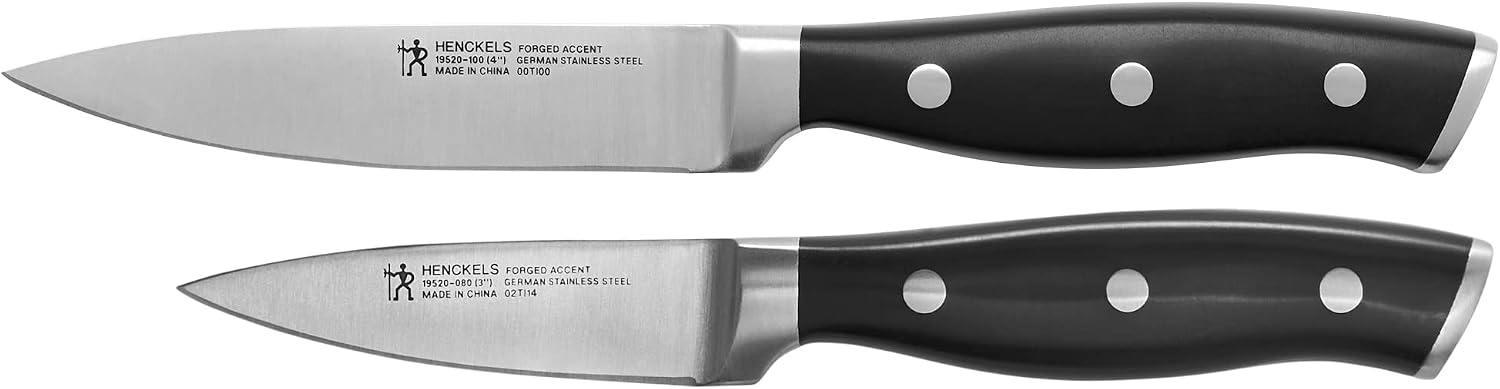
The paring knife: Henckels Forged Accent 2-Pc Paring Knife Set, Razor-Sharp German Engineered
Check current Amazon price.
This is the second knife most people skip and then miss every single day. A paring knife is the blade for work that happens in your hand or over a bowl: hulling strawberries, trimming green beans, peeling apples, taking the top off a garlic clove, deveining shrimp. The chef's knife stays on the board for that. A paring knife goes where the board cannot.
Henckels builds this one forged, with German-engineered steel, which means it has the weight and the tang that a stamped paring knife does not. That weight matters more than people expect in a small knife. A forged paring knife does not flex when you are working around a curve, and it does not feel like a toy in a grown hand. Two sizes in the set means one for detail work and one for slightly bigger jobs, and you will find a favorite within a week.
Flaws but not dealbreakers: A forged paring knife is heavier, and the bolster sits close to the edge, so sharpening the first half inch takes a little patience on a stone. If you want the lightest possible paring knife, a stamped blade will feel nimbler. I still prefer forged, because the stamped ones I have owned either wandered off or bent.
Anyone building a first real knife setup, or replacing the paring knife that came in a cheap block, should start here.
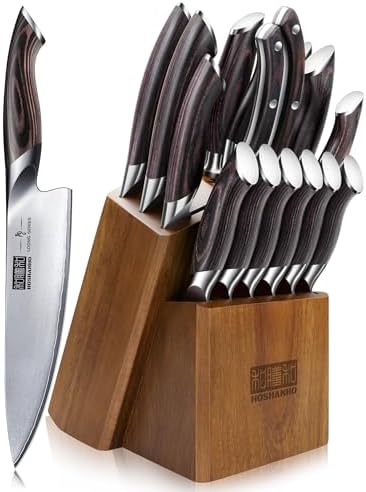
The full set: HOSHANHO 16PCS Knife Set, Ultra Sharp Japanese Kitchen Knife Set with Block
Check current Amazon price.
If you want the block on the counter and everything in one purchase, this is the set to look at. Japanese-style knives run thinner behind the edge than German knives and take a steeper angle, which makes them excellent on vegetables and precise on protein. The 16-piece count means you get the full range, including the steak knives and the bread knife that most people end up buying separately anyway.
"Ultra sharp" on a box is marketing, and I say that as someone who has opened hundreds of boxes. Every knife is sharp from the factory. That is the start line, not the finish. What matters is what happens in week three, and whether the geometry lets you bring the edge back with a steel and a stone.
Two things to check before you commit to any block set. First, count the pieces you will actually use. A 16-piece set that includes a pile of steak knives is really a smaller set with packaging. Second, look at how the block holds the blades. A slot that lets the edge rest against wood or plastic at a bad angle will dull a knife every time you put it away, which is the most common way a good set goes bad in a home kitchen.
Flaws but not dealbreakers: Japanese-style steel is harder and thinner, so treat it accordingly. It is a joy on onions and tomatoes and it is not the knife for hacking through a chicken carcass or anything frozen. Use the heaviest blade in the set for that, or keep a cheap cleaver for bones.
Anyone who wants a complete counter setup in one purchase, and who will hand wash and dry the blades, will get years out of this.
The actual setup workflow
Now the part you came for. This works whether you bought one knife or sixteen.
Step one: Track your cuts for a week. Before you buy anything, notice which knife you reach for and what you cut with it. Most home cooks use one knife for the bulk of the work. That knife is your priority, and everything else is support.
Step two: Put your money into the chef's knife. An 8-inch chef's knife is the one blade that does the most work in any kitchen. If you are splitting a budget, spend it here. A great chef's knife with a modest paring knife beside it will out-cook a mediocre set every time.
Step three: Add one small knife. A paring knife handles the off-board work: hulling, trimming, peeling, deveining. This is the piece people forget and then improvise with a chef's knife, which is how fingers get cut.
Step four: Buy both a honing steel and a sharpener. A honing steel is not a sharpener. It is a realignment tool, and yes, you need both. The steel straightens the rolled edge that happens with normal cutting. A stone removes steel and creates a new edge. Use the steel often, the stone rarely, and never confuse the two.
Step five: Hone before every session. Five to ten light strokes per side at roughly a 15 to 20 degree angle, matching the blade's existing bevel. If the edge catches on your thumbnail, it is ready. If it slides, keep going.
Step six: Sharpen on a schedule, not on a feeling. When honing stops bringing the edge back, it is stone time. For a home cook that is usually every couple of months. In a professional kitchen it is weekly. If you cannot remember the last time you sharpened, that is your answer.
Step seven: Fix your cutting board. Wood or plastic, and never glass, ceramic, or stone. A glass board will roll an edge in a single meal. This one change does more for edge retention than any upgrade you can buy.
Step eight: Fix your storage. A magnetic strip, edge guards, or a block with slots that hold the blade properly. Knives loose in a drawer chip each other, and a bad block dulls a knife on insertion every single time. If your block came with the set, check how the blades sit in it before you trust it.
Step nine: Hand wash and dry immediately. No dishwasher, ever. Heat, detergent, and the knocking around of a rack will wreck a handle and spot an edge. Thirty seconds at the sink is the cheapest knife maintenance there is.
Step ten: Retire the dead weight. If a knife has not been used in a year and cannot be sharpened back into service, it is taking up a slot that should hold something you reach for.
The competition and why it lost
The German classics are still the benchmark. Wüsthof Classic takes an edge, holds it through a service, and the bolster is actually comfortable in the hand. Zwilling Pro is the best German alternative, with an ergonomic handle and slightly softer steel that is easier to maintain if you sharpen at home. Both are excellent and both are priced accordingly, which is fine if you are buying one knife for a decade.
Shun Classic is the best Japanese entry point. Screaming sharp out of the box, but the steel is brittle and you will pay for sharpening if you are not doing it yourself. That is not a knock, it is a trade: hardness buys edge retention and costs toughness.
Victorinox Fibrox is the best budget option, and the chef's knife is the best value blade in existence at its price point. The rest of the set is just okay, which is exactly why I would buy the chef's knife alone and pair it with a better paring knife.
Mercer Culinary is the professional sleeper. It is what a lot of restaurant kitchens actually use, and it shows in the handle and the balance.
What loses every time is the oversized set that leads with the block instead of the blade. You are paying for wood, a bread knife you will not use, and a stack of steak knives that will never touch a steak. If that is the budget, buy one good chef's knife instead and add the paring knife next month.
What this all costs
The two picks in this guide cover both ends of the decision: a small forged paring set for people building knife by knife, and a complete Japanese-style block set for people who want it handled in one purchase. Check current Amazon price on each before you decide, because both move.
What actually costs you money over ten years is not the knives. It is the sharpening. A honing steel and a combination stone are a one-time purchase that will outlast several sets of knives, and the habit of using them is free. The person who spends the least on blades and the most on maintenance ends up with the best edges in the neighborhood.
The math is simple. Two good knives, honed before you cook, sharpened when honing stops working, washed and dried by hand, stored off the edge. That is a setup that will still be cutting in a decade. The big block that lives in the dishwasher is a set you will replace in two years.
Start with the knife you will use tonight. The rest is garnish.