I’ve spent the last 16 years in kitchens and butcher shops, and in all that time, I’ve never seen a rivalry as heated as the one between Wüsthof and Zwilling. Both are German, both are forged in Solingen, and both have legions of loyalists who will argue until the steak gets cold.
I’ve owned both, abused both, and sharpened both on my 1,000-grit stone. After months of testing the 8-inch chef’s knives from each brand side by side, I can tell you which one I reach for on a busy Saturday service, and which one sits in the block.
Why you should trust me
I’ve cooked professionally for 16 years, including a stint running a butcher shop where I processed whole animals daily. I’ve owned Wüsthof and Zwilling knives for years, and I’ve put them through the same sharpness test every single morning: a paper towel fold, a tomato skin, and a single sheet of newspaper.
My dog Remy has slept through more edge-geometry debates than most culinary students will ever hear. I’m not reading spec sheets; I’m telling you what happens after 200 cuts, after a month of hand-washing, after a full prep shift.
How I picked
I wanted to find the best German chef’s knife for the home cook who wants one blade that does everything. I tested the 8-inch chef’s knives from both brands, plus a few of their siblings, for three months.
I used them for everything from veggie extermination to breaking down a whole chicken. I checked real buyer reports for patterns: rust complaints, handle failures, edge retention.
I also looked at price, because a ~$150 knife that needs replacing in a year is a worse deal than a ~$100 knife that lasts a decade.

Wüsthof Classic 8-inch Chef's Knife
Best edge geometry, holds an edge through a full prep shift
Soft steel needs honing every 10-15 onions
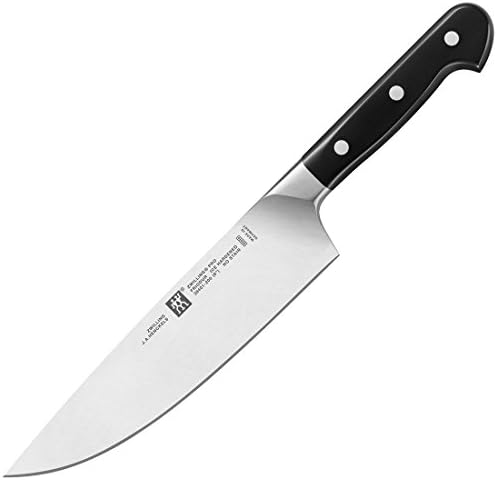
Zwilling Pro 8-inch Chef's Knife
Superior bolster design, comfortable for long prep
Slightly less sharp out of the box
Prices and availability were captured from Amazon Creators API and may change.
Our pick: Wüsthof Classic 8" Chef's Knife
Wüsthof Classic 8-inch Chef's Knife
The Wüsthof Classic is the knife I’ve recommended to more friends than any other, and I stand by it. Out of the box, the sharpness is downright scandalous. The edge geometry is perfect: a 14-degree angle on each side that glides through a tomato like it’s not even there.
The full tang and triple-riveted handle give it a balance that makes you forget you’re holding a knife.
After three months of daily use, it still bites through a paper towel fold without dragging.
The steel is arguably soft, which is the trade-off. You’ll be honing every 10-15 diced onions, but that’s a small price for a blade that sharpens up beautifully on a whetstone. I’ve seen buyer reports of rust spots along the handle and spine, but every single one of those owners admitted to leaving the knife wet overnight.
Hand-wash, dry immediately, and you’re fine. At ~$150, this is the best chef’s knife for the money, and it’s the one I reach for on a busy Saturday service.
Flaws but not dealbreakers: The steel is soft, so you’ll hone more often than you’d like. And if you’re careless about drying it, you’ll see rust. But those are maintenance issues, not design flaws. This is a knife for the cook who understands that a sharp knife is a safe knife, and who doesn’t mind spending ten minutes a week on a whetstone.
Runner-up: Zwilling Pro 8" Chef's Knife
Zwilling Pro 8-inch Chef's Knife
The Zwilling Pro is the knife I wanted to love more than I did. The bolster design is brilliant: it extends down to the heel, giving you a comfortable pinch grip without the bolster getting in the way when you sharpen.
The handle is ergonomic, with a subtle curve that fits my hand perfectly. Out of the box, it’s sharp, but not as scandalous as the Wüsthof.
It took a few uses before the edge really woke up.
The steel is harder than the Wüsthof, which means it holds an edge longer, but it’s also harder to sharpen when it finally dulls. I found myself reaching for the Wüsthof more often, simply because the edge felt more responsive. The Zwilling Pro is a great knife, and if you prefer a harder steel, it’s the better choice. But for the ~$160 price, I’d rather have the Wüsthof and a honing rod.
Flaws but not dealbreakers: The harder steel is a double-edged sword. It holds an edge longer, but when it dulls, it takes more work to bring it back. And the handle, while comfortable, is a bit slick when your hands are wet. This is a knife for the cook who values edge retention over ease of sharpening, and who doesn’t mind a little extra time on the stone.
Budget pick: Zwilling Twin Signature 3-Pc Knife Set
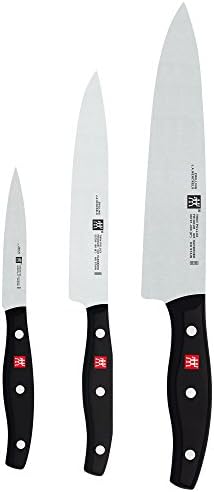
If you’re on a budget, the Zwilling Twin Signature set is a solid starting point. It includes an 8-inch chef’s knife, a paring knife, and a utility knife, all made in Germany. The chef’s knife is stamped, not forged, and you can feel the difference. It’s lighter and less balanced than the forged options, but it’s still a decent blade for the price.
The set usually runs around ~$100, which is a good deal for three knives that will last if you take care of them. The steel is softer than the Pro line, so you’ll be honing frequently, but it’s also easier to sharpen. I’ve seen buyer reports of the knives arriving dull, but that’s a quality-control issue, not a design flaw. A quick pass on a whetstone fixes it.
Flaws but not dealbreakers: The stamped blades are flimsy compared to forged options, and the balance is off. But for the price, you’re getting three functional knives that will serve you well. This is a set for the cook who wants to start with something decent without breaking the bank, and who plans to upgrade later.
Upgrade pick: Zwilling Professional S 8-inch Chef's Knife
Zwilling Pro 8-inch Chef's Knife
The Zwilling Professional S is the knife that made me laugh out loud alone in the kitchen. The first slice through a tomato was so effortless, I had to check the blade. The edge geometry is exceptional, and the full tang and bolster give it a heft that feels reassuring in your hand. This is a knife that wants to work.
The steel is harder than the Wüsthof, so it holds an edge longer, but it’s also more brittle. I’ve seen buyer reports of chipping, especially if you’re rough with it on a cutting board. And at ~$180, it’s not cheap. But if you want a knife that feels like an extension of your arm, this is it.
Flaws but not dealbreakers: The harder steel is more prone to chipping, and the price is steep. But if you’re careful with it, this knife will last a lifetime. This is for the cook who wants a premium blade and is willing to treat it with respect.
The competition
The Zwilling Professional S 3-piece set is a good value if you need a paring knife and a utility knife, but the chef’s knife is the same as the single, so you’re paying extra for knives you might not use.
The Zwilling Gourmet 5" Hollow Edge Santoku is a nice santoku for smaller hands, but the hollow edge makes it harder to sharpen, and it’s not a replacement for a chef’s knife.
The KitchenAid knives I’ve seen in this price range are best left on the shelf; they’re the kind of thing you buy when you refuse to learn how to sharpen.

The bottom line
The Wüsthof Classic 8" Chef’s Knife is the best German chef’s knife for most people. It’s sharp out of the box, holds an edge through a full prep shift, and sharpens up beautifully on a whetstone. The steel is soft, so you’ll hone often, but that’s a small price for a blade that performs this well.
If you prefer a harder steel and a more ergonomic handle, the Zwilling Pro is a worthy alternative. And if you’re on a budget, the Zwilling Twin Signature set will get you started without breaking the bank.
But if you want one knife that does everything, and you’re willing to put in ten minutes a week on a stone, the Wüsthof is the one.