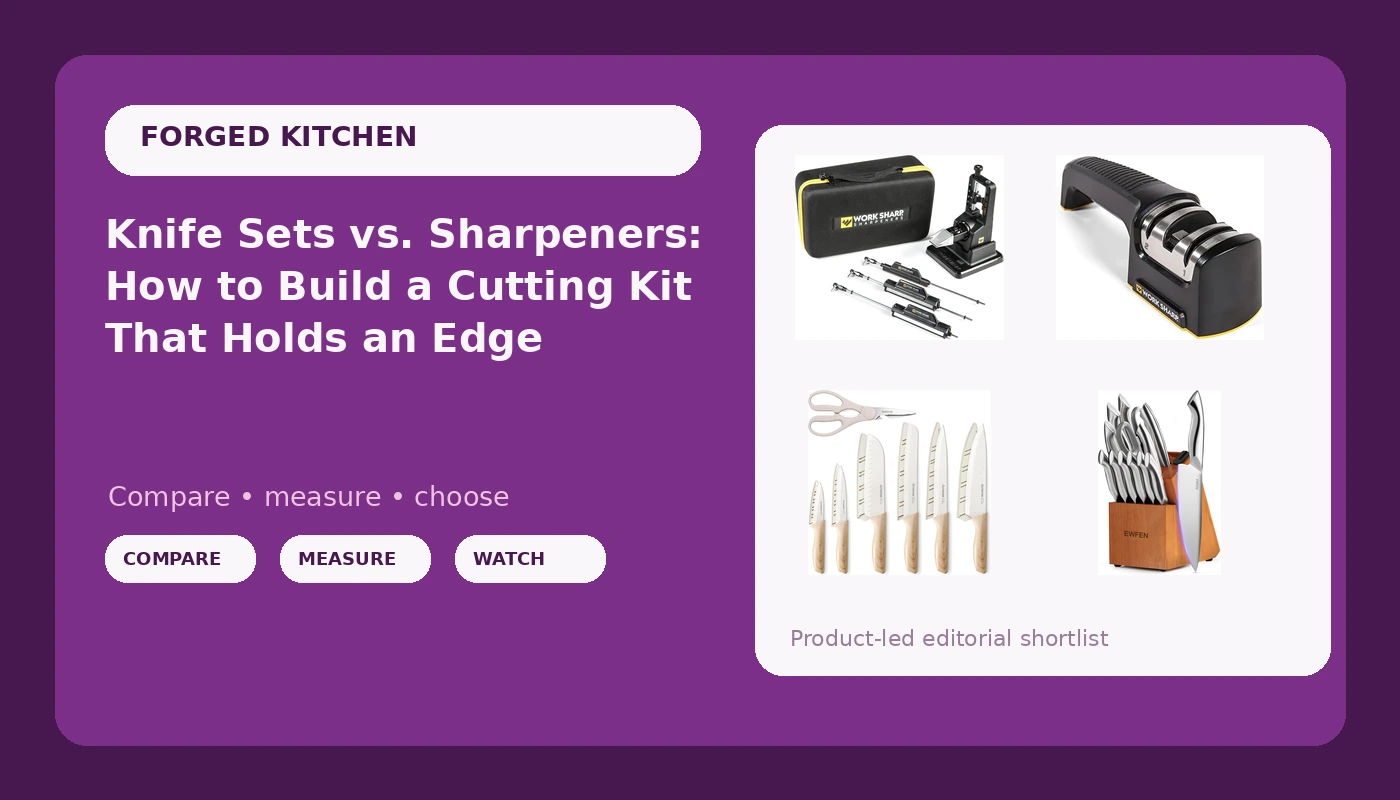
The knife aisle sells two things that look unrelated and are not: knife sets and sharpeners. A set promises a whole block of tools in one purchase. A sharpener promises those tools will still cut next month. Most home cooks buy the set, reach for the chef's knife for everything, and then wonder why dicing an onion has turned into a wrestling match. Here is the honest version: a set is mostly one blade, and a sharpener is the part that keeps that blade worth owning. This explainer covers what each of the four options below is actually built to do, where the trade-offs sit, and how to decide which one fits the way you cook.
Related: Honing vs. Sharpening: Why Your Steel Isn't Fixing Anything →
Quick answer
A knife set gives you the blades; a sharpener keeps them cutting. If you want the simplest path, pair a modest set with a real sharpening plan instead of buying a large set and hoping for the best. A block set with a built-in sharpener covers both in one purchase, while a fixed-angle guided system gives you more control and repeatable edges over time. Match the choice to how often you actually cook, not to the piece count printed on the box.
Four useful options
| Model | Best fit | What stands out |
|---|---|---|
| Astercook 13-Piece Knife Set with Ceramic Coating | First kitchens, rentals, and drawer storage | 13 pieces including six blade guards; ceramic-coated stainless steel; wood grain handles |
| EWFEN 14-Piece Knife Set with Block | Cooks who want storage and upkeep in one buy | German stainless steel; storage block with a built-in knife sharpener; curved anti-slip handles |
| Work Sharp Precision Adjust Elite Knife Sharpener | Anyone ready to sharpen at a repeatable angle | Fixed-angle guided system built for kitchen and pocket knives |
| Work Sharp Pull Through Kitchen Knife Sharpener | Fast touch-ups between full sharpenings | Pull-through design for quick edge maintenance on kitchen knives |
The everyday set: Astercook 13-Piece Knife Set
The ceramic coating is the detail worth understanding. A coating is a surface treatment over a stainless blade, and it can help with sticking and cleanup, but it is not the same thing as a hard, thin, hand-finished edge. Treat it as a convenience feature, not a performance guarantee. The blade guards, on the other hand, do real work: knives in a loose drawer dull against each other far faster than they dull against food. As for the dishwasher listing, heat and detergent are hard on edges and handles, so hand washing and immediate drying will keep any set in better shape for longer.
The block set: EWFEN 14-Piece Knife Set
A built-in sharpener in a block is usually a pull-through slot, which means it removes metal quickly and is best used in short bursts rather than as a weekly ritual. Its real value is psychological: the tool is right there, so you use it, and a knife you actually maintain beats a better knife you never touch. Two things to check when the set arrives. First, how the block holds the blades, since a slot that lets an edge rest against wood or plastic can dull a knife as you slide it home. Second, the grip, because a curved handle with an anti-slip surface is only useful if it fills your hand comfortably through a full pile of vegetables.
The guided system: Work Sharp Precision Adjust Elite Knife Sharpener
Angle consistency is the whole argument for a guided system. An edge is a bevel, and a bevel only forms cleanly when the abrasive meets the steel at a steady angle. Sharpen at 15 degrees one month and 25 the next and you are grinding a new bevel each time, which wastes steel and never quite gets sharp. A fixed-angle setup solves that by removing your wrist from the equation. The trade-off is time and setup: this is a session tool, not a ten-second fix, and it rewards the cook who is willing to spend twenty minutes once every month or two. It also handles pocket knives, which makes it a household tool rather than a kitchen-only one.
The quick touch-up: Work Sharp Pull Through Kitchen Knife Sharpener
Pull-through sharpeners work by dragging the edge through fixed abrasive slots. That is effective and fast, and it removes metal at a rate that is perfectly reasonable for an inexpensive stamped knife and hard on an expensive thin blade. The practical rule: use a pull-through for the knives you bought as a group, and keep it away from anything you would be upset to replace. Pair it with a honing steel, and understand the division of labor. Honing realigns an edge that has folded over. Sharpening removes steel to create a new edge. They are not substitutes, and a set that gets both treatments lasts far longer than one that gets neither.
Prices and availability may change. Product images, names, and retailer links are matched to verified listings. No current price, rating, stock status, or measured result is stated here without current evidence.
What a 13-piece or 14-piece set actually contains
Piece count is the least useful number on the box. In practice, a set like these is one chef's knife, a paring or utility knife, a serrated bread knife, and then a stack of steak knives and extras that pad the count. The chef's knife does the overwhelming majority of the work, so that is the blade worth judging. If the chef's knife feels balanced and the handle fills your hand, the set is probably fine for a home kitchen. If it feels like a stamped blank with a hollow handle, the extra pieces will not save it.
Construction matters more than count. A full tang, where the steel runs the length of the handle, is the difference between a knife and a disposable tool; a handle held together by rivets through a partial tang is the part that fails first. Stamped blades are not inherently bad, they are just thinner and softer than forged ones and will not hold an edge as long under heavy use. Storage is the other quiet variable. A block looks tidy, but a magnetic strip or individual blade guards usually treats edges better, because nothing touches the cutting edge when the knife is put away.
Finally, ignore the pieces you will never use. A bread knife is worth having only if it actually slices bread rather than crushing it. Steak knives are worth having only if you serve steak. Every extra piece is cost you could have put toward the chef's knife or toward the sharpener that keeps it alive.
Sharpening, honing, and the habit that keeps a set alive
Sharpness is a maintenance habit, not a purchase. The best knife in a drawer goes dull, and a modest knife that gets honed weekly and sharpened twice a year will outcut it at dinner every single night. The two jobs are different, and mixing them up is why so many home cooks think their knives are ruined when they are merely tired.
Honing is realignment. A few light strokes on a steel or ceramic rod, at roughly the angle the knife was made with, straightens an edge that has rolled over during normal cutting. It does not remove meaningful steel and it does not restore a truly dull blade. Sharpening is abrasion. It grinds away steel to rebuild the bevel, and it is the only thing that fixes a knife that will not bite into a tomato.
- Hone lightly before or after each cooking session, a few strokes per side, with almost no pressure.
- Test the edge honestly. If it slides across a tomato skin instead of catching, it needs more than honing.
- Sharpen when honing stops helping, which for a home kitchen is usually every few months.
- Match the tool to the knife: a pull-through for inexpensive blades, a guided fixed-angle system for anything you plan to keep.
- Rinse and dry the blade after sharpening, since abrasive residue and moisture are not kind to steel.
How to keep any set cutting
- Hand wash and dry immediately, even when the listing says dishwasher safe.
- Store blades on a magnetic strip, in a block that does not touch the edge, or in individual guards.
- Cut on wood or plastic boards, never glass or stone, which roll an edge in a single meal.
- Use the right knife for the job: no frozen food and no bones with a thin blade.
- Keep a honing steel within arm's reach and a sharpener in the drawer, because a tool you have to hunt for does not get used.
Which option should you choose?
Choose the Astercook Knife Set, 13 Pieces Kitchen Knives Set with Ceramic Coating, Stainless Steel Chef Knife Sets with 6 Blade Guards, Dishwasher Safe Knives with Wood Grain Handle, Elegant White when you are outfitting a first kitchen or a rental and want guards to keep blades separated in a drawer. Choose the Knife Set, EWFEN 14-Piece Kitchen Knife Set with Block, German Stainless Steel Knives with Built-in Knife Sharpener, Anti-Slip Sharp Knives Set for Kitchen, Dishwasher Safe, Curved Handle when you want storage and a sharpener included in the same purchase. Choose the Work Sharp Precision Adjust Elite Knife Sharpener - Fixed Angle Sharpening System for Kitchen & Pocket Knives - Professional Guided Knife Sharpening Tool when you are ready to sharpen at a repeatable angle and want one system for kitchen and pocket knives. Choose the Work Sharp Pull Through Kitchen Knife Sharpener when you want a fast touch-up tool for the months between full sharpenings.
One caveat worth stating plainly: the listings for these products do not publish angle figures, steel hardness ratings, or edge-retention results, so nothing here claims them. What is described is what the products are built to do and how that fits a real kitchen routine.
The bottom line
Buy the set for the chef's knife, and buy the sharpener because the set is only as good as the edge on it. A 13-piece set with blade guards and a block set with a built-in sharpener both solve the storage and starter-kit problem; a guided fixed-angle system and a pull-through sharpener solve the maintenance problem at two different levels of effort. If you cook a few times a week, one decent chef's knife, a paring knife, and a sharpening habit will outlast any oversized block. Check current Amazon price on each option, and put the money you save on extra pieces toward keeping the blades you actually use sharp.