Most cooks own one knife they actually use and a drawer of knives they feel guilty about. The chef's knife takes the onions, the cabbage, the chicken. Then the shallot, the strawberry, the mushroom stem, and the shrimp vein show up, and people keep forcing the big blade through work it was never built for.
I'm Erik. I cooked for sixteen years, six of them on the line in fine dining and four running a butcher shop, and I have sharpened more knives than most people will ever own. Paring knife skills are the least glamorous thing I teach and the fastest to pay off. Small blades do small work, and once you stop fighting a chef's knife through a strawberry hull, prep gets quicker and the cuts get cleaner.
The short version: one small knife you can control with your fingertips, a board that will not dull it, and a habit of touching up the edge. Everything below is the long version.
Why you should trust me
Sixteen years in professional kitchens, a thousand-grit stone on the counter, and a sharpness test every single morning before service. I spent four of those years in a butcher shop, which is where I learned that a knife is a maintenance habit and not a purchase. I have taken stamped blades that cost less than lunch and gotten them sharper than forged knives that cost ten times as much, and I have watched four-hundred-dollar blades go dull in a month because nobody owned a honing steel.
I do not care what a knife costs. I care whether it holds an edge through a prep shift, whether the handle is still comfortable after two hundred cuts, and whether I can put it on a stone without fighting a bolster.
How I judge a paring knife before it earns drawer space
A paring knife is the cheapest knife in the kit and the one you touch the most. That combination means the criteria are different from what you would use on a chef's knife.
Edge geometry. A paring knife should be thin behind the edge. Thick stock splits a strawberry instead of slicing it. You want a blade that glides through a tomato skin with almost no pressure.
Blade length. Three to four inches. Anything longer and you have a utility knife that does not fit in your hand for peeling. Anything shorter and you cannot core a tomato.
Handle comfort in a pencil grip. You will hold this knife like a pencil, not with a pinch grip on the bolster. If the handle has hard seams or a slick finish, your hand will cramp during a bag of potatoes.
Ease on the stone. A paring knife gets sharpened more often than any other blade in the house because it does the most contact work. If the steel fights you on a stone, it will sit dull in the drawer.
Storage. This is the one people skip. A paring knife that lives loose in a drawer gets its edge knocked off by the vegetable peeler next to it. Covers, a magnetic strip, or a slot in a block, pick one.
Price per knife if it comes in a pack. Multiple small knives in one box is not automatically a gimmick. In a house with two cooks, or with kids learning to peel, it solves a real bottleneck.
What you need at the station
Two things, and only one of them is a knife. The other is the tool that keeps your containers honest, because a kitchen that does not label food is a kitchen that throws food away.
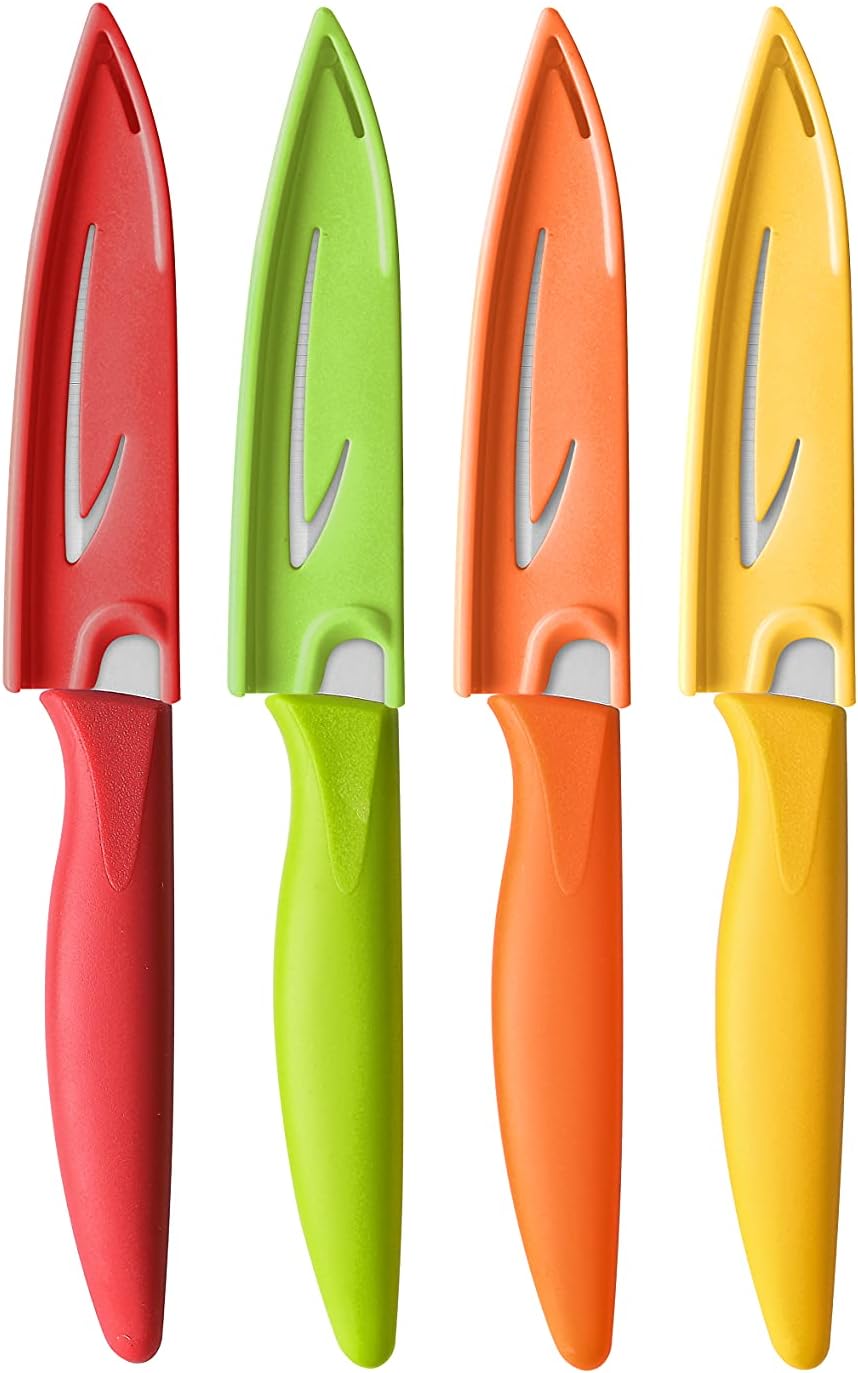
Budget pick: VITUER Paring knife, 4PCS Paring knives (4 Knives and 4 Knife cover), 4 Inch Peeling Fruit and Vegetable Knife, Ultra Sharp Kitchen Knives, German Steel, PP Plastic Handle
 Visit on Amazon →
Four 4-inch paring knives with four covers. German steel, a PP plastic handle, and a blade length that fits small work in the hand rather than on a board.
What you should expect at this tier: a stamped blade that takes a decent edge and gives it back quickly, a handle that is comfortable but not heirloom furniture, and an edge that wants a touch-up more often than a forged German blade does. None of that is a defect. It is the trade you make at the budget end, and for peeling, hulling, and trimming, it is a trade that costs you almost nothing. The honest limitation is that stamped steel flexes if you lean on it, so this is not the knife you pry with or take to a chicken backbone.
The covers are the part I care about most, and they are the reason a four-pack makes sense. A loose paring knife in a drawer loses its edge to whatever metal is rolling around next to it, and it is also the knife most likely to catch a hand reaching in blind. Cover them or put them on a strip.
Flaws but not dealbreakers: Plastic handles feel like plastic, and four cheap knives are still four cheap knives. Keep them out of the dishwasher, do not cut through bones, and plan on a quick hone every week or two.
Anyone setting up a first kitchen, a rental, a camp box, or a house with two people prepping at once will get the most out of a four-pack. Check current Amazon price.
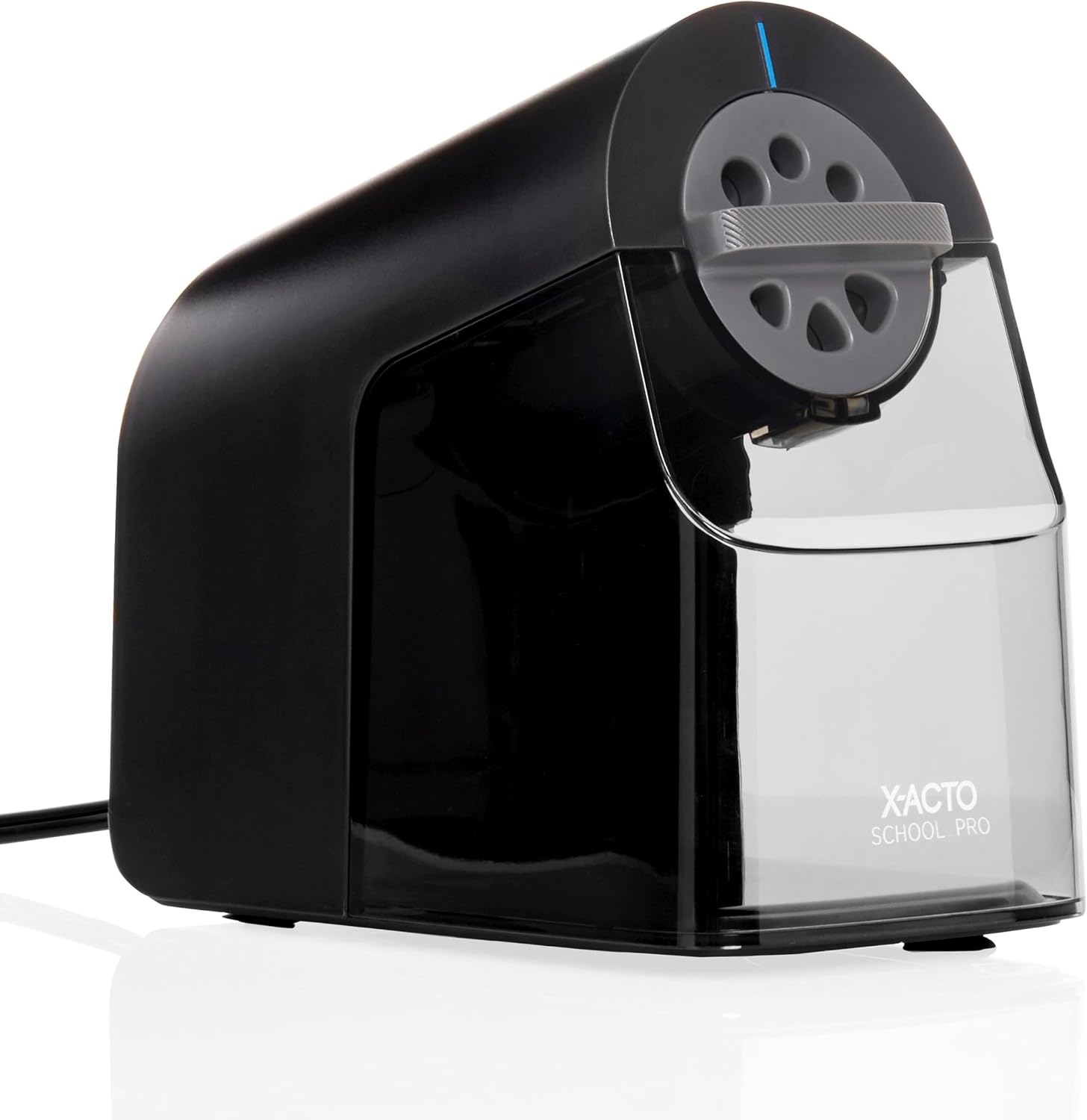
For the labeling station: X-ACTO Pencil Sharpener, School Pro Electric Sharpener, Black, With Six Size Dial, XL Shavings Bin - Heavy Duty, Classroom Supplies
 Visit on Amazon →
Stay with me, because this one is not a knife. In a working kitchen, tape and a pencil do more food safety work than half the gadgets on the shelf. Date dots on every container, initials on the leftovers, the day the stock went on, the allergen note on the shelf. A marker smears the second the container sweats. A pencil on masking tape does not, and it still writes on freezer tape at temperatures where ink gives up.
The catch is that a kitchen pencil goes dull fast, because it gets dropped, dunked, and dragged across cardboard cases. This is a classroom sharpener: an electric unit with a six-size dial and an XL shavings bin, built for a room full of students. A six-size dial means it is not a one-size hole, which is the thing that kills cheap sharpeners, and the oversized bin means you are not emptying it every day.
Flaws but not dealbreakers: It has a cord and a motor, so it wants a dry counter, not the wet side of the sink. Keep it far from the knife drawer so nobody is tempted to feed it anything that is not a pencil. If you label with a marker and never lose track of a date, you can skip it.
Anyone who cooks in batches, freezes, or cooks for other people will reach for it more than they expect. Check current Amazon price.
The actual workflow
This works on any small blade with a thin edge. If your paring knife is blunt, none of it will feel good, so start by honing and, if that does not bring it back, sharpen it.
Step one: set the station. Board in front of you, a scrap bowl to one side, a finished bowl to the other, and a dry towel within reach. Peeling is a two-handed rhythm and you do not want to be hunting for a bowl mid-potato.
Step two: hold the knife like a pencil. Thumb and index finger on the blade just ahead of the handle, the rest of your hand wrapped around the grip. Your wrist stays still. The motion comes from your fingers and the food, not your elbow.
Step three: peel toward your thumb. Hold the potato or apple in your off hand, blade facing your thumb, and shave the skin off in strips while your thumb rotates the food. Keep the thumb behind the blade edge, not under it. If you are new to this, peel on the board instead, flat side down, and move the food, not the knife.
Step four: trim, do not saw. A paring knife cuts in one controlled draw. If you find yourself sawing, the blade is dull or you are cutting something that belongs on a board with a chef's knife.
Step five: hull, core, and stem. Point the tip into the strawberry shoulder, rotate the knife around the green, and pull the hull out in one piece. For a tomato, cut a shallow cone around the stem and lift it. For mushrooms, cut the stem flush instead of snapping it.
Step six: devein shrimp. Run the tip along the back curve, shallow, and lift the vein out. The tip does the work. If you are pressing hard enough to feel resistance, you are too deep.
Step seven: rotate the food, not the knife. The most common mistake with a small blade is moving the knife around a stationary vegetable. Turn the food into the edge instead. It is faster, it is safer, and the cuts come out even.
Step eight: wash and dry it immediately. Warm water, a little soap, towel dry. A paring knife left wet on a rack is a paring knife with a rust spot at the heel by next week.
Step nine: hone weekly, sharpen when honing stops working. A honing steel realigns an edge. It does not restore one. When ten passes on the steel no longer bring the knife back, it goes on a 1,000-grit stone at roughly 15 to 20 degrees per side. That is a fifteen-minute job for the whole four-pack.
Where the labeling habit lives
The pencil sharpener sits on the dry counter next to a roll of masking tape, and that little corner does more for your food budget than any container system. Every container gets a date and a name. Every leftover gets an initial. Every freezer bag gets a pencil line that survives the frost.
The rule in my kitchen is simple: if it does not have a date, it does not go in the walk-in. Pencil, tape, date, done. A sharp pencil writes through the condensation on a deli container, and the tape peels off clean so you are not scrubbing adhesive off plastic every night.
Mistakes that kill a small edge
- The dishwasher. Heat, detergent, and rattling against other silverware. Hand wash it, dry it, put it away.
- Glass and ceramic boards. They are edge killers. Wood or plastic, every time.
- Loose storage. A bare paring knife rolling in a drawer will be dull within a month. Use the covers.
- Prying and bones. A thin blade is not a screwdriver and not a cleaver. Do not cut through chicken backs or frozen anything.
- Treating the steel as a sharpener. If you hone a dull knife forever, you round the edge instead of restoring it.
- Leaving the whole set dirty. Four knives means you always have a clean one, not that you can ignore the sink.
What did not make this list
I left off the twelve-piece block sets, because you are paying for a block, a bread knife you will not use, and four steak knives that belong at the table and not on the board. I left off the long serrated "tomato" knives, because a thin paring knife does that job better. I left off pull-through electric sharpeners, because they remove too much steel too fast on a blade this small. And I left off the oversized utility knives marketed as paring knives, because a five-inch blade does not fit in a pencil grip.
What this all costs
I am not going to quote numbers, because prices move and the wrong number is worse than no number. Check current Amazon price on both items and do the math against what you already spend.
Here is the frame that matters. A paring knife is a consumable in the sense that it gets used hardest, so the money question is not what you pay for the knife, it is what you pay to keep it sharp. One stone and a honing steel, bought once, outlast a decade of replacement knives. The four-pack covers the household bottleneck. The sharpener covers the labeling habit, which is really a food-waste habit in disguise.
Cheap knives with a sharpening routine beat expensive knives without one. Every time.
That is the whole job. Small blade, thin edge, a board that does not fight you, and a date on every container. Do that and your prep gets faster without you buying anything impressive.