My first year on the line, the sous chef made me sharpen every house knife in the kitchen before he would let me touch his. Sixteen years later I still start the morning the same way: a few passes on the steel, a thumbnail test, and an honest decision about whether the edge needs real work. That habit is why I care less about which knife you buy and more about the kitchen knife sharpening setup sitting next to it. A great blade with no maintenance plan is a dull blade in six weeks.
Related: Honing vs Sharpening: Why You Need Both
This comparison puts four very different answers side by side: a three-stage electric sharpener, a compact rolling diamond kit, a dedicated vegetable blade, and a starter set with a block. One of them earns permanent counter space in my kitchen. The rest depend entirely on how you cook and how many knives you actually own.
The short version: a three-stage electric sharpener is the right call for a household with a mixed drawer of blades, a rolling diamond kit is the right call for a small kitchen and one or two good knives, and a block set is a starter kit, not an heirloom. The long version is mostly about angles, steel, and habits, so let's get into it.
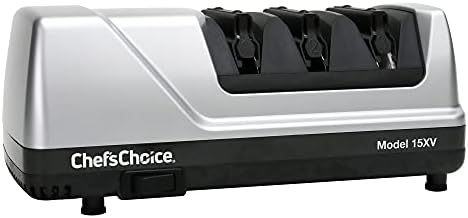
Chef'sChoice 15XV EdgeSelect Professional Electric Knife Sharpener
Three stages and 100 percent diamond abrasives, with precision angle guides and support for both straight edge and serrated knives
Needs counter space and an outlet, costs more than every other item here combined, and rewards careless use by eating steel
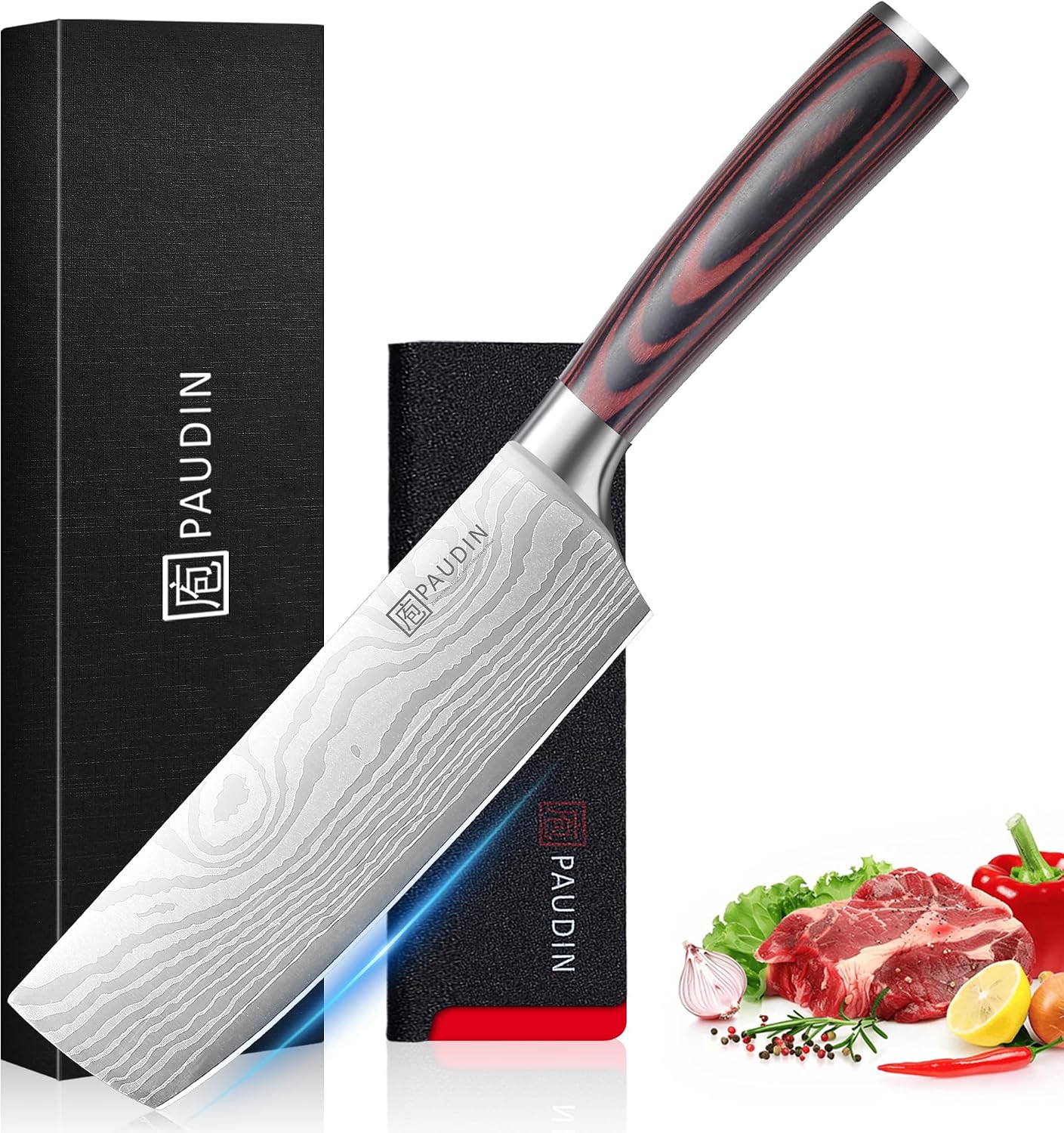
PAUDIN Nakiri Knife, 7 inch
A tall, thin, flat-profiled vegetable blade in high carbon stainless steel that makes prep work feel effortless
It is a specialist, not a chef's knife. No tip, no rock chop, and nothing with a bone in it

AIERLIAN Rolling Knife Sharpener Kit
Diamond and ceramic abrasives with magnetic 15 and 20 degree angle guides, sized to live in a drawer
The rolling motion takes practice, and it will not rescue a chipped edge or a serrated blade
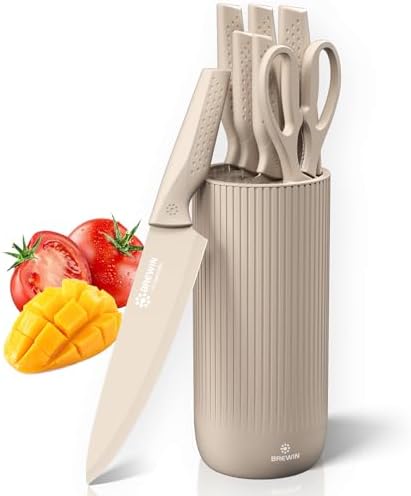
Brewin Kitchen Knife Set with Universal Knife Block
Everything a first kitchen needs in one box, with a block to hold it, at a price that will not scare anyone
Block sets always include one or two pieces you will never reach for, and the steel is a starting point rather than a destination
Prices and availability were captured from Amazon Creators API and may change.
How I judge a sharpening setup
Three questions decide it for me, and none of them involve the word "professional" on the packaging.
First, does it produce a repeatable angle? An edge is a geometry problem. If the angle wanders every time you touch the blade, you are not sharpening, you are grinding. Guides, magnets, and slots exist so your hands do not have to be perfect.
Second, does it work on the steel you actually own? A soft German blade and a hard Japanese blade want different treatment. A tool that only handles one of them is a tool with a narrow job.
Third, does it live somewhere you will use it? The best sharpener in the world is worthless in a cupboard behind the stand mixer. If it takes two hands, a cord, and a cleared counter, it gets used twice a year.
That is the whole test. Now the four products.
The electric option: Chef'sChoice 15XV EdgeSelect
This is the one I recommend when someone tells me their drawer contains a German chef's knife, a couple of steak knives, a serrated bread knife, and a paring knife from a grocery store. The 15XV is a three-stage machine with 100 percent diamond abrasives in the sharpening stages, precision angle guides, and a design that handles straight edge and serrated knives in the same unit. For a household with mixed steel and mixed skill levels, that breadth is the entire argument.
Stage one is for a blade that has been abused, the kind that will not catch a tomato skin. Stage two builds the actual edge. Stage three is the polish and strop stage, which is where a decent edge becomes a pleasant one. The angle guides take the guesswork out of holding a consistent bevel, and that consistency is what makes an edge last longer between sessions. You are not learning a skill so much as operating a machine correctly.
The honest trade-offs. It costs more than the other three items in this comparison combined, and it needs real counter space plus an outlet. It removes steel faster than a stone or a rolling kit, which is fine when you use it properly and expensive when you do not. And it is not a substitute for a honing steel. An electric sharpener resets the bevel; a steel realigns it between sessions. I reach for the steel daily and the sharpener rarely, and that ratio is the point.
The rolling option: AIERLIAN rolling sharpener kit
A rolling sharpener solves the two problems that kill most home sharpening habits: storage and angle discipline. The AIERLIAN kit uses diamond and ceramic abrasives with magnetic angle guides set at 15 and 20 degrees, and it is small enough to keep in a drawer instead of a cabinet. You place the blade in the magnetic holder, which locks the angle, then roll the sharpening body along the edge.
That magnetic angle system is the reason I like this format for a beginner. Most people who think they cannot sharpen a knife are really people who cannot hold a steady 20 degrees freehand. Remove that variable and the results improve immediately. The 15 degree setting suits thinner, harder Asian blades, and 20 degrees suits the softer Western steel most people own. Diamond abrasive handles steel of any hardness, which is more than you can say for a lot of cheap pull-through gadgets.
The trade-offs are real. The rolling motion is a technique, and your first few attempts will feel clumsy until the muscle memory arrives. It will not repair a chipped edge, and it will not do anything useful for a serrated bread knife. It is also a maintenance tool, not a repair tool. If your knives are in genuinely bad shape, you either need the electric machine or a coarse stone and some patience.
The nakiri: a specialist worth the drawer space
Most people should own one great chef's knife before they own anything else. After that, the PAUDIN nakiri is the blade I would add first, especially if you cook a lot of vegetables.
A nakiri is a flat-profiled, tall, thin blade with no tip. You push it straight down through an onion, a carrot, or a cabbage and the food releases instead of clinging, because the blade is tall enough to scoop. There is no rocking motion, which means less wrist fatigue over fifty pounds of prep. The high carbon stainless steel takes a keen edge, and the ergonomic handle keeps the grip comfortable through a long session.
What it will not do: chop through a chicken backbone, carve a roast, or handle any task that wants a fine tip. A nakiri is not a replacement for a chef's knife, and anyone who tells you otherwise has not broken down a chicken with one. It is the second knife, the one that makes the first knife last longer because you stop abusing it on vegetables.
If you buy it, match your sharpening angle to it. Thin Asian blades generally want the 15 degree setting on a rolling kit or an angle guide, not the 20 degree setting designed for thick German steel. Sharpening a nakiri at 20 degrees is not a crime, but you are giving away the geometry that makes the knife worth owning.
The starter set: Brewin knife set with block
Block sets get a bad reputation from me, and most of them deserve it. The classic offender is the "15-piece" set with four steak knives, a bread knife that cannot slice bread, and a block that dulls every blade on insertion. So when I look at a set like the Brewin kitchen knife set with a universal knife block, I judge it as what it is: a first-apartment, RV, or guest-kitchen purchase.
In that role it works. You get the pieces a new kitchen needs, a block that holds them, and one price that covers everything. The universal block means you can slot in the nakiri or a future upgrade without buying new storage. For someone moving into a first apartment or outfitting an RV, that convenience is worth more than the marginal steel quality you would gain by buying two knives separately.
Where it falls short is longevity. A set at this price is built to a budget, and the difference shows up years later in handle construction and edge retention, not on day one. That is fine as long as you know it going in. If you want knives you hand to your grandkids, you buy one good chef's knife and add from there. If you want a functional kitchen this weekend, a set gets you cooking.
One rule either way: check that the block holds blades by the handle or a magnetic strip rather than letting edges rest against a slot floor. A block that dulls knives on insertion is worse than no block at all.
How the pieces fit together
Here is the pairing logic, which matters more than any single pick.
For a small kitchen and one or two good knives, the rolling diamond kit plus the nakiri is the leanest useful setup here. Compact storage, angle discipline built in, and a blade that makes vegetable prep genuinely faster.
For a full drawer of mixed knives and mixed users, the electric sharpener is the anchor. It handles the serrated bread knife, the cheap paring knife, and the good chef's knife without you learning a new skill for each one.
For a first kitchen with nothing in it, the block set gets you functional, and you add a sharpener next. Do not skip the sharpener. A set without a maintenance plan is a set that goes dull in the same six weeks as everything else.
Sharpening is a habit, not a purchase
This is the part people skip, and it is the part that decides whether any of the above matters.
Buy a honing steel and use it before every session. It realigns the edge; it does not sharpen it. The sharpener is for when realignment stops working, which for a home cook is every few months, not every week.
Pick an angle and stay with it. If your knives are German or generic Western steel, 20 degrees is the safe default. If they are thinner Asian blades, 15 degrees. Mixing angles on the same knife just wastes steel.
Finally, do not chase a razor edge on a knife you are about to cut on a plastic board. A sharp knife and a soft board are a partnership; a sharp knife and a glass board is a countdown.
The bottom line
If you want one purchase that fixes the most knives for the most people, it is the three-stage electric sharpener. If you want the smallest, most affordable tool that still respects edge geometry, it is the rolling kit. The nakiri is the best second knife money can buy for a vegetable-heavy kitchen, and the block set is a starting point, not a finish line.
Buy the sharpener first. Buy the blade second. Buy the set when you need a kitchen running by Friday. That order has never let me down.