Related: How to Hone a Knife Without Rolling the Edge
Sixteen years in kitchens, six of them on a fine dining line and four running a butcher shop, and I still give every cook the same answer when they ask what to buy: a knife set is 80 percent chef's knife. The rest is garnish. That is not a knock on kitchen knife sets. It is a warning about how they get sold, usually in a block with fifteen pieces, four of them steak knives, and a bread knife that cannot slice bread.
I have sharpened more blades than most people will ever own, from twenty dollar stamped knives to four hundred dollar Japanese gyutos, and the pattern never changes. The set that survives in a home kitchen is the one where somebody picked two or three real knives and then committed to keeping them sharp. The set that ends up dull and rusted in a drawer is the one bought for the piece count.
So here is how I would spend the money in 2026: one Japanese set for the cook who wants thin, hard steel, one forged set for the cook who wants weight and toughness, and a guided sharpener for both of them. A knife without a sharpening plan is a rental.
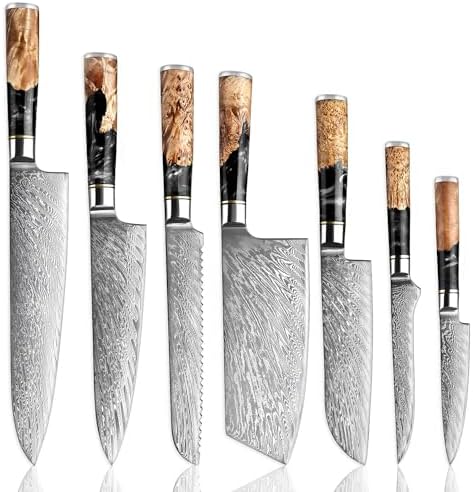
Best Overall for Most Home Kitchens: SENKEN 7-Piece Damascus Kitchen Knife Set
Plenty of sets are one good knife with six friends along for the ride. This one is closer to a real working kit. The Tsunami Collection runs 67-layer Japanese VG10 steel and covers the jobs a home kitchen actually does: chef's knife, santoku, cleaver, bread knife, boning knife, and more, seven pieces in total.
VG10 is the interesting part. It is a hard, fine-grained steel that takes a very fine edge and holds it, and that is exactly what you want when you are working through case after case of onions, carrots, and potatoes. The thin Japanese geometry moves through a tomato under its own weight. The same hardness is the tradeoff. Hard steel is more brittle, so you do not chop through chicken bones or frozen blocks with it, and you do not leave it sitting wet in a sink or a dish rack.
Layered Damascus cladding is not only decoration. Those layers sit around a harder core and give the blade a little toughness to go with the edge. It is also the reason these knives look like they cost more than they do, which matters if you are buying a set as a gift.
The maintenance plan is simple and non-negotiable. Hand wash, dry immediately, hone regularly on a steel, and sharpen on a guided system or a stone. Treat a hard Japanese blade like a tool you intend to keep for twenty years, not like a beater you leave in the block.
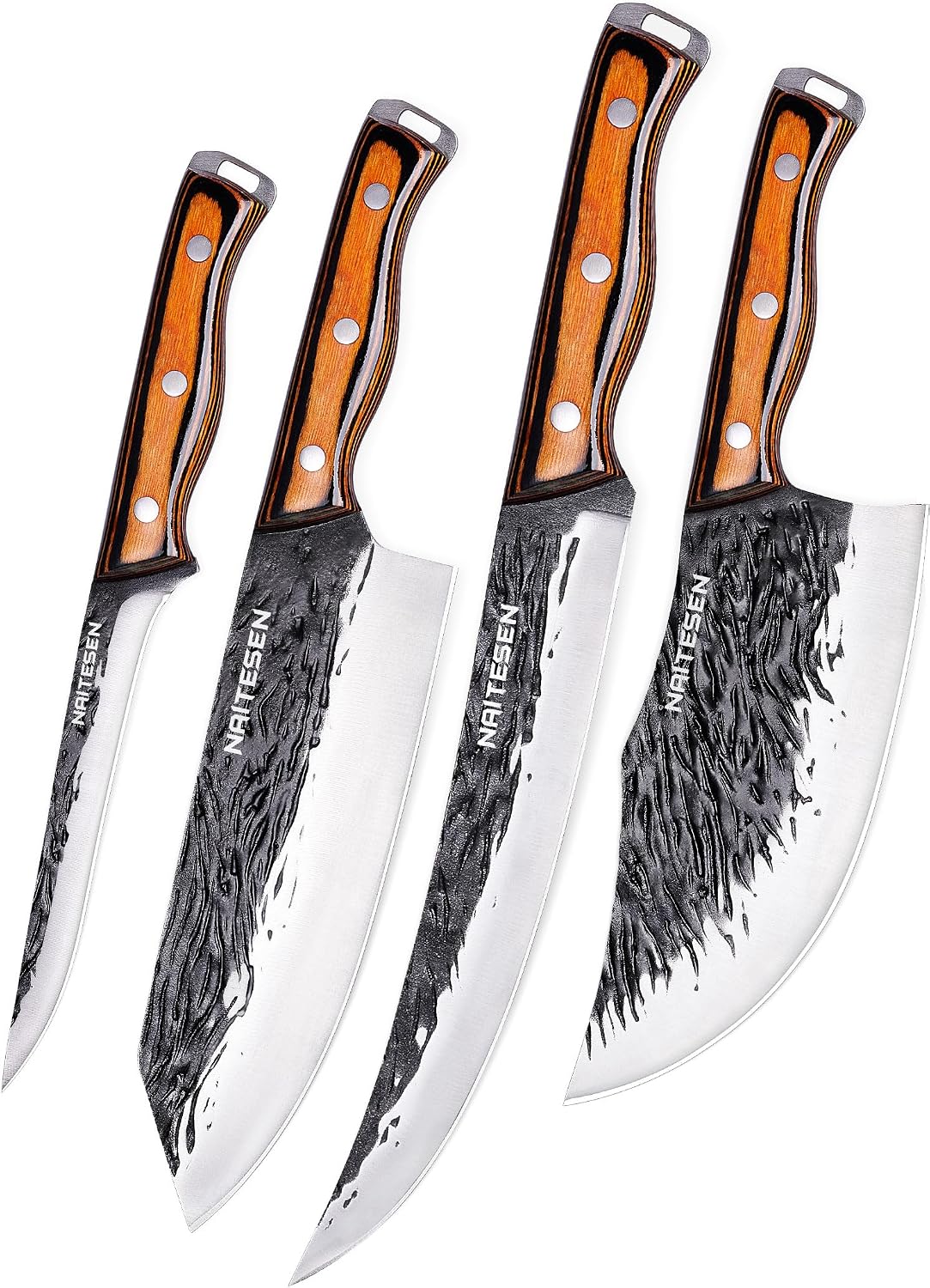
Best Value: 4PCS Hand Forged Butcher Knife Set
If you want forged steel without paying Damascus money, this is the set that fills the gap. Four pieces, hand forged, butcher styling, sold as a gift set for men and women, which tells you the bracket it lives in.
Hand forged matters more than most shoppers realize. Stamped knives are cut from a sheet of steel, and they are perfectly good tools. Stamped steel is not bad. It is just not a knife you will hand to your grandkids. Forged means the steel was shaped under heat, which generally gives you a thicker spine, more weight in the hand, and a blade that shrugs off work that makes thin knives flex. Butcher-style blades run heavier and longer, so they suit breaking down proteins, splitting a chicken, and heavy prep far better than delicate shallot work.
Two things to check on any set in this price bracket. First, full tang. The steel should run the full length of the handle, and that is the difference between a knife and a toy. A bolted handle is a knife that will fail you mid service. Second, the handle itself, because a heavy blade with a handle that does not fit your hand is a blister waiting to happen.
This is also the set I would hand to somebody who cooks with intent but not with a knife budget. It looks like a tool, it feels like a tool, and it does not require you to baby it the way hard Japanese steel does.
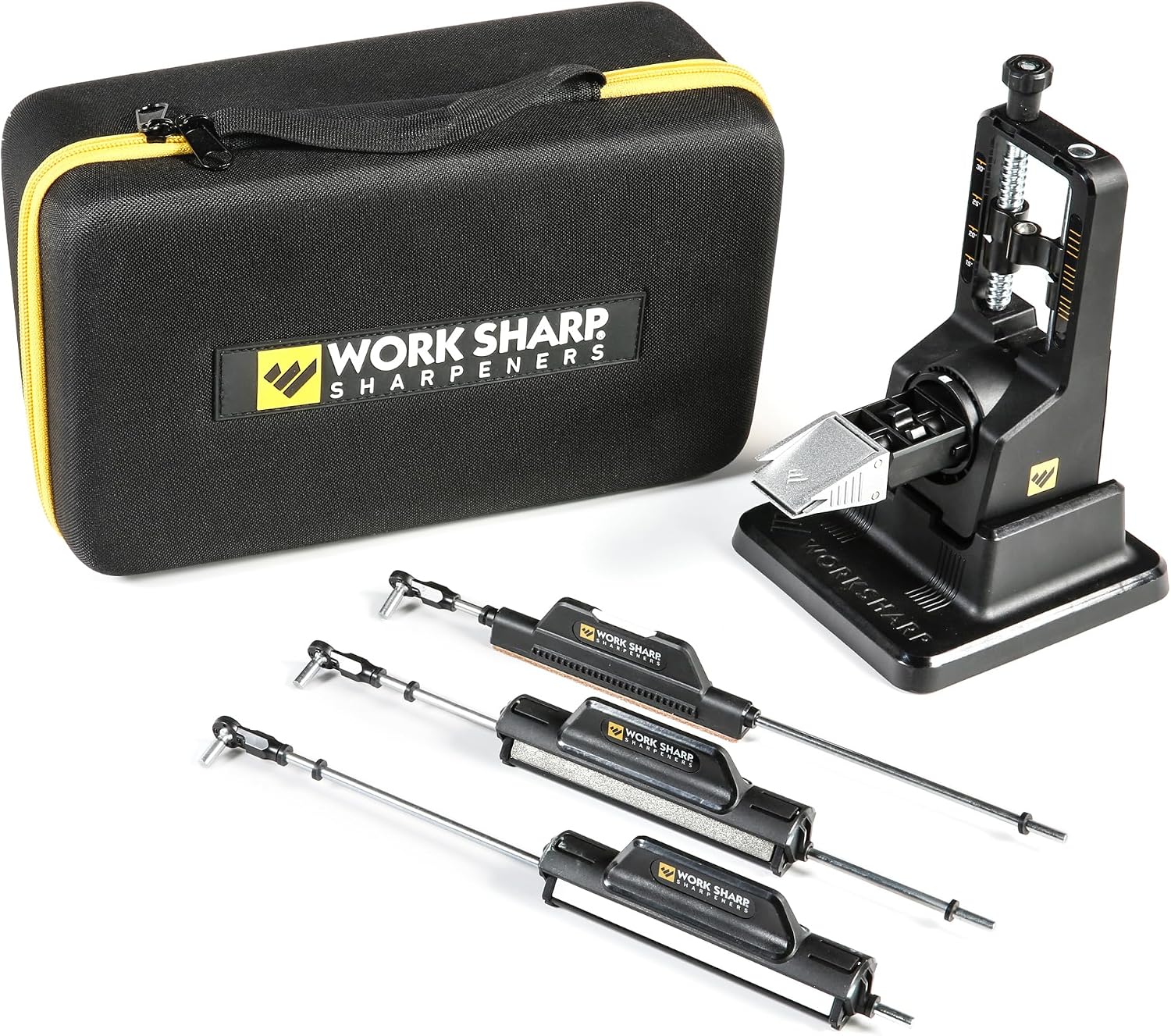
The Piece That Keeps the Whole Set Alive: Work Sharp Precision Adjust Elite Knife Sharpener
No knife talk without a sharpening recommendation. That is the rule in my kitchen, and it is the rule in this guide.
Here is the thing nobody tells you when you buy a set: sharpness is a maintenance habit, not a purchase. The best knife in the world goes dull. A honing steel is not a sharpener, it is a realignment tool, and yes, you need both. Once the edge is genuinely gone, you have to remove metal, which means stones or a guided system.
The Work Sharp Precision Adjust Elite is a fixed angle guided sharpening system for kitchen and pocket knives. The value of a guided system is that it deletes the hardest part of sharpening, which is holding a consistent angle. Freehand stones take practice, and most home cooks never put in the reps, so their knives get a little worse every year until they decide the knives are bad. They are not bad. They are dull.
A fixed angle system clamps the blade, sets the angle, and lets you work through the grits without guessing. It is also much friendlier to a bolster-heavy German knife, because you are not fighting the steel collar at the heel of the blade the way you do on a stone.
Buy it with the set, not after. The sharpener is what makes the set last a decade instead of a season.
Off the Cutting Board: Rosetta Stone Sapphire
Not a knife. I am flagging it because it landed in the same batch of links, and because there is one honest use case for a cook. A twelve month subscription covering 25 languages, working on PC, Mac, iOS, and Android with an online code, is a genuinely useful gift for the person heading off to a stage in another country, or for the cook who wants to read a menu in Lyon without asking the chef to repeat himself for the third time.
If you came here for knives, skip it. If you are shopping for the culinary student in your life, it beats another steak knife.
How I judge a knife set
Four questions, every time, before a set earns a spot on my strip:
- Does it hold an edge through a full prep shift?
- Is the handle still comfortable after 200 cuts?
- Can I sharpen it without fighting the bolster?
- Would I reach for it on a busy Saturday service?
That is the bar. A set that fails question three fails permanently, because a knife you cannot sharpen is a knife with a countdown on it.
The edge retention question needs a month, not a meal. My standard is thirty mornings of daily use before I would ever tell anyone a blade stays sharp. Any claim about edge retention that has not survived a month of breakfast prep is marketing copy, not a knife review.
For the prep shift test, I care about four things. Onions, because a thin blade should glide and a thick one should wedge. Carrots, because dense vegetables expose geometry fast. Butternut squash, because that is where a cheap grind starts steering instead of slicing. And a whole chicken, because that is where hard steel tells you the truth about brittleness. The last check is a ripe tomato. If it crushes instead of slicing, the knife is dull and the problem is maintenance, not the knife.
Analysis: what actually matters in a set
The chef's knife is the set. Everything else is support. If a set has a great chef's knife and four mediocre companions, you bought one knife and a drawer filler, and that is fine as long as you know it.
Steel hardness is the fork in the road. Harder steel, higher on the Rockwell scale, holds an edge longer and takes a finer edge, but it is more brittle and harder to sharpen. Softer steel is tougher and easier to bring back, but it needs more frequent attention. Japanese VG10 sits on the hard side. German steel sits softer. Neither is wrong. They are different maintenance contracts.
Full tang is non-negotiable. I will say it in every guide I write, because a partial tang or a bolted handle is where cheap sets hide their shortcuts.
The bolster is a genuine tradeoff. It protects your fingers and it adds balance, and it also complicates sharpening because the heel of the blade never touches the stone the same way. A bolsterless knife marketed as professional is one of my pet peeves, since it usually means the maker skipped the part that keeps your hand off the edge.
Blocks dull blades on insertion. Every slot you slide a knife into is a chance to roll the edge against wood or plastic. My daily knives live on a magnetic strip. The block is for guests, and for the knives I am not using this week.
Skip any fifteen-piece set under a hundred dollars. You are paying for a block, a set of steak knives nobody asked for, and a bread knife that cannot slice bread.
The knife set reference table
This is how I would sort these four if somebody handed me a budget and asked me to spend it in one order.
| Knife or tool | What it is | Best for | Notes |
|---|---|---|---|
 Visit on Amazon → Visit on Amazon →4PCS Hand Forged Butcher Knife Set |
Four-piece hand forged butcher set | Heavy prep, breaking down proteins, gifting | Entry point into forged steel. $58.10 |
 Visit on Amazon → Visit on Amazon →SENKEN 7-Piece Damascus Kitchen Knife Set |
67-layer Japanese VG10 Damascus, seven pieces | Vegetable-forward cooking, the all-round home kitchen | Hand wash, dry immediately, no bones. $395.00 |
 Visit on Amazon → Visit on Amazon →Work Sharp Precision Adjust Elite Knife Sharpener |
Fixed angle guided sharpening system | Keeping any set sharp | The piece most sets are missing. $129.95 |
 Visit on Amazon → Visit on Amazon →Rosetta Stone Sapphire Learning Software |
Twelve month subscription, 25 languages | Not a knife | Listed for completeness. $127.20 |
Should you buy the SENKEN 7-Piece Damascus Kitchen Knife Set?
Yes, if your cooking leans vegetable-forward. VG10 takes a screaming edge and holds it, the seven pieces cover the jobs a home kitchen actually does, and the Damascus cladding gives you toughness around a hard core.
Go in with your eyes open. Hard steel is brittle, so no bones and no frozen blocks, and it needs to be dried the moment it is washed. And plan for sharpening, because a hard Japanese blade that never sees a stone becomes a very expensive butter knife.
If you want one set that handles most of a home kitchen and you are willing to maintain it, this is the one.
Visit on Amazon Check current Amazon price
Should you buy the 4PCS Hand Forged Butcher Knife Set?
Yes, if you want forged steel, heavier blades, and a gift that looks and feels like a real tool rather than a block filler. Butcher styling suits heavy prep and proteins, and hand forged construction is the line between a knife and a disposable.
Check two things before you commit: a full tang, and a handle that fits your hand. Those two details decide whether a set in this bracket lasts ten years or two.
If you are shopping for somebody who cooks hard and does not want to fuss over delicate steel, this is the set.
Visit on Amazon Check current Amazon price
Should you buy the Work Sharp Precision Adjust Elite Knife Sharpener?
Yes, and it belongs in the same order as the knives. A fixed angle guided system removes the one variable that ruins most home sharpening, which is the angle, and it is far more forgiving than a stone on a knife with a full bolster.
A honing steel realigns. It does not sharpen. Once the edge is gone, you need to remove metal, and this is the least frustrating way to do that at home. Buy fewer knives, buy a sharpener, and keep the ones you have. That is the whole strategy.
Visit on Amazon Check current Amazon price